How to Write a Service Page That Doesn’t Suck (and Actually Makes Money)
Write your service page for the client who feels the cost of stalled launches, missed leads, and manual work. Lead with the measurable result you help them achieve, then present one clear, outcome-driven solution with transparent deliverables, timeline, pricing, and proof. Show how your process protects their budget, standards, and momentum. If you want generic, keep scrolling. End with a decisive CTA that makes starting easy. Next, you’ll see how to turn each section into a conversion asset. Websites like PageKiss’s service page scorer can help you get closer than ever before to new leads.
Define Your Ideal Service Page Client
Your service page should make the right people think, “Yep, this is for me,” before they ever book a call. Define who benefits most from your approach, then write from their perspective—not yours. Signal the outcomes they value, whether that’s elevated luxury, high-performance function, or smart budget control. You don’t need a laundry list of personas; use specific cues that let ideal prospects recognize themselves fast.
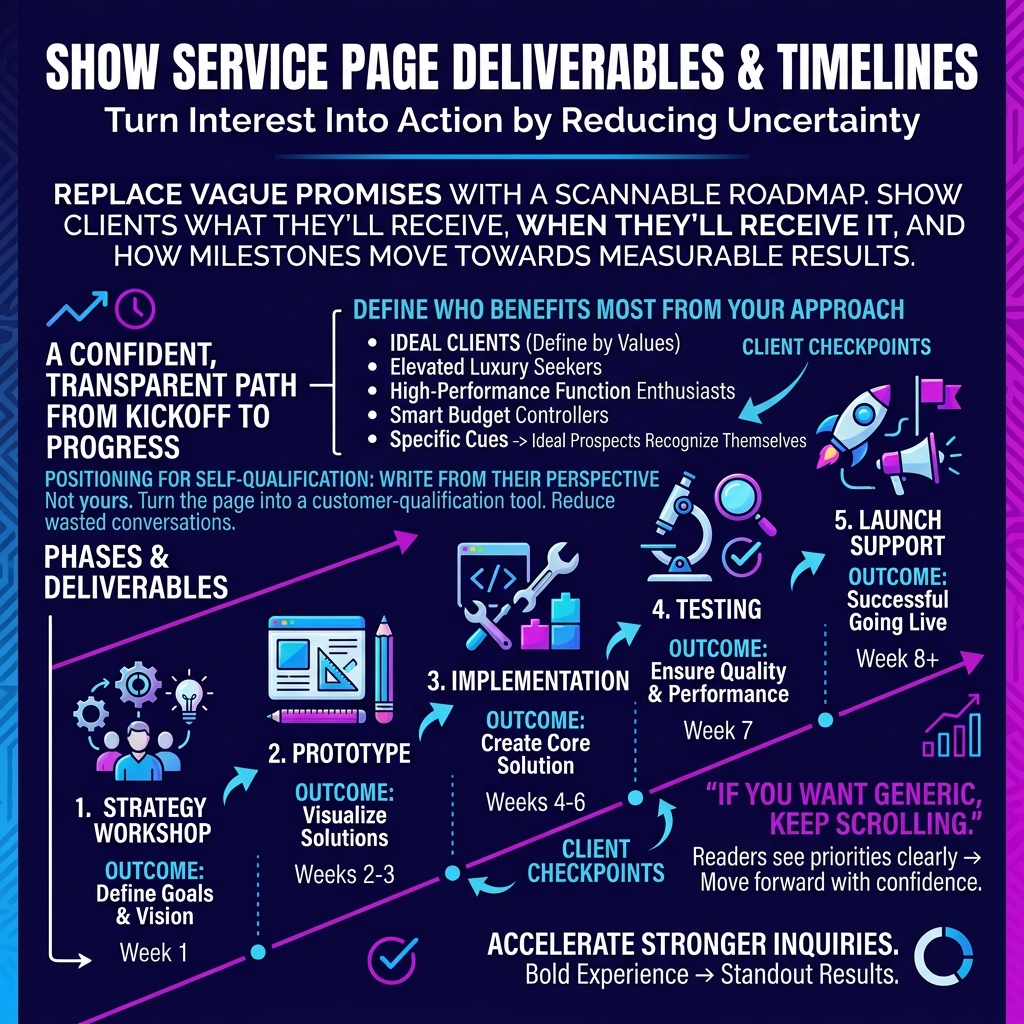
This outside-in positioning turns your page into a customer-qualification tool, reducing wasted conversations and accelerating stronger inquiries. Be direct about the experience you’re built to deliver, the standards you maintain, and the kind of collaboration that creates standout results. A bold line can help: “If you want generic, keep scrolling.” When readers see their priorities reflected clearly, they’ll move forward with confidence and momentum.
Identify the Problem Your Service Solves
Once the right client sees themselves on the page, name the problem that’s costing them time, money, or momentum. Don’t open with your process, credentials, or service list. Start outside-in: show you understand what their day looks like when stalled launches, fragmented systems, missed leads, or manual work keep innovation from moving forward.
Make the pain point specific and measurable. If poor conversion costs revenue, say so. If approval bottlenecks delay delivery, quantify the impact. Precision creates urgency and helps qualified prospects recognize that you’re speaking directly to them.
Then distill the issue into a clear problem statement tailored to your ideal client. For example: “Your team has the ideas and demand, but disconnected workflows slow execution and drain budget.” This framing filters out irrelevant inquiries and gives the reader a reason to keep exploring.
Lead With a Client-Focused Promise
Lead with the result you’ll help the client achieve—not a rundown of what you do. Your H1 should make a direct promise that connects their current friction to a sharper, more valuable future: launch faster, convert more qualified buyers, or leave with a clear next move.
Frame the message from the outside in. Don’t open with your process, tools, or credentials; show that you understand what’s blocking momentum and what success looks like in their world. Be specific enough to feel real. “Cut approval delays by 30%” beats “streamline operations.”
Then reinforce the promise in your introduction with practical evidence: what changes, why it matters, and how you’ll measure progress. Use confident, straight-shooter language. You’re not selling vague transformation—you’re inviting clients into a focused path toward outcomes they can see, track, and act on.
Present Outcome-Driven Service Packages
A strong promise gets attention; a ready-to-build package turns that attention into a confident yes. Position your service packages around the transformation clients can measure: hours reclaimed, conversion lift, revenue unlocked, or operational friction removed. Don’t make prospects assemble their own solution from a menu of vague capabilities.
Instead, present one outcome-driven plan that solves the core problem for most buyers from the first proposal. Bundle your expertise into a clear, repeatable system that feels innovative, complete, and easy to approve. By reducing decision points, you create momentum and show that you understand the path forward better than they do.
This approach shifts you from hired practitioner to strategic system builder. Your offers become scalable assets, protect your margins, and give clients price confidence. Make the next step unmistakable: choose the plan, start the transformation.
Show Service Page Deliverables and Timelines
Clear deliverables and timelines turn interest into action: they show clients exactly what they’ll receive, when they’ll receive it, and how each milestone moves them toward a measurable result. Replace vague promises with a scannable roadmap that reduces uncertainty and maintains momentum.
List your inclusions in plain language: strategy workshop, prototype, implementation, testing, launch support, or whatever your service requires. Add a short outcome beside each item, so prospects see its strategic value immediately. Then map the process by phase, with realistic timelines and client checkpoints.
You don’t need a complex project plan. You need a confident, transparent path from kickoff to measurable progress. When clients can visualize the next step, they’re more likely to inquire, commit, and collaborate quickly. Finish with a prominent button that invites them to start their transformation.
Make Service Page Pricing Easy to Understand
When prospects can understand your pricing in seconds, they’re more likely to take the next step. Give them clarity with descriptive tiers: “Starting at $X” and “Includes strategy, design, and launch support.” Connect every option to an outcome, such as cutting onboarding time by 40% or accelerating delivery threefold. You’re not just listing costs; you’re showing what their investment unlocks.
Make inclusions and exclusions visible, so buyers can evaluate fit without chasing a quote. If you offer multiple packages, use a clean comparison table that spotlights the differences that matter. Keep the copy concise, direct, and consistent with your service promise. Then place one prominent CTA beside your pricing—“Book a discovery call” or “Get a custom quote”—so prospects can move from evaluation to action without friction.
Add Proof to Your Service Page
Proof turns your service promise into a safer business decision. Don’t rely on vague praise when you can show what changed: a 32% lift in conversion, 18 hours saved per week, or $140,000 in pipeline created. Specific proof helps prospects see the commercial upside of choosing you.

Match every result to the goal your ideal client already cares about. If they need faster launches, show before-and-after delivery timelines. If they want growth, highlight revenue, retention, or qualified-lead gains. Use compact charts, bold metrics, and short case-study snapshots so visitors can scan the evidence without losing momentum.
Place proof beside the claims it validates, including your package and pricing sections. This creates a credible decision path: you’ve solved this problem before, you understand the stakes, and your approach produces measurable impact.
End Your Service Page With a Clear CTA
Make the outcome tangible, timely, and low-friction. Don’t force visitors to decode vague labels like “Learn more” or choose between competing actions. Your CTA should move them confidently from interest to momentum.
Design matters, too. Use high contrast, generous button sizing, and mobile-friendly placement so the action is impossible to miss. A clear final invitation sustains decision flow, removes hesitation, and turns qualified attention into conversions.
Frequently Asked Questions
What Type of Website Is Most Profitable?
The most profitable website for you is usually a niche, high-ticket service site that solves an urgent, measurable business problem. You’ll earn more by targeting clients with budgets, showcasing outcomes, and offering a clear package than by chasing broad traffic. Build around recurring revenue, strong margins, and automation where possible. Validate demand first, show proof, publish transparent starting prices, and drive visitors toward one decisive next step.
What Are the 7 C’s of a Website?
The 7 C’s of a website are Clarity, Consistency, Conciseness, Credibility, Concreteness, Conversation, and Customization. You use them to make your site easier to understand, trust, and act on. State your value clearly, keep branding uniform, cut filler, prove claims with evidence, show specific outcomes, invite engagement, and tailor content to your ideal visitor. You’ll create a smoother, more persuasive digital experience that drives smarter conversions.
How to Get 1000 Visitors a Day to Your Website?
To reach 1,000 daily visitors, target 1–3 high-intent keywords and build 4–6 authoritative pillar posts around them. Publish 3–5 useful articles weekly, connect them with smart internal links, and optimize every page for speed, mobile, headers, alt text, and schema. Amplify winners through email, social, and guest posts. Track engagement and traffic weekly, then double down on formats and topics that deliver measurable growth.
What Are the Five Golden Rules of a Website?
The five golden rules of a website are: clarify your value instantly, design for effortless mobile use, guide visitors toward one clear action, build trust with proof and transparent details, and continuously optimize speed. You’ll win more attention when every page solves a real problem quickly. Keep navigation simple, copy customer-focused, and performance sharp. Test what users do, remove friction, and evolve your site as their needs change.
Conclusion
A service page that converts makes your value obvious, your process simple, and your next step easy. When you speak directly to the client’s problem, package clear outcomes, show realistic timelines, explain pricing, and back it up with proof, you remove the reasons to hesitate. Why make potential buyers guess what working with you looks like? Use your page to build confidence, create momentum, and invite the right clients to take action now.