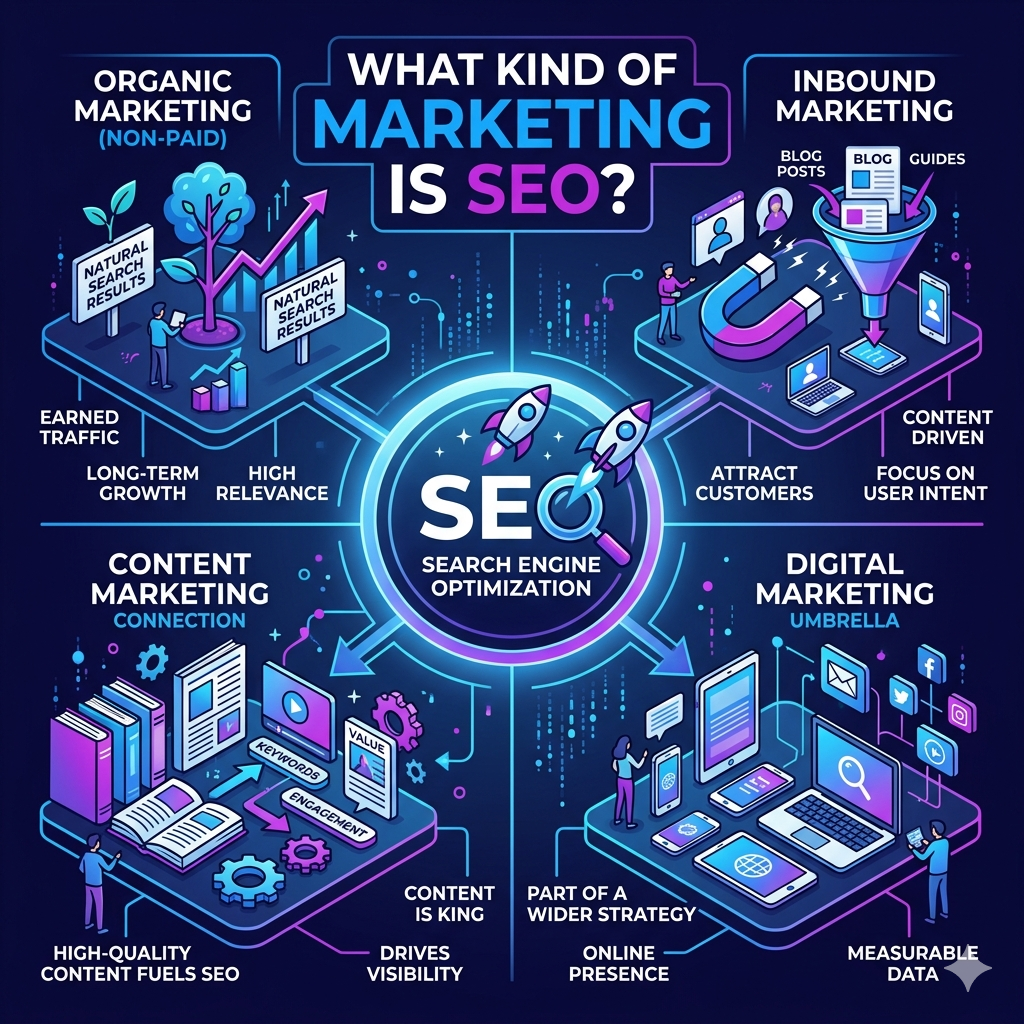
SEO is an inbound digital marketing channel that helps you earn organic visibility in search engines without paying for each click. You improve rankings by aligning content, on-page optimization, technical performance, and authority signals with user intent. Unlike paid media, SEO builds a durable acquisition system that captures demand across informational, commercial, and transactional searches. It also supports broader digital marketing through content, UX, analytics, and local visibility, with more strategic context just ahead.
What Kind of Marketing Is SEO?
SEO is a form of digital marketing that increases your visibility in search engines by aligning content, technical performance, and user experience with search intent. You use SEO to break free from dependence on paid distribution and build a durable acquisition engine. It balances relevance, authority, and accessibility to improve rankings and attract organic traffic from users already seeking solutions.
You strengthen SEO through three coordinated layers: on-page optimization, off-page authority, and technical infrastructure. On-page work refines keywords, metadata, headings, internal links, and content structure so search engines can interpret relevance precisely. Off-page signals, especially backlinks and reputation cues, help validate trust and authority. Technical SEO improves crawlability, indexation, speed, mobile usability, and structured data, removing friction that suppresses performance. When you align these elements with user intent, SEO becomes a cost-efficient, compounding marketing system that expands discovery, supports credibility, and delivers sustainable organic traffic without locking you into continuous ad spend cycles.
Where SEO Fits in Digital Marketing
Within digital marketing, SEO functions as a foundational organic acquisition channel that helps you increase search visibility, qualified traffic, and conversions. You use search engine optimization to strengthen on-page relevance, technical crawlability, internal linking, and authority signals, so your site captures demand without paying for every click. That creates leverage, giving you more control over sustainable growth and organic traffic.
SEO also works beside SEM, not against it. You can use paid search for immediate exposure and test high-intent keywords, while SEO compounds performance over time with cost-efficient rankings. It intersects with content marketing, UX, and analytics because searcher intent, page speed, schema, and engagement signals all influence outcomes. If you serve geographic markets, local SEO extends this system through NAP consistency, Google Business Profile optimization, and location pages. To measure impact, you track rankings, click-through rate, dwell time, conversions, and channel-specific performance in analytics platforms to continuously refine strategy.
Why SEO Is Inbound Marketing
Why does search optimization qualify as inbound marketing? Because you attract people who are already searching for answers, products, or relief, instead of chasing them with disruptive ads. That difference matters. Inbound marketing aligns visibility with intent, and SEO does exactly that through keyword targeting, content relevance, and technical accessibility.
When you optimize pages for search intent, speed, mobile usability, headings, and metadata, you increase discoverability and indexing efficiency. You don’t rent attention; you earn it. High-quality, optimized content compounds over time, builds authority, and reduces dependence on paid media. That creates a more autonomous acquisition system. SEO also filters for relevance: users arrive through specific queries, so leads tend to be more qualified and conversion-ready. Even before discussing organic traffic growth, the model is clearly inbound. You’re meeting demand as it forms. That’s why SEO often delivers exceptional ROI, with revenue returns that frequently outperform many paid channels over time.
How SEO Drives Organic Traffic

That inbound foundation explains how search optimization generates organic traffic at scale: it matches your pages to real queries, earns rankings in unpaid SERPs, and captures clicks from users with clear intent. You break dependence on ads when your SEO strategy aligns keywords, content, and UX with ranking signals. Better visibility means more qualified sessions without paying per click.
- Research keywords by intent, volume, and difficulty to target winnable demand.
- Publish useful content that satisfies queries and strengthens engagement signals.
- Improve speed, crawlability, and mobile usability to enable efficient indexing by engines.
- Measure organic traffic, rankings, and conversions with Analytics and Search Console.
When you execute consistently, SEO compounds. Each optimized page becomes a durable entry point that can attract visitors for months. That creates leverage: you own discoverability instead of renting attention. Use data to refine titles, internal links, and content depth, and you’ll expand organic traffic while lifting conversion opportunities and brand authority over time.
What Are the Main Types of SEO?
Broadly, the main types of SEO are on-page, technical, and off-page, with content strategy and user engagement shaping how well each one performs. To gain search visibility on your terms, you need each discipline working together as one system.
On-page SEO gives you direct control over relevance. You optimize target keywords, title tags, meta descriptions, headings, internal links, and content structure so search engines can map your page to intent. Technical SEO removes friction. You improve site speed, mobile usability, crawlability, indexability, structured data, and HTTPS so engines can access, interpret, and trust your pages efficiently.
Off-page SEO builds authority beyond your site. You earn high-quality backlinks, brand mentions, and credibility signals that strengthen domain trust. Content strategy fuels all three types by aligning authoritative pages with user intent and link-worthiness. Meanwhile, engagement signals such as click-through rate and dwell time indicate whether your content actually satisfies users and sustains rankings over time.
SEO vs. SEM: What’s the Difference?

How do SEO and SEM differ in practice? You use SEO to build durable visibility in organic search, while SEM expands that reach with paid search placements. SEO compounds through technical optimization, content relevance, and authority signals; SEM activates immediate exposure through bidding, targeting, and ad copy. If you want freedom from overreliance on any single traffic source, you should understand both clearly.
- SEO targets unpaid rankings and strengthens long-term acquisition efficiency.
- SEM includes PPC ads that capture high-intent demand fast.
- SEO usually costs less over time; SEM spends more for speed and precision.
- Combining both channels broadens search coverage and improves conversion opportunities.
Your choice depends on goals, budget, and timeline. If you need rapid testing or instant visibility, SEM works quickly. If you want sustainable traffic and lower marginal acquisition costs, SEO is the stronger option. In most technical marketing systems, integrating SEO and SEM gives you broader discovery, better data, and more resilient search performance overall.
Who Should Use SEO Marketing?
Why should only large brands benefit from search visibility when SEO marketing works for nearly anyone with an online presence? If you run a business, personal brand, storefront, or publication, you can use search optimization to reach your target audience without depending entirely on paid media. SEO marketing gives you leverage: stronger indexing, higher relevance, and more qualified organic traffic.
If you operate a local company, you can capture high-intent searches and outrank nearby competitors. If you manage a global brand, you can expand discoverability across markets and product categories. If you sell online, SEO marketing can drive transactional visits and direct revenue. If you publish blogs, videos, or niche resources, you can build topical authority, increase recurring traffic, and monetize attention. If you run an agency, you can offer SEO as a performance channel that improves client visibility and retention. In short, SEO serves anyone who wants scalable digital independence online.
How to Build an SEO Strategy
Before you optimize a single page, define an SEO strategy around competitive gaps, target audience behavior, and search intent. You need a clear map: analyze competitors to uncover underserved topics, weak pages, and backlink opportunities. Then align keyword research with the phrases your audience actually uses at each decision stage. That lets you build SEO-friendly content that answers intent, not just targets terms.
- Audit competitors for keyword gaps, thin content, and authority signals.
- Segment your audience by intent: informational, navigational, commercial, transactional.
- Strengthen technical SEO through speed, crawlability, indexing, and mobile usability.
- Earn relevant backlinks from authoritative sites in your niche.
Your SEO strategy should connect content, architecture, and authority so you can compete without depending on paid channels. Optimize titles, headings, internal links, and metadata across all pages to reinforce topical relevance. When you pair technical precision with intent-driven content, you create an organic growth system that expands your visibility and gives your brand more independence online.
How to Measure SEO Success
Once your SEO strategy is in place, you need a measurement framework that ties rankings, traffic, and conversions to actual search performance. You’ll use Google Analytics and Google Search Console to track organic traffic, keyword rankings, conversions, and landing-page behavior. That data frees you from guesswork and shows whether your optimization actually compounds authority.
Measure growth over time, then connect traffic shifts to specific actions like content refreshes, internal linking changes, or technical fixes. In Search Console, watch average position, impressions, and CTR for target queries to quantify search visibility. In Analytics, evaluate dwell time, bounce rate, and pages per session to judge traffic quality, not just volume. Set concrete goals, such as 20% more organic traffic in six months or a 15% CTR lift on core pages. Review performance consistently, refine underperforming assets, and double down on winning keywords so your SEO system creates measurable freedom, not dependency on paid acquisition channels.
Frequently Asked Questions
SEO is digital marketing focused on organic search visibility. You optimize technical performance, content, keywords, and authority signals to capture intent-driven traffic, free yourself from paid-click dependence, and drive sustainable rankings, conversions, and long-term brand growth.
You’ll find four core digital marketing types: content marketing, social media marketing, email marketing, and paid advertising. You can integrate SEO across each channel to amplify visibility, authority, targeting precision, and conversion-driven growth independently.
SEO falls under digital marketing. You use it to drive organic search visibility through technical optimization, content strategy, keyword targeting, and backlinks, freeing your brand from total dependence on paid ads while compounding long-term traffic.
SEO is inbound marketing. You attract intent-driven users through keyword targeting, technical optimization, and relevant content, instead of interrupting prospects. You earn organic visibility, authority, and sustainable traffic, giving your brand more control, freedom, and compounding growth.
Yes — keywords are still foundational because they tell search engines what people are searching for and help align your content with that intent. Keyword research uncovers what your audience is typing into search engines so you can create content, pages, and messaging that match their needs — boosting your chances of ranking higher for relevant search terms.
Search engines crawl the web to find, analyze, and rank content based on hundreds of signals — things like relevance to the search query, the quality and depth of content, website speed, mobile usability, and the strength of backlinks pointing to a page. SEO helps align your site with these ranking factors so search engines view you as a more valuable result than your competitors.
SEO needs ongoing attention. Search engines continually update their algorithms, competitors optimize their sites, and customer behavior evolves — so what worked last year might need refinement tomorrow. At Brandignity, we track performance, adjust strategy, refresh content, and optimize technical elements to keep your rankings climbing and traffic growing over the long haul.
Absolutely — and especially local businesses. Local SEO focuses on helping businesses show up in geo-based searches like “barbershop near me.” That means optimizing your site, map listings, local citations, and reviews so potential clients in your area find you first. Local SEO makes your shop visible on maps and search results before competitors — which is huge for foot traffic and bookings.
Content is the heart of SEO. Search engines reward sites that provide useful, relevant, and engaging information to users. Every blog post, service page, or FAQ helps search engines understand what your business does and who it serves. High-quality content also keeps visitors on your site longer, encourages shares and backlinks, and signals that your website is trustworthy—all of which boost your rankings.
Backlinks are links from other websites pointing to yours, and they act as votes of confidence in the eyes of search engines. High-quality backlinks signal authority and trustworthiness, which improves your website’s credibility and ranking potential. Brandignity helps build strategic backlinks so your business appears more trustworthy and authoritative online.
## Conclusion
SEO is the compass in your digital marketing system, guiding your brand toward lasting visibility rather than short-lived clicks. When you treat SEO marketing as an inbound, organic growth channel, you align content, technical structure, and search intent with precision. You don’t chase attention—you earn it. By measuring rankings, traffic, and conversions, you turn data into direction. In that sense, SEO isn’t just a tactic; it’s the engine that keeps your online presence moving forward.