
What Is Subcontracting Marketing Work? A 2026 Guide
Subcontracting marketing work is defined as a contractual arrangement where a primary agency or contractor hires a specialized external party to execute specific marketing tasks while retaining full responsibility to the end client. This model differs from simple outsourcing in one critical way: the prime contractor, not the client, owns the relationship with the subcontractor. 73% of businesses in 2026 use at least one external agency partner, which means the mechanics of subcontracting marketing services are no longer a niche concern. They are a core operational decision. Brandignity works within this model regularly, both as a prime contractor and as a specialist partner, and the structural clarity it requires is non-negotiable.
What is subcontracting marketing work and how does it function?
Subcontracting in marketing is the industry’s recognized term for what many business owners call “hiring out” specific tasks. The formal structure involves three parties: the client, the prime contractor (usually a marketing agency or in-house team), and the subcontractor (a specialist freelancer or agency). The prime contractor signs the main agreement with the client and then delegates defined work to the subcontractor through a separate contract.
The prime contractor manages scope, deadlines, and quality. The subcontractor delivers the work. The client typically interacts only with the prime contractor, though this depends on whether the arrangement is transparent or branded. The primary agency retains full liability to the client for the subcontractor’s output. That single fact shapes every decision in the relationship.

Common tasks delegated through subcontracting marketing services include SEO audits, paid advertising management, content creation, graphic design, email campaign builds, and social media management. A mid-size agency might handle client strategy and account management internally while subcontracting technical SEO work to a specialist firm. That division keeps the agency lean and the client’s results strong.
How does the subcontracting process work in practice?
The process begins when a prime contractor wins a client engagement that requires skills outside its core team. The prime contractor scopes the deliverables, selects a subcontractor with the right expertise, and issues a subcontract that mirrors the obligations in the main client agreement.
Prime marketing agencies typically apply a 25–60% markup on subcontractor rates, resulting in gross margins of about 15–40%. That margin compensates the prime contractor for account management, quality control, and the liability it carries. The subcontractor prices for their labor; the prime contractor prices for the full service.
Two operational modes exist. In branded reselling, the subcontractor remains invisible to the client, and all work is delivered under the prime contractor’s brand. In transparent subcontracting, the client knows a specialist is involved. Each mode has different implications for communication, crisis management, and trust.
Pro Tip: Decide upfront which mode you are operating in. Unclear roles between branded and transparent subcontracting create confusion when deadlines slip or deliverables miss the mark.
The table below compares the three main models business owners encounter when structuring external marketing relationships.
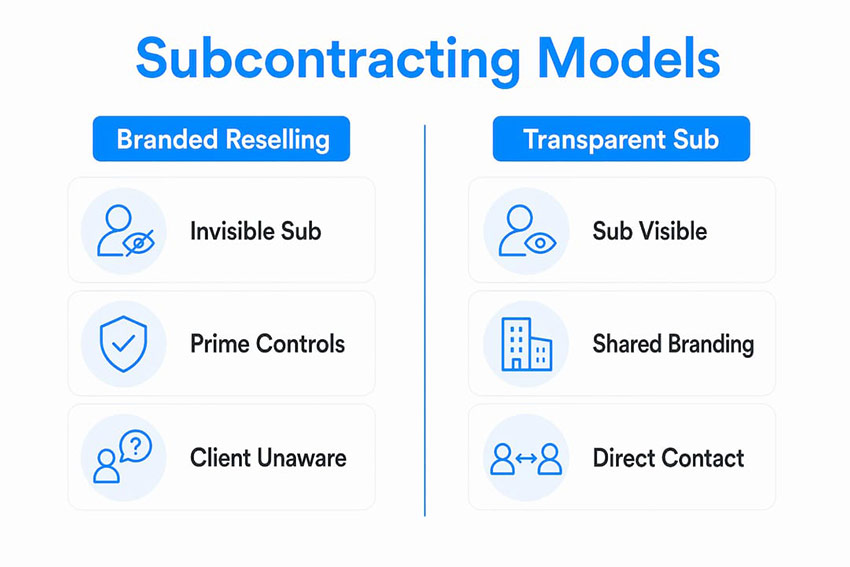
| Model | Client awareness | Brand control | Prime margin | Accountability |
|---|---|---|---|---|
| Transparent subcontracting | Client knows subcontractor | Shared | 15–40% | Prime contractor liable |
| Branded reselling | Subcontractor invisible | Full prime control | 15–40% | Prime contractor liable |
| Direct outsourcing | Client owns relationship | Client controls | None | Client liable |
What are the benefits and challenges of subcontracting marketing work?
Benefits worth knowing
The benefits of subcontracting marketing are concrete and measurable. Subcontracting marketing offers a way to expand capacity and expertise quickly without hiring full-time staff. That matters for agencies managing fluctuating client loads and for business owners who need specialist skills for a defined project.
- Access to specialists. A generalist agency can deliver SEO, paid ads, and content by subcontracting to experts in each discipline rather than building three separate internal teams.
- Cost efficiency. Subcontracting avoids the overhead of salaries, benefits, and software licenses tied to permanent hires.
- Flexibility. Engagements scale up or down based on client demand without restructuring the core team.
- Operational focus. Internal teams stay focused on strategy, client relationships, and business development while subcontractors handle execution.
Challenges that require active management
The challenges are equally real. Managing multiple parties across a single client engagement creates communication risk. Payment terms between the prime contractor and subcontractor must align with the prime’s own payment schedule from the client, or cash flow problems follow.
Quality control is the most common failure point. The prime contractor’s reputation is on the line for work it did not produce. Vague contracts and informal agreements often lead to project delays and disputes when managing external marketing partners. A missed deadline from a subcontractor becomes the prime contractor’s missed deadline in the client’s eyes.
Brand reputation risk is real when a subcontractor communicates directly with a client in branded reselling mode. One off-brand email or an undisclosed tool can unravel months of relationship building.
Pro Tip: Vet subcontractors the same way you would vet a full-time hire. Check references, review past work, and run a paid test project before committing to a long-term engagement.
Subcontracting vs outsourcing marketing: what is the difference?
The distinction between subcontracting and outsourcing marketing is one of structure and accountability, not just terminology. Outsourcing typically involves delegating in-house tasks to an outside party as a cost-saving measure, whereas subcontracting hires specialized expertise temporarily for tasks that cannot be completed internally. The difference in control and liability is significant.
In outsourcing, the client company contracts directly with the external provider. The client owns the relationship, manages performance, and carries the risk if the provider underdelivers. In subcontracting, the prime contractor sits between the client and the specialist. The client never contracts with the subcontractor directly.
This structural difference has legal weight. Service providers must obtain client consent before subcontracting and remain fully responsible for subcontractor performance and compliance. Many client agreements include clauses that prohibit subcontracting without written approval. Ignoring this requirement exposes the prime contractor to contract breach liability.
| Factor | Subcontracting | Outsourcing |
|---|---|---|
| Who holds the client contract | Prime contractor | Client directly |
| Liability for delivery | Prime contractor | Client |
| Client relationship ownership | Prime contractor | Client |
| Typical use case | Specialist task execution | Ongoing function replacement |
| Client approval required | Often yes | No |
Subcontracting suits agencies that want to expand service offerings without building internal teams. Outsourcing suits business owners who want to hand off an entire function, such as all social media management, to an external firm that reports directly to them.
What are the best practices for successfully subcontracting marketing work?
Getting subcontracting right requires discipline in four areas: contracts, communication, quality management, and vendor selection. The 2026 trend in marketing is toward rigorous vendor management, and the agencies that thrive are the ones that treat subcontractor relationships with the same formality as client relationships.
- Write an ironclad subcontract. The subcontract must mirror the obligations in the main client agreement. Include flow-down clauses for data privacy compliance covering CCPA and GDPR, intellectual property ownership, confidentiality, and deliverable specifications. Generic freelance agreements do not cover these requirements.
- Define service-level agreements upfront. Specify turnaround times, revision rounds, file formats, and approval workflows before work begins. Clear documentation of expectations prevents disputes and delays when internal teams and external contractors work together.
- Align payment terms carefully. Structure subcontractor payment schedules to avoid cash flow gaps. If the client pays on net-30 terms, avoid committing to net-7 payments to subcontractors on the same project.
- Decide on transparency early. Determine whether the engagement is branded reselling or transparent subcontracting before the first client touchpoint. Changing modes mid-project damages trust on both sides.
- Build a vetted subcontractor roster. Maintain a short list of reliable specialists across disciplines: SEO, paid media, content, and design. A pre-vetted roster reduces the time pressure of finding a subcontractor after a contract is already signed.
Pro Tip: Include a dispute resolution clause in every subcontract. Specify the process for handling missed deadlines, rejected deliverables, and payment disagreements before they happen, not after.
Why subcontracting marketing is more than a cost play
The most common mistake I see business owners make is treating subcontracting as purely a cost decision. They find a cheaper specialist, hand off the work, and assume the savings justify any friction. That framing misses the real value of the model.
Subcontracting, when done well, is a capability decision. It lets a prime contractor offer services that would take years to build internally. A two-person agency can deliver enterprise-level SEO, paid advertising, and content programs by building the right subcontractor network. The prime contractor’s value is not in doing every task. It is in knowing which specialists to trust and managing the whole engagement to a consistent standard.
The pitfalls I have seen most often are not about the subcontractors themselves. They are about the contracts that were never written clearly, the client expectations that were never set, and the communication gaps that opened up when no one defined who owned each deliverable. The structural work before the project starts determines whether subcontracting creates value or creates problems.
The future of subcontracting in marketing points toward more specialization, not less. AI tools are changing what generalist teams can produce, but deep expertise in technical SEO, conversion rate optimization, and paid media strategy still requires specialists. The prime contractors who build strong subcontractor networks now will have a structural advantage as client demands grow more complex.
— Maciej
How Brandignity fits into your subcontracting marketing strategy
Businesses that need a reliable specialist partner for AI-driven marketing services have a clear option in Brandignity. The agency operates with full transparency on subcontracting arrangements, provides written service-level agreements, and delivers across SEO, paid advertising, content, and web design.
Brandignity also supports agencies looking for a white label partner, handling execution while the prime contractor manages the client relationship. Every engagement starts with a defined scope, clear deliverables, and contractual protections for both parties. For business owners and agencies ready to build a subcontracting model that actually holds up, Brandignity’s marketing services provide the specialist depth and operational structure to make it work.
Key takeaways
Subcontracting marketing work creates a three-party structure where the prime contractor retains full client liability while delegating specialist tasks to an external provider under a separate, mirrored contract.
| Point | Details |
|---|---|
| Prime contractor holds all liability | The prime contractor is accountable to the client for every subcontractor deliverable, regardless of who produced it. |
| Contracts must mirror client obligations | Subcontracts need flow-down clauses for IP, data privacy, and deliverable standards to protect all parties. |
| Two modes require an upfront decision | Branded reselling and transparent subcontracting have different rules for communication and crisis management. |
| Margins run 15–40% for prime agencies | Prime contractors apply a 25–60% markup on subcontractor rates to cover management and liability. |
| Subcontracting differs from outsourcing | Outsourcing gives the client direct control; subcontracting keeps the prime contractor between the client and the specialist. |
FAQ
What does subcontracting involve in a marketing context?
Subcontracting in marketing involves a prime contractor hiring a specialist agency or freelancer to complete defined tasks under a separate contract, while the prime contractor retains full responsibility to the end client.
How does subcontracting marketing differ from outsourcing marketing?
In subcontracting, the prime contractor owns the client relationship and carries liability for the subcontractor’s work. In outsourcing, the client contracts directly with the external provider and manages that relationship themselves.
Do clients need to approve subcontracting arrangements?
Service providers must obtain client consent before subcontracting in most professional agreements. Many client contracts include explicit clauses requiring written approval before any work is delegated to a third party.
What tasks are most commonly subcontracted in marketing?
SEO audits, paid advertising management, content creation, graphic design, and social media management are the tasks most frequently subcontracted by marketing agencies and prime contractors.
What is the typical margin for a prime contractor in a subcontracting model?
Prime marketing agencies typically apply a 25–60% markup on subcontractor rates, resulting in gross margins of about 15–40% on subcontracted work.