12 Ways to Improve E-commerce Category Pages for SEO
If you want to improve your ecommerce website’s performance, enhance its user experience, and dominate the search engine results, optimizing your product category pages is the way to go.
Consider eCommerce category pages as the aisles in a physical store. As you head to the water bottle aisle in a home appliances store, you navigate to the water bottles category page on an eCommerce site.
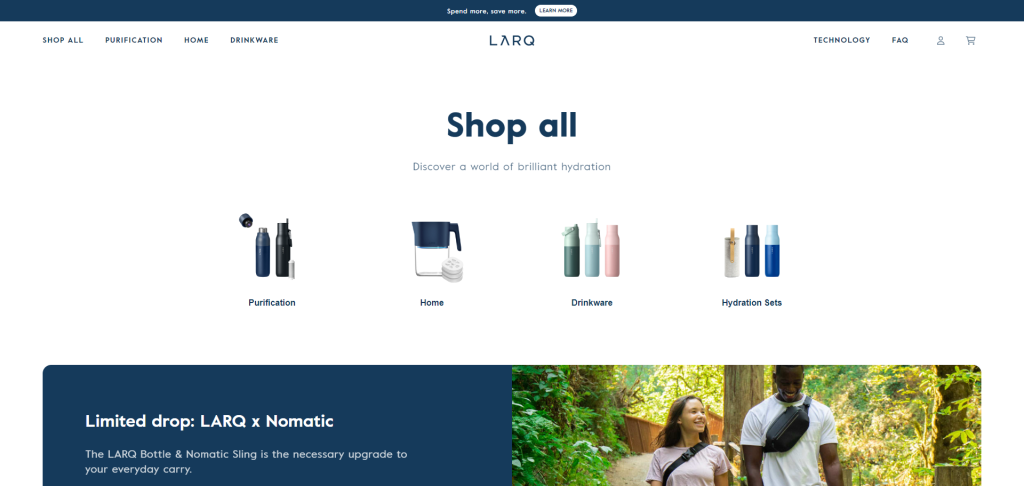
Source: Shop | LARQ
Optimizing category pages is important for SEO and your customers. On one hand, it helps search engines understand how different pages of your website are related to each other. On the other hand, it directs customers to precisely what they’re searching for with clarity and efficiency.
This increases the chance of people finding your products when they search online, bringing more potential customers your way. Today, we will discuss the best strategies for improving your eCommerce category pages for SEO.
Let’s get right into it.
12 Strategies to Enhance eCommerce Category Pages for SEO
Hubspot’s State of Marketing Report 2024 found that 23.6% of e-commerce orders are attributed to organic traffic.
Organizing and presenting products on category pages to enhance user experience and facilitate navigation is key for eCommerce SEO.
SEO has three components: technical SEO, On-page SEO, and off-page SEO, and these tips cover all three aspects.
1. Keyword Research
Long-tail keywords are like hidden treasures for your category pages, offering specialized products tailored to niche audiences. While they may attract a different volume of searches than broader categories, their targeted nature makes them a lucrative avenue for conversion.
Research from Embryo shows that long-tail keywords have a remarkable 36% conversion rate compared to the modest 11.5% of short-tail counterparts. These keywords help search spiders read search intent and deliver relevant content.
Long-tail keywords have low competition and are best if you sell a product in a specific market. These keywords can help you capitalize on that demand and attract more eyeballs.
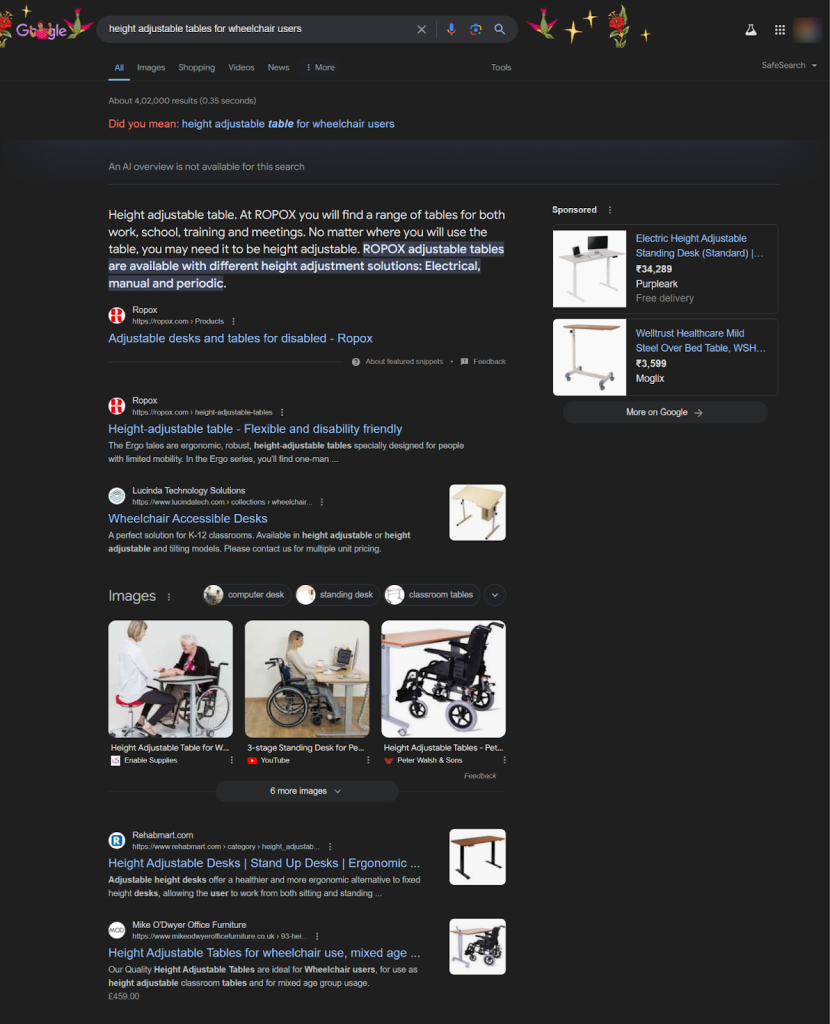
Consider this: I want to purchase a height-adjustable work table for someone who uses a wheelchair. This keyword is for a certain type of audience, so when I use it, I get relevant results that speed up my buying process.
Moreover, AI voice assistants like Siri or Google Voice amplify the significance of long-tail keywords. With 58% of U.S. smartphone users turning to AI voice assistants for product and service inquiries, optimizing for conversational queries becomes imperative.
2. Add Reviews and User Guides
Positive reviews serve as powerful trust signals in the digital market, instilling confidence in potential buyers and significantly boosting conversion rates.
With 99.9% of users relying on product reviews to inform their purchasing decisions, the influence of customer feedback cannot be overstated.
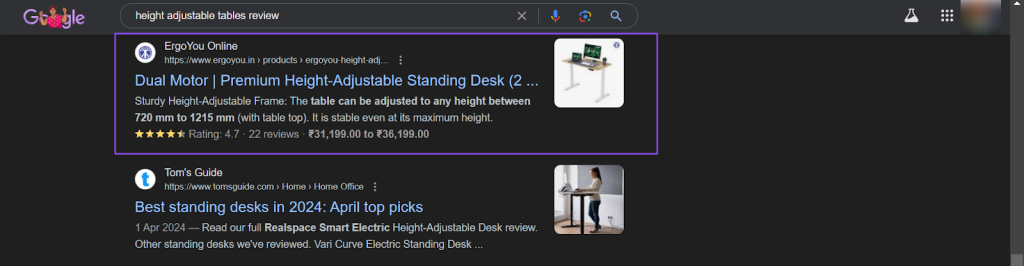
Additionally, reviews are pivotal in enhancing SEO for ecommerce product category pages. Including star ratings alongside search results elevates SERP listings, catching users’ eye and driving higher click-through rates. Determining the best time to send NPS surveys can further optimize the collection of valuable customer feedback and enhance overall customer satisfaction.
3. URL Structure Improvement
SEO-friendly URLs ensure search engines and users grasp a page’s content and context easily. Implementing URL best practices optimizes your pages for search visibility and enhances user experience.
Follow these tips to create one:
- Standardize sentence case: Maintain consistency in URL capitalization to prevent search engines from treating similar URLs as distinct entities like SEO.com/ecommerce and SEO.com/ECOMMERCE. Keeping URLs in lowercase eliminates potential SEO complications and minimizes internal linking errors.
- Incorporate keywords in category subfolders: Use keywords within your URL structure to signal relevance to search engines. Google’s John Mueller has announced that keywords in URLs contribute to ranking factors, enhancing the visibility of your category pages.
- Avoid unnecessary words: Streamline URLs by eliminating stop words and superfluous punctuation. Remove extraneous elements such as “category” prefixes and opt for descriptive category names to maintain clarity and conciseness.
- Manage redirects efficiently: Handle product page redirects to maintain website hierarchy and minimize disruption. Use proper redirections, such as 301 to category pages, to ensure seamless navigation and preserve SEO integrity.
4. Page Content Optimization
A consistent design and layout throughout your page content are important for providing users a seamless experience. Consistency fosters predictability, allowing users to anticipate and understand the website’s structure effortlessly.
To achieve a consistent layout, keep these tips in mind:
- Standardize design elements: Maintain uniformity in color schemes, fonts, and button styles across all pages.
- Establish a uniform page structure: Fix the placement of navigation menus, product categories, and essential information throughout the website.
- Utilize branded visuals: Ensure consistency in image sizes and align other visual elements, such as graphics, with your brand identity.
High-quality product images are pivotal in influencing purchasing decisions and mitigating returns. Research shows that 83% of online shoppers find product images extremely influential, and 22% of returns occur due to discrepancies between product images and reality. Investing in high-quality images can lead to a 94% higher conversion rate, underscoring their significance in driving sales.
Creating consistent page content is easy with page builder plugins, which come with supporting features like a copy-paste tool.
Eton Shirts is the perfect example of effectively using visuals to educate customers about product differences and enhance their shopping experience.
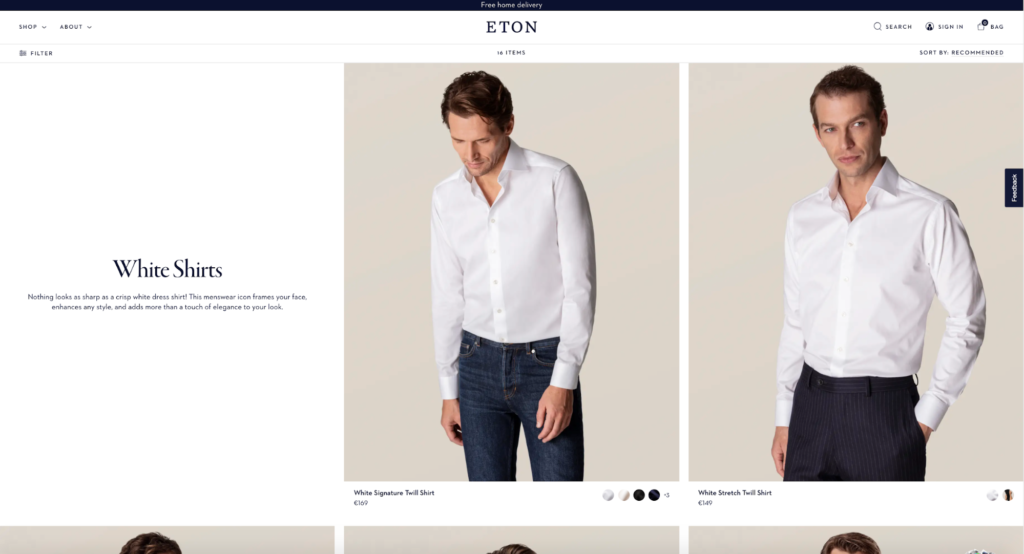
Customers make informed purchase decisions based on their preferences and body types by providing detailed information about the tailored and slim-fitting silhouettes of their super slim-fit shirts.
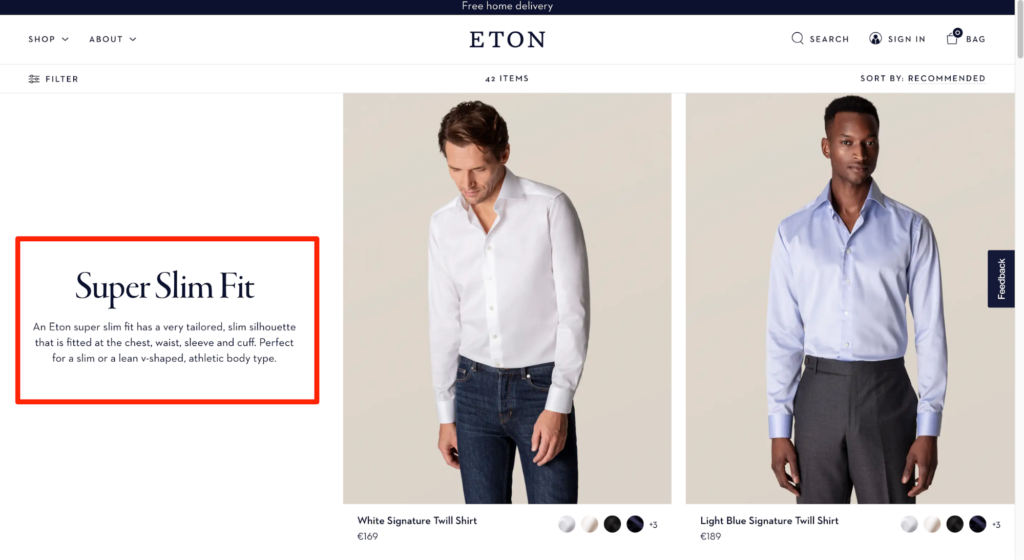
Aside from being very beautiful to look at, category pages are often SEO-optimized, which is why the customer may end up without visiting the homepage.
5. Image Alt Text Optimization
If high-quality visuals matter, optimizing those for SEO does too.
As search engines can’t read images, they need an alternative in the form of alt text.
For instance, if the image features a photo album on a bedroom drawer, the alt text could describe the image while incorporating relevant keywords, such as “a couples photo album for bedroom.”
Moreover, alt text plays a pivotal role in ensuring accessibility for users who rely on screen readers or encounter issues with image loading. By providing descriptive alt text, you enhance the usability of your website for all visitors, regardless of their browsing capabilities.
Adding relevant keywords and maintaining contextual relevance in your alt text is important. While keywords can boost your SEO efforts, avoid keyword stuffing, as it violates search engine guidelines.
6. Site Speed Optimization
The frustration caused by sluggish loading speeds is something we’ve all felt. We mustn’t make our customers feel the same, as it often translates into higher bounce rates, deterring visitors from exploring further.
Using tools like Google’s PageSpeed Insights, you can optimize your site’s speed performance for improvement.
Optimizing images is a fundamental aspect of accelerating page load times. Compressing images without compromising quality can significantly reduce file sizes and expedite loading speeds.
Additionally, implementing browser caching enables returning visitors to load previously accessed resources from their local cache rather than re-downloading them from the server. This results in quicker page load times and a smoother browsing experience.
7. Mobile Optimization
If you’re wondering what your friend is doing behind the privacy of their phones, they’re probably shopping.
A report from Integral Ad Science found that mobile phones are the most popular devices people use to shop, ahead of desktops and tablets.
As mobile shopping continues to surge in popularity, ensuring the mobile-friendliness of your ecommerce site is essential. A responsive design is imperative, guaranteeing that your website displays correctly and optimally across all mobile devices.
This enhances user satisfaction and engagement, positioning your brand for success in an increasingly mobile-centric marketplace.
8. Navigation Enhancement
Research indicates that 37% of European and U.S. users point to poor navigation and layout as significant factors leading to website abandonment.
To address this challenge, start by analyzing your entire product catalog and organizing products based on commonalities. Begin by sorting products into broad categories, then refine them into more specific ones. Additionally, we will reach out to users via emails, using email finder tools to find emails and ask them to review our products so that we can make further improvements.
For instance, rather than merely featuring “ball pens” and “notebooks” under a generic “Stationery” category, consider offering them under more specialized categories like “black ballpoint pen” and “ruled A4 size notebooks.” This approach aligns with how users search for products, catering to their specific intents and preferences.
A prime example is observed in Kohl’s, a renowned department store chain with a robust online presence. Kohl’s website exemplifies user-centric navigation, featuring circular thumbnails showcasing various product categories, each leading to relevant subcategories upon selection.
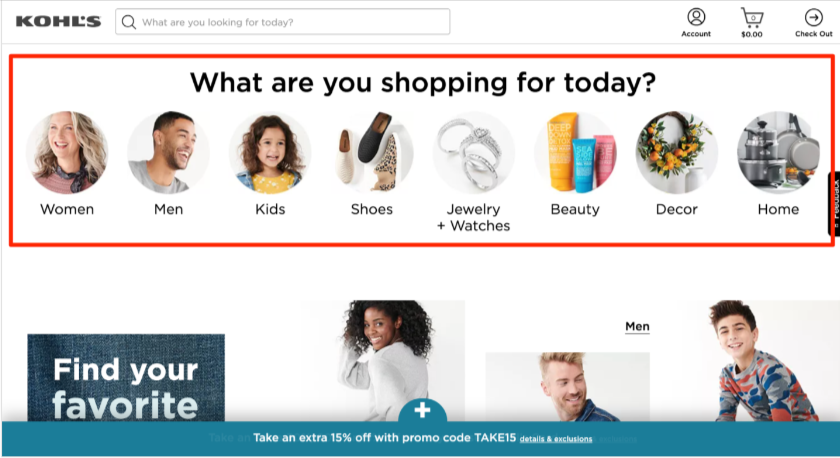
Take, for instance, Kohl’s “Bed & Bath” page, which boasts a clean and intuitive design. The top section presents five categories related to bedroom and bathroom essentials: Bedding, Bath, Pillows, Mattress Pads and Toppers, and Blanket and Throws.
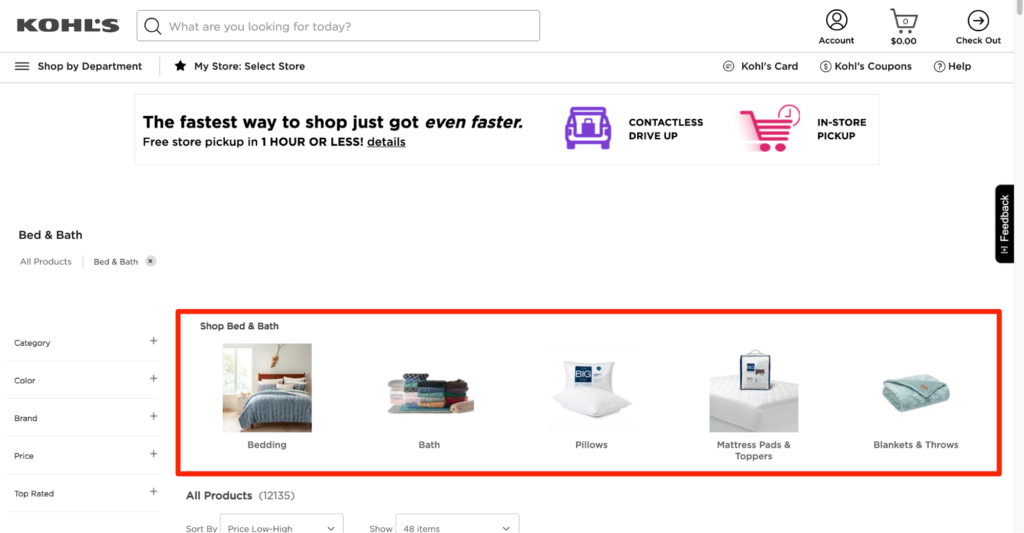
This visual approach empowers customers to navigate to their desired sections efficiently and either make immediate purchases or explore available options further.
9. Filters and Sorting Options Implementation
Faceted navigation, a staple feature of SEO ecommerce category pages, helps shoppers refine their product searches using filters such as size, price, color, ratings, and material.
By leveraging filters, also known as “facets,” customers can swiftly locate relevant products, a convenience that can elevate conversion rates by up to 26%. However, exercise caution to avoid detrimental impacts on category page SEO stemming from URL combinations.
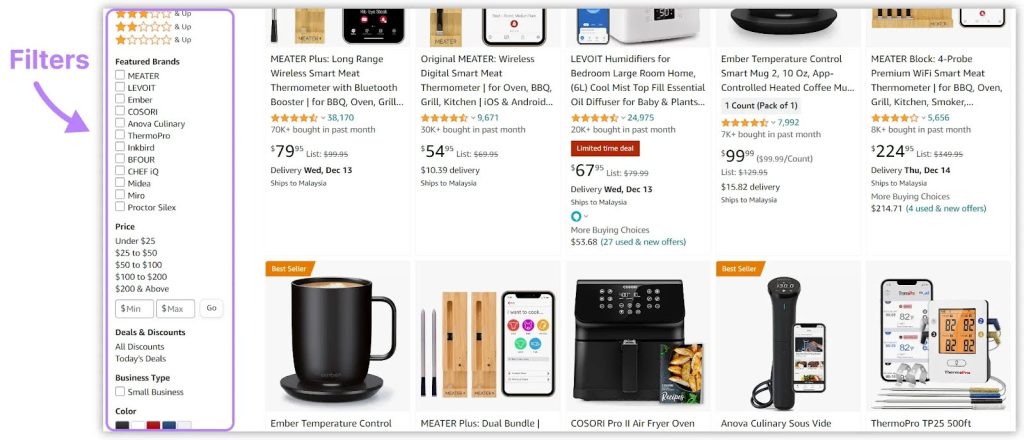
Consider the example of Forever21’s category page for dresses.
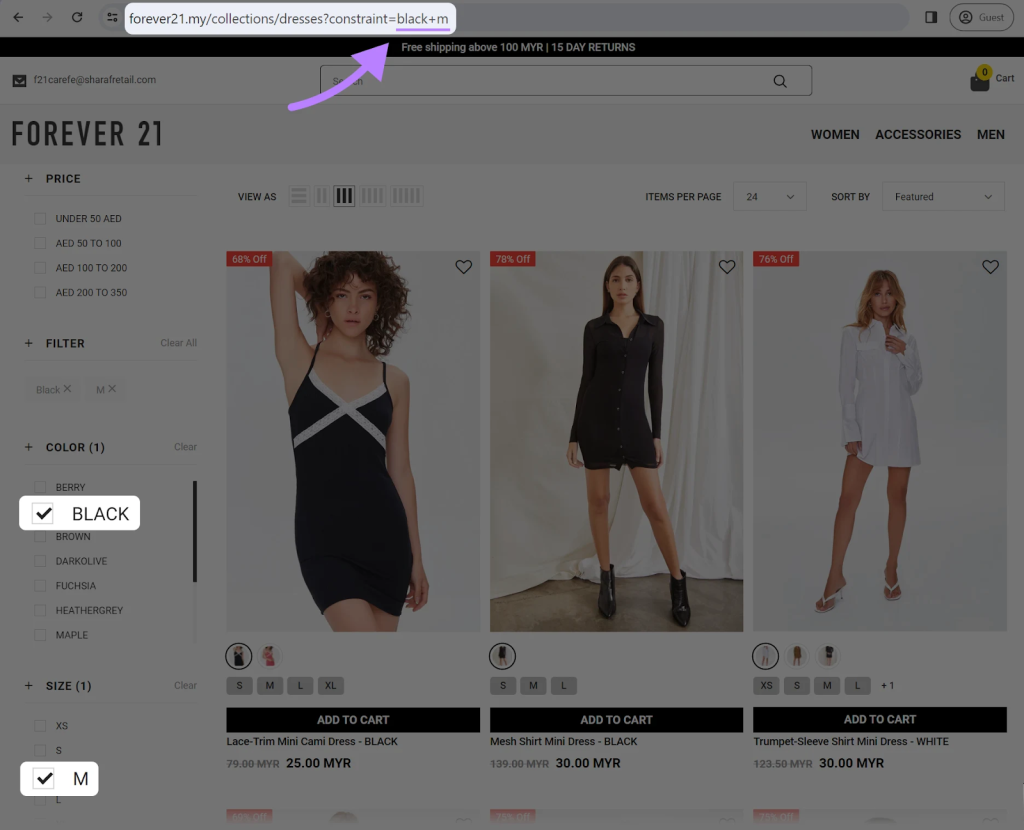
The base URL,https://forever21.my/collections/dresses, serves as the starting point.
When applying a single filter, such as size, the URL expands to https://forever21.my/collections/dresses?constraint=m. Further refinement, including size, color, and material, alters the URL to https://forever21.my/collections/dresses?constraint=m+black+knitwear_women.
While such URL variations enhance user experience, they can impede search engine crawling efficiency and confuse indexing algorithms. These combinations may not align with typical user search queries and could consume crawl budgets unnecessarily.
To manage these URL permutations effectively, several strategies prove beneficial:
- Utilize robots.txt directives to instruct search engines to refrain from indexing faceted URLs.
- Implement the no-follow directive on internal links leading to faceted URLs, discouraging search engine bots from exploring these variations.
By judiciously managing faceted navigation and optimizing URL structures, ecommerce sites can enhance user experience while safeguarding SEO performance.
10. Internal Linking
Internally linking from broader categories to subcategory pages serves dual purposes: it enhances site structure and enriches user experience. Moreover, category pages are pivotal in distributing PageRank throughout the website.
PageRank, a metric gauging a page’s authority in search engines, considers internal links among its factors. Therefore, a well-structured internal linking framework can influence SEO rankings substantially. One effective strategy within this framework is the use of deep linking, which targets specific product pages or promotions directly from category pages. This approach not only bolsters PageRank distribution but also enhances the navigational ease for users, guiding them precisely where they want to go without unnecessary intermediate steps.
But before creating an internal linking strategy, it’s crucial to understand the difference between category listing pages (CLPs) and product listing pages (PLPs).
CLPs epitomize broader categories, showcasing diverse product types within a single category.
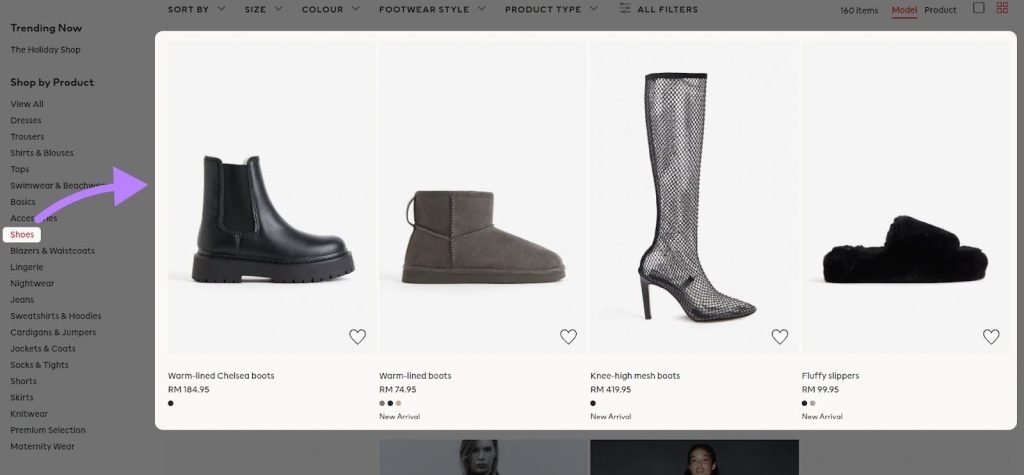
Conversely, PLPs represent subcategories, offering a more focused selection of products under a specific theme.
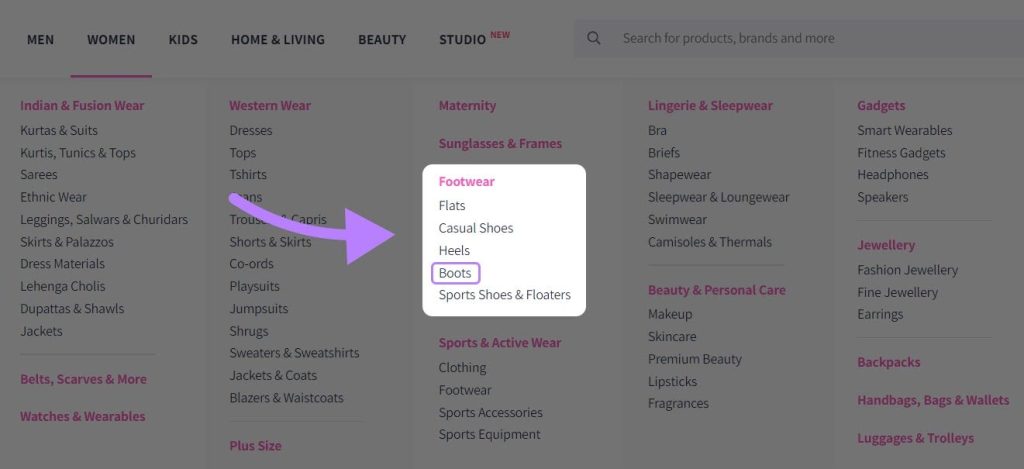
The parent-child relationship between CLPs (parents) and PLPs (children) lays the foundation for a robust internal linking strategy. By establishing this hierarchical linkage within the website architecture, internal linking efforts can be automated for efficiency.
For instance, developers can implement coding scripts that dynamically link new PLPs to their corresponding CLPs upon addition. Similarly, Yoast SEO or RankMath facilitates automated hierarchical linking from category pages to PLPs.
11. Schema Markup Implementation
Schema markup offers a structured approach to enhancing search engines’ understanding of webpage content.
Implementing Schema markup on ecommerce category pages empowers search engines with explicit insights into the content’s meaning. For instance, utilizing Product Schema on a page featuring “Women’s Running Shoes” enables the inclusion of details such as product name, image, description, price, and availability.
The beauty of Schema markup lies in its potential to showcase this information directly in search results through rich snippets. Presenting such detailed snippets makes your page more visually appealing to users, potentially boosting click-through rates.
However, it’s crucial to wield Schema markup responsibly and accurately, ensuring it truthfully represents your content. Any misuse, such as marking up misleading information, could attract penalties from search engines.
Tools like Google’s Structured Data Testing Tool prove invaluable for validating and ensuring the correct implementation of Schema markup.
12. Metrics to track the effectiveness of e-commerce category pages
Here are four crucial metrics to track the effectiveness of e-commerce category pages:
- Conversion Rate
Conversion rate is the percentage of visitors who complete a desired action (e.g., making a purchase) after visiting your ecommerce category page. It is a key indicator of how well the category page is driving sales and achieving its primary goal of converting visitors into customers.
To calculate the conversion rate,
Conversion Rate = (Number of Conversions / Number of Visitors) x 100
- Average Revenue Per User (ARPU)
The average revenue generated per user to the category page is the average revenue per user. ARPU metric helps understand the revenue contribution of each user, indicating the financial effectiveness of the category page in converting users into paying customers.
ARPU = Total Revenue / Number of Visitors
- Bounce Rate
Bounce rate is the percentage of visitors who leave the site after viewing the category page without interacting further. A high bounce rate may indicate that the category page is not engaging or relevant to visitors, signaling a need for optimization.
Bounce Rate = (Number of Single-Page Sessions / Total Number of Sessions) x 100
- Click-Through Rate (CTR)
The Click-Through Rate is the percentage of visitors who click on a product link from the category page. This metric shows how effectively the category page encourages visitors to explore specific products, which is a crucial step toward conversion.
CTR = (Number of Clicks on Product Links / Number of Visitors) x 100
Conclusion
Optimizing your eCommerce category pages for SEO is important for various reasons. Tools like Google’s Structured Data Testing Tool prove invaluable for validating and ensuring the correct implementation of Schema markup.
Standardized URL layout, long-tail keyword usage, adding alt-text for the images, schema markup implementation, and other factors will make your category pages more crawlable for search engines.
These methods are not only helpful for search engines but also enable users to navigate easily and quickly, locate the right products, and make an informed selection.
Author’s Bio: Neha is a content marketing specialist with over 3 years of experience in creating engaging and effective content for various SaaS companies. Neha is specialized in developing content strategies that drive website traffic and generate leads.