
Data-Driven Selling: How to Optimize Your Amazon Business for Maximum Profit
When selling on Amazon, data management and utilization have emerged as highly effective strategies to increase profits. It uses facts and figures on consumer buying behavior and other relevant indicators to make decisions that increase sales. To Amazon sellers, it can define the difference between no movement and growth and a period of considerable success.
Understanding the Importance of Data
Selling on Amazon is anchored in data, which will help attract the right customer base and boost sales. Customer databases, purchase behavior, and product specifications provide sellers with insight into how to relate performance to profitability. This helps them effectively manage product presentation, pricing, and other promotional activities with reference to consumers’ needs and wants to strengthen their competitive position.
Key Metrics and Analytics Tools
Given the competitive landscape, one has to focus on rates and customer feedback. Such tools, as seen in in-depth Jungle Scout insights, provide seller data that help evaluate statistics, monitor how metrics change over time, and determine which steps to take to improve them. For instance, focusing on sales across various product types or making price adjustments based on competitor analysis are among the most thought-provoking strategies for influencing sales results.
Optimizing Amazon Product Listing
Many techniques are involved in optimizing product listing pages using the received data. The keywords being researched must also be effectively inserted into specific product attributes, including the title, description, and keyword-rich backend. Improving product images and their features based on customers’ suggestions and trends can also enhance visibility and conversions.
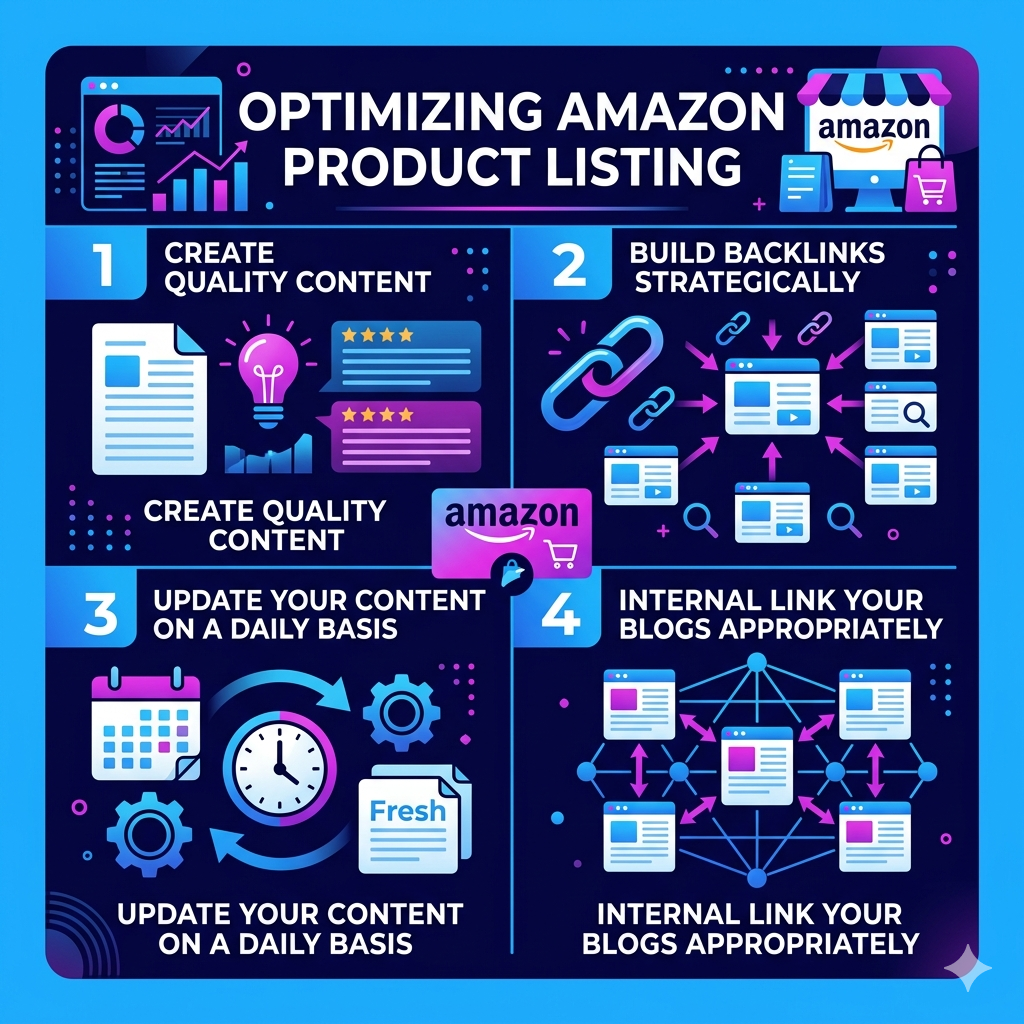
Optimizing an Amazon product listing is about finding the perfect balance between appealing to Amazon’s ranking algorithms (like A10, COSMO, and Rufus) and converting human shoppers into buyers. A strong optimization creates a compounding loop: better relevance drives visibility, and clearer copy drives conversions.
Here is a comprehensive breakdown of best practices for optimizing your Amazon product listings:
1. High-Impact Product Title
- The Blueprint: Put your brand name first, followed immediately by your absolute highest-volume primary keyword.
- Front-Load for Mobile: Ensure the most crucial details and primary keywords are in the first 50 to 80 characters, as this is all mobile shoppers see before clicking.
- Readable Length: Aim for a natural, readable title between 150 to 180 characters. Avoid keyword stuffing or repetitive phrases, which read as spam to customers and algorithms alike.
- Essential Inclusions: Incorporate key differentiators such as size, quantity, materials, or primary use cases without using promotional terms (e.g., avoid “Sale” or “Best Seller”).
2. Strategic Bullet Points (“About this Item”)
- Benefit-First Copy: Lead each bullet with a bolded outcome or benefit, then follow it up with the technical feature (e.g., “Dishwasher Safe” instead of just listing materials).
- Address Intended Use Cases: Specifically mention who or what the product is for to help semantic search engines connect your item with broad, intent-based questions.
- Preempt Objections: Use the bullets to answer common product questions and clear up customer doubts before they exit the page.
- Keep it Clean: Keep each bullet under 200 characters and write in natural, human language rather than as a long list of raw keywords.
3. Conversion-Driven Visuals & Video
- The Main Hero Image: Use a pure white background, with the product filling at least 85% of the frame. Ensure it is a high-resolution file (at least 2000x2000px) to enable crisp zoom functionality.
- Infographics with Bold Text: Dedicate secondary image slots to graphics highlighting dimensions, product anatomy, or size comparisons. Use large fonts (60-80pt) so they are completely legible on mobile screens.
- Lifestyle Imagery: Show the product in real-world scenarios, ideally featuring human interaction, to build desire and showcase practical scale.
- High-Quality Video Content: Upload a sub-90-second video demonstrating the product in action, unboxing, or showing durability proof points.
4. A+ Content & Brand Story (For Brand Registry)
- Immersive Design: Replace standard text descriptions with rich A+ Content modules that feature interactive comparison charts, banner images, and clean layouts.
- Leverage Brand Story: Utilize the horizontal Brand Story carousel to cross-sell other products in your catalog and share your brand’s philosophy.
- Incorporate an FAQ Module: Answering common questions within your A+ Content directly supplies Amazon’s conversational AI assistants with data to pitch your item to shoppers.
5. Hidden Backend Search Terms
- Max Out the Limit: Use the full 249-byte limit available in Seller Central.
- No Repetition: Do not repeat any words already featured in your title or bullets, as Amazon indexes them once across the whole page.
- Synonyms and Variations: Focus this invisible space entirely on target-audience synonyms, alternative use cases, common misspellings, or foreign-language translations (such as Spanish equivalents).
6. Review Management & Social Proof
- Kickstart with Vine: Use the official Amazon Vine program to secure initial, authentic reviews for new product launches.
- The “Request a Review” Button: Use compliant automated tools or the native Seller Central button to request customer reviews without violating Terms of Service (never offer incentives or ask specifically for 5 stars).
- Monitor Customer Q&A: Regularly answer community questions on your listing, as unresolved queries represent a direct drop-off in sales.
- Pro Tip for Long-Term Growth: Product optimization is an ongoing cycle, not a one-time setup. Pull keyword data from your search query reports every 60 to 90 days, run A/B tests on your titles and images using Amazon’s Manage Your Experiments tool, and refresh your copy to adapt to changing shopper behavior.
Pricing Strategies
Pricing strategies are fairly sensitive on Amazon since most clients select sellers based on price. Sellers can also use data analytics to determine the right price at which to sell their products and make a profit for their businesses. Dynamic pricing strategies can automatically adjust prices based on factors such as competitor prices, supply and demand, and seasonal changes, so sellers can remain competitive and potentially achieve good profits without compromising prices.
Enhancing Customer Experience
Feedback, especially reviews, is the best source of data about customers’ satisfaction, concerns, and opportunities for improvement. Delicate attention to feedback enables sellers to handle complaints appropriately and improve the quality of their products while increasing customer satisfaction. Positive reviews also help socially prove the product and help make a sale.
Forecasting and Inventory Management
Knowing anticipated customer requirements is vital and forms the basis of inventory management. Sales trends and seasonal analysis help sellers understand demand patterns, so inventory control is maintained effectively to avoid overstocking or stockouts. This helps with timely order processing, minimizes warehousing expenses, and optimizes operations.
Scaling Your Amazon Business
Data-driven selling improves the efficiency of existing sales processes and helps the company expand on a larger scale. With performance data and figures from tools like SellerApp, and the ability to identify which products would be most rewarding, sellers can adjust the supply of goods, cross-sell into new markets, and profit from burgeoning vectors. That is why it is possible to say that effective data management helps make the right decisions that support the stable development of the business.
Challenges and Considerations
The use of data in the selling process has made many positive contributions; nevertheless, it also has drawbacks. Due to the sheer volume of data generated, collecting and managing big data is more crucial than ever. Further, analyzing data and drawing inferences from it requires professional skills and an aptitude for understanding figures and numbers.
Sellers must acquire comprehensive knowledge of that technique to maximize Amazon’s profit. Understanding how Amazon’s tools work, drawing insights into daily sales performance, updating listings, and bringing dynamism to price points will collectively enable sellers to achieve a competitive advantage in the era of e-marketplaces. Successful quantitative decision-making improves operations and consumer satisfaction, and drives the ability to grow and sustain profitability. An analytical approach is also beneficial because it helps address challenges, manage them, and achieve maximum profitability in Amazon sales. Selling on Amazon is not a mere sale of goods but the use of compiled statistics to improve the position of your enterprise in the fluctuating market.