
Answer Engine Optimization: How to Rank in AI Answers (and Get Cited)
Answer Engine Optimization (AEO) helps you show up in AI-generated answers by making your content easy to extract and safe to cite. You’ll win citations when you lead with a one-sentence claim, support it with 2–3 verifiable facts, and link to primary sources with dates and methods. Structure each section around one micro-intent, use tables or steps for precision, and add schema plus sameAs IDs to confirm entities. Keep going to see how to measure citation share over time.
What Is Answer Engine Optimization (AEO)?
Where do your customers go when they want a single, definitive answer—Google’s AI Overviews, ChatGPT, voice assistants, or a featured snippet? That shift makes Answer Engine Optimization (AEO) your discipline for earning inclusion in machine-generated answers, not just blue-link clicks. You align content with user intent, structure it for extraction, and validate claims with authoritative, citable sources. Unlike classic SEO’s page-level ranking focus, AEO optimizes for answer-level utility: clear definitions, scoped entities, unambiguous steps, and measurable outcomes.
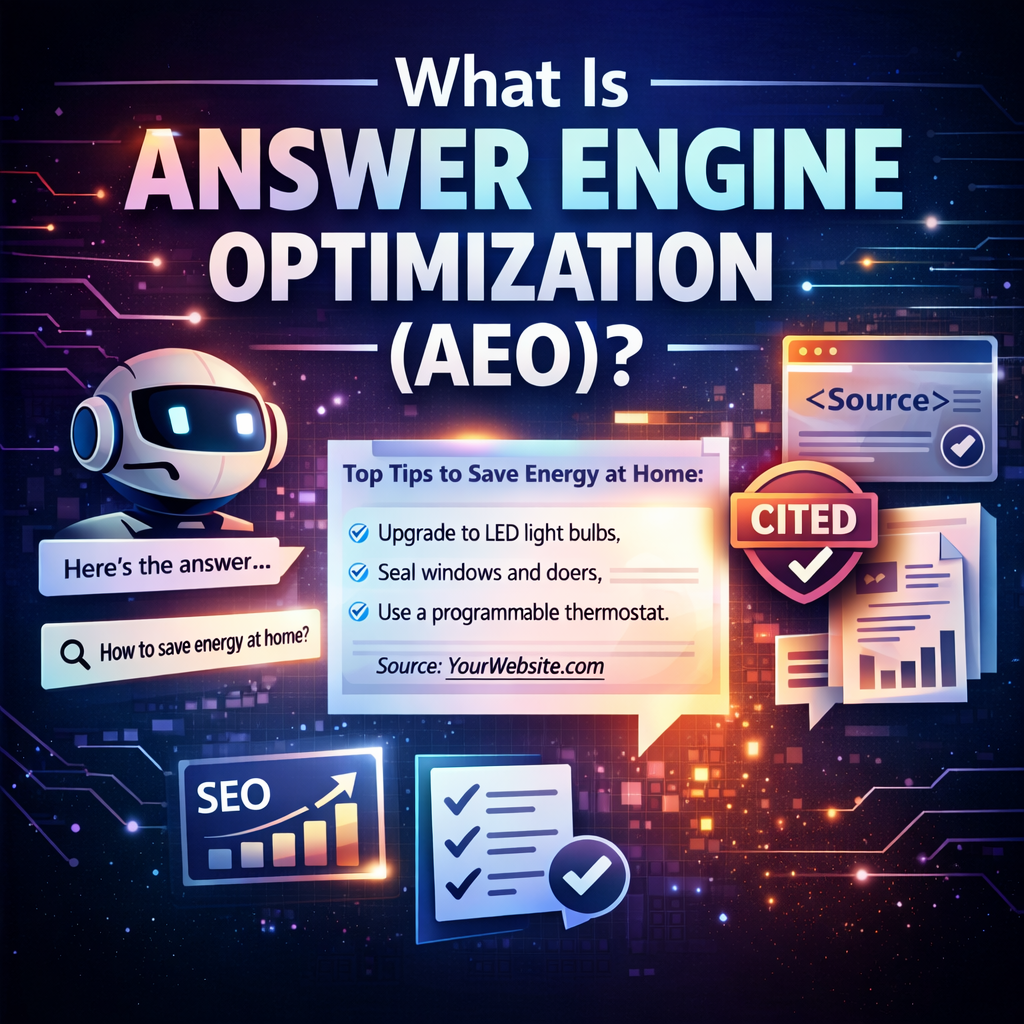
You also build trust signals—transparent authorship, update cadence, and AI ethics guardrails—because accuracy and responsible messaging influence whether users accept an answer. Track AEO with question coverage, impression share in answer surfaces, and downstream actions, then iterate based on query patterns and gaps.
How Answer Engines Choose Sources and Citations
When answer engines pick sources and citations, you’re competing on measurable retrieval and indexing signals like crawlability, structured data, and query-to-document alignment. You also need to earn authority and trust factors—credible authorship, transparent sourcing, and consistent reputation signals—that models can score and cross-check. Finally, you win citations when your evidence matches the prompt’s intent with tight citation relevance matching, so your quoted passages directly support the exact claim.
Answer engines (AI search + “AI answers”) generally choose what to cite using a mix of retrieval ranking + trust signals + answer-fit. The exact recipe differs by product, but the patterns are pretty consistent:
- Relevance to the prompt: They look for sources that directly answer the question as asked (including constraints like “for startups,” “under $500,” “in 2026,” “step-by-step”).
- Extractability (how easy it is to quote): Content that’s clearly written, well-structured (headings, bullets, short definitions), and has “copyable” statements is easier to cite.
- Authority & trust (E-E-A-T-style signals): Strong domains, credible authors, clear “About” info, citations to primary sources, and a history of accurate content tend to win.
- Freshness (when recency matters): For topics that change fast (pricing, product specs, news, medical guidance), newer or recently updated pages get prioritized.
- Consensus and cross-source confirmation: If multiple sources agree, the engine is more confident. Outlier claims without corroboration are less likely to be cited.
- Coverage and completeness: Sources that cover the topic thoroughly (definitions + steps + examples + caveats) often beat thin pages.
- Specificity and “entity” clarity: Pages that clearly define entities (brand, product, people, locations) and relationships (features, use cases, comparisons) are easier for models to reason about and cite.
- Evidence density: Original data, methodology, screenshots, tables, examples, and case studies increase citation likelihood.
- Readability and accessibility: Clean HTML, fast load times, minimal intrusive interstitials, and content not locked behind heavy scripts support crawling and extraction.
- Spam and risk filters: Engines down-rank content that looks manipulative: keyword stuffing, thin affiliate pages, excessive ads, misleading claims, or unsafe medical/financial advice.
- Citation intent: Sometimes citations are chosen to: back up a factual claim, offer a “learn more” link, or show diverse viewpoints (especially for debated topics).
Retrieval And Indexing Signals
Signals—freshness, authority, and retrievability—drive which pages answer engines pull into the candidate set and ultimately cite. You win citations by optimizing the mechanics: make your content easy to discover, parse, and fetch under tight budgets.
First, reduce retrieval latency: ship fast TTFB, compress assets, keep HTML lean, and expose key facts above the fold so extractors don’t time out. Second, maximize indexability: consistent canonicals, clean internal links, updated sitemaps, and stable URLs that don’t fragment signals. Third, improve axiomatic relevance: align headings, entities, and definitions to the query’s core propositions, then reinforce with structured data and concise summaries. Finally, monitor crawl and index logs; treat coverage, fetch times, and chunk-level embedding quality as KPIs you iterate weekly.
Authority And Trust Factors
Fast retrieval and clean indexing get you into the candidate set, but authority and trust decide whether an answer engine will quote you, link you, or ignore you. You earn trust by proving expertise, transparency, and consistency at scale. Publish bylined content with verifiable credentials, disclose methods, and cite primary sources with stable URLs and dates. Strengthen entity signals: consistent organization details, schema, and authoritative mentions across reputable publications. Maintain an authentic voice, but back claims with measurable evidence—benchmarks, datasets, and reproducible steps. Reduce risk signals: fix factual errors, avoid exaggerated promises, and keep updates frequent with clear changelogs. Align with user intent by documenting who the guidance fits, assumptions, and edge cases. When engines detect reliable patterns, they preferentially surface you as the safe, citable source.
Citation Relevance Matching
A high-trust page still won’t earn citations if its evidence doesn’t match the question’s intent, scope, and constraints. Answer engines score subtopic relevance by aligning your claims to the query’s entities, timeframe, geography, and required format (steps, thresholds, benchmarks). You should instrument pages so each section answers one micro-intent, then surface the exact statistic, definition, or procedure in the first 150–250 words.
Build a citation taxonomy: primary sources (peer-reviewed, standards, regulators), secondary synthesis (industry reports), and operational proof (datasets, changelogs, docs). Then map each claim to the right tier and anchor it with dates, methods, and sample sizes. You’ll get cited when your snippet resolves the user’s constraint faster than alternatives.
Structure Content So AI Can Quote It (AEO)
How do you get an AI to quote you instead of paraphrasing a competitor? You structure content for extraction: lead with a one-sentence claim, follow with 2–3 bulletproof supporting facts, then add a definitional line AI can lift verbatim. Use tight headings, short paragraphs, and consistent terminology to maximize ai quoting accuracy. Place key metrics, thresholds, and steps in tables or numbered lists to prevent retrieval models from blurring them.
Then reinforce trust by using consistent citation formatting and source attribution. Place a “Sources” block directly under each claim, link to primary data, include publication dates, and cite the exact table/figure. Use stable URLs, anchor text that matches the claim, and quote-ready snippets (20–35 words). You’re engineering quotability, not just readability.
AEO vs SEO: What to Keep, What to Change
You don’t throw out SEO when you shift to AEO—you keep the shared ranking foundations like crawlable architecture, authoritative links, and intent-aligned content, then validate impact in Search Console and log data. What changes is the target: answer engines reward extractable, attribution-ready passages and strong source signals, so you’ll optimize for quotability and citation likelihood, not just clicks. That means tightening content structure and upgrading schema (FAQ/HowTo where appropriate, Product/Article/Organization, and clear authorship) so your claims map to evidence and your pages render as reliable answers.
Shared Ranking Foundations
Where do AEO and SEO overlap enough that you can reuse your playbook without losing ground? Start with fundamentals that both systems reward: clear relevance, provable authority, and frictionless accessibility. Map queries to intents and build pages that answer them fast, then support claims with primary sources, datasets, and dated references so models can cite you with confidence. Tighten information architecture, internal linking, and crawl hygiene to protect indexation and passage-level retrieval.
Prioritize measurable trust signals: expert bylines, transparent methods, and consistent entity naming across your site and citations. Monitor rankings alongside citation share, snippet capture, and branded query lift; treat each as a leading indicator. Execute idea one and idea two by shipping structured headings, concise definitions, and verifiable stats that algorithms can extract and attribute.
Shifts For Answer Engines
Why do answer engines force a different kind of optimization than classic SERPs? Because you’re no longer competing for a click, you’re competing for inclusion inside the generated answer, where model confidence and verifiable sourcing decide visibility. Keep SEO fundamentals that predict trust: crawlability, topical authority, and clean internal linking. Change your goalposts: optimize for “quote-ready” claims, tight definitions, and statistics that a model can lift without paraphrase drift. Measure success by citation rate, position in answer blocks, and consistency across queries, not just sessions. Use contrastive prompts to test whether the model prefers your phrasing versus competitors’ and identify missing qualifiers. Then apply citation editing: tighten attribution cues, align claims with sources, and reduce ambiguous statements that could trigger exclusion.
Content And Schema Updates
How do content and schema tactics change when you optimize for citation and answer inclusion instead of rankings and clicks? You keep SEO fundamentals—clean IA, fast pages, canonical control—but you shift to extractable, attributable facts. Write tight definitions, scoped claims, and evidence blocks with sources, dates, and methodologies so models can quote you. Prioritize data freshness: publish update logs, last-reviewed timestamps, and change logs tied to key entities.
For schema, don’t spam markup; engineer schema nuance. Expand beyond Organization and Article to include FAQ, HowTo, Dataset, Product, and sameAs links that disambiguate entities. Validate with rich-results tools, then monitor citation lift: track which pages appear in AI answers, what lines get cited, and refine headings, tables, and JSON-LD accordingly.
Build AEO Trust Signals AI Can Verify
In an AI-first search landscape, trust isn’t a vibe—it’s a set of verifiable signals that models and retrieval systems can confirm across sources. You earn it by publishing traceable facts, consistent updates, and transparent ownership that a crawler can corroborate.
Prioritize reliability indicators: dated research, primary-source links, methodology notes, and version histories. Strengthen citation provenance by naming data providers, retaining stable URLs, and exposing references that resolve fast and don’t redirect. Align your claims across channels (site, docs, repos, press) so retrieval systems see the same numbers everywhere. Reduce ambiguity by providing clear definitions, units, and assumptions, and correct errors publicly via changelogs. Finally, prove operational credibility: secure your domain, maintain uptime, and keep author bios and contact paths current—signals models can verify at scale.
Earn AEO Citations With Entities and Schema
Where do AEO citations actually come from when models assemble an answer—guesswork or machine-readable evidence? You’ll earn citations faster when you turn your expertise into resolvable entities and explicit relationships. Start by aligning each page to a primary entity (product, organization, person, concept) and a tight set of attributes: name, definitions, specs, pricing, dates, claims, and sources. Then implement schema (JSON-LD) that reinforces those facts: Organization, Product, FAQPage, HowTo, Article, and Speakable where appropriate. Link entities with sameAs to authoritative IDs (Wikidata, Crunchbase, official profiles) so models can disambiguate you. Keep markup and visible copy consistent; contradictions kill trust. Use subtopic ideas to create entity-rich sections, and cut non-relevant discussions that dilute salience.
Measure AEO Citations and Visibility Over Time
Why guess whether your content earns AEO citations when you can track them like any other acquisition channel? Build a baseline by logging every AI answer that mentions or links to you, then tag each citation by model, prompt type, query intent, and landing URL. Set a measurement cadence (weekly for fast-moving topics, monthly for evergreen) and trend citation share versus competitors. Watch for citation decay: when mentions drop after updates, model refreshes, or SERP shifts, flag the pages and refresh facts, schema, and internal links. Connect citations to outcomes by mapping cited URLs to assisted conversions, demo requests, or pipeline. Prioritize optimizations that lift both visibility and downstream value, and document the prompts that reliably trigger your brand mentions too.
Conclusion
You’re not chasing blue links anymore—you’re stepping into an Odyssean arena where answer engines crown the most verifiable source. When you structure quotable passages, reinforce entities with schema, and build trust signals AI can confirm, you earn citations, not just impressions. Keep SEO fundamentals, but optimize for extraction and attribution. Then measure visibility like a portfolio: citation count, query coverage, and source consistency over time. In AI answers, proof beats polish.