Fixing the Foundation: Why Post-Processing Starts Before Video Generation
In the high-pressure environment of agency-side content production, the phrase “fix it in post” has long been a dark joke among editors. With the advent of generative video, that joke has morphed into a dangerous assumption. Many teams assume that the power of a model like Nano Banana Pro lies in its ability to hallucinate movement from thin air. While that is technically true, the commercial viability of that movement—its flicker rate, temporal consistency, and adherence to brand guidelines—is almost entirely determined by the assets provided at the start of the pipeline.
For agencies delivering to clients with strict aesthetic standards, the “text-to-video” workflow is often too unpredictable for production-grade output. Instead, the industry is shifting toward a “pre-processed” image-to-video workflow. This approach treats the initial frame not as a mere starting point, but as a technical blueprint that dictates how every subsequent pixel will behave.
The Myth of the Magic Prompt
There is a common misconception that the most important part of AI video production is the prompt used within the video generator. In practice, an operator could write the most evocative five-paragraph prompt in history, but if the source image has ambiguous lighting or cluttered composition, the video engine will struggle to maintain coherence.
When we use Nano Banana Pro for high-fidelity motion, the model looks for semantic cues in the first frame to understand depth, material physics, and light paths. If a character’s hand is partially merged with a coffee cup in the source image, the video model will likely interpret that as a single, shifting mass of “hand-cup” matter. This is why the quality of the source asset is the single greatest predictor of downstream success.
We have found that spending 70% of the production time on the “pre-video” stage—generating, editing, and refining the static image—drastically reduces the time spent on failed video renders. This is a tactical pivot from “generating” to “constructing.”
Compositional Integrity and the AI Image Editor
A raw generation from any AI model is rarely production-ready. There are almost always artifacts: a stray shadow, an extra button on a coat, or a horizon line that isn’t quite level. In a static image, these are minor annoyances. In a video, these artifacts become “anchors” that cause the AI to glitch.
Using a dedicated AI Image Editor to clean these assets is a mandatory step for professional teams. If there is a stray pixel cluster in the background, the video model might interpret it as a bird or a lens flare, creating distracting movement where there should be stillness. By utilizing a canvas-based workflow to mask, in-paint, and refine the first frame, you are essentially “cleaning the track” for the video engine to run on.
However, a point of uncertainty remains in how various models handle extremely high-frequency details. We have observed that while a perfectly sharpened image looks better to the human eye, an over-sharpened source can sometimes cause “shimmering” artifacts in motion. Finding the balance between “clean” and “over-processed” is still more of an art than a hard science.
Why Nano Banana Pro Requires High-Contrast Cues
Every generative video model has a “bias” in how it interprets pixels. Nano Banana Pro tends to perform best when the source image provides clear “depth maps” through lighting. If you provide a flat, evenly lit image, the model has a harder time calculating parallax—the way objects at different distances move at different speeds.
When preparing assets for Nano Banana, operators should look for:
- Strong Rim Lighting: This helps the model separate the subject from the background, preventing “bleeding” during movement.
- Geometric Consistency: Clean lines in architecture or furniture give the AI stable reference points to “pin” the motion.
- Semantic Clarity: Every object in the frame should be clearly identifiable. If the AI can’t tell if an object is a rock or a cat, the resulting motion will be a confusing hybrid of the two.
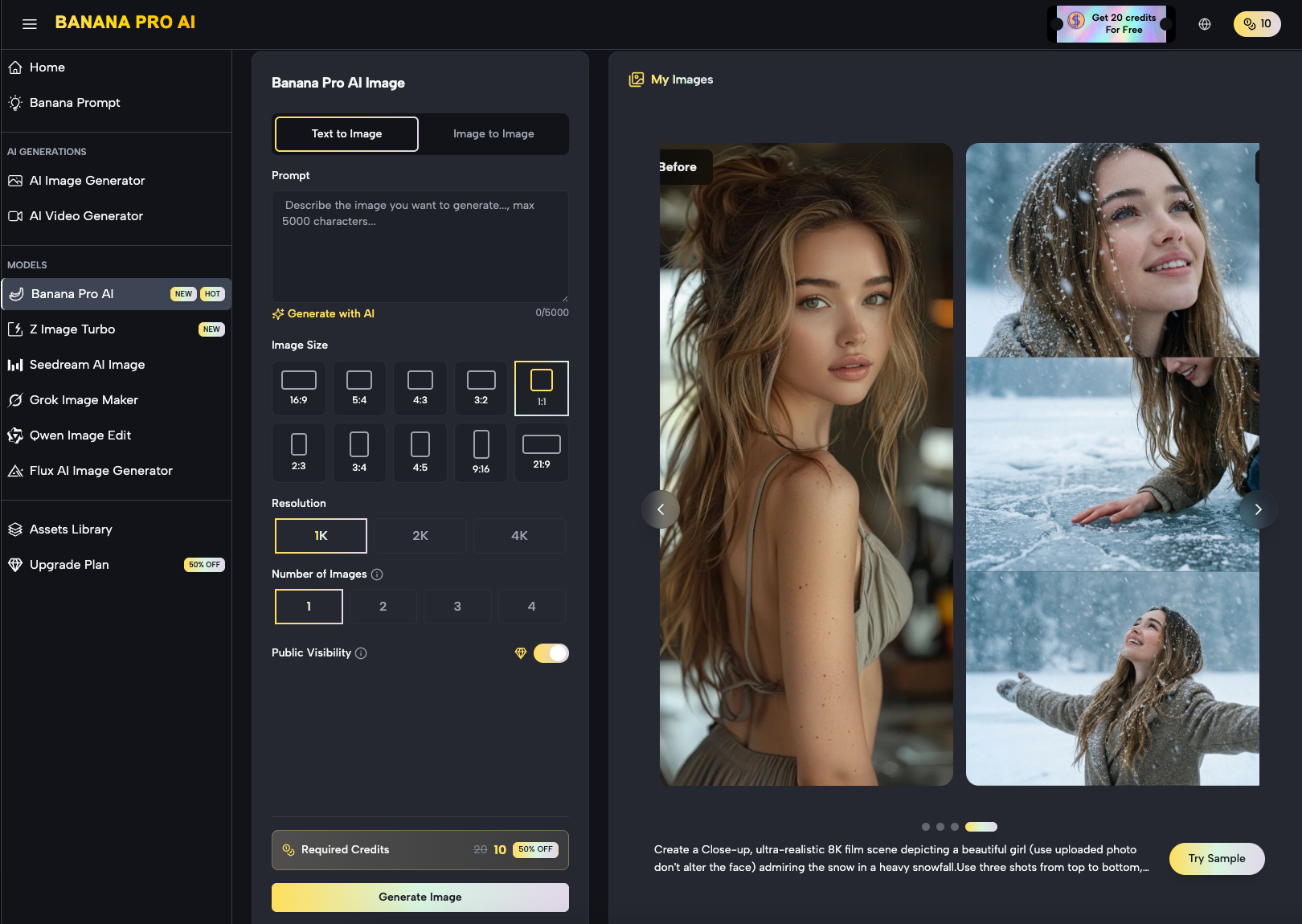
Banana Pro users often find that the “Banana 2 AI” or “Midjourney” models provide excellent base frames, but even these need a pass through a dedicated editor to ensure the composition isn’t too crowded for the video engine to handle.
The Role of Aspect Ratio and Framing
In traditional cinematography, the frame is everything. In AI video, the frame is a boundary that the AI is constantly trying to “outthink.” If your subject is too close to the edge of the frame in your source image, Banana AI might struggle to animate them moving without their limbs clipping out of existence.
We recommend a “safe zone” approach. Generate your source image at a slightly wider angle than you need, use the AI Image Editor to ensure the edges are clean, and then let the video model handle the motion. This gives the AI enough “pixel data” to work with when it needs to reveal what was previously hidden behind a moving subject.
It is worth noting a significant limitation here: current models still struggle with “out-painting” motion. If a character is walking toward the camera and reaches the edge of the frame, the AI often doesn’t know how to generate the “new” environment they are walking into with perfect accuracy. Expectations must be managed when a client asks for expansive, sweeping camera movements starting from a tight portrait.
Technical Debt in the Prompting Workflow
When teams skip the image-refinement stage, they accrue “technical debt” that must be paid during the video rendering phase. You might spend 50 credits trying to get a “perfect” video render from a mediocre image, whereas a five-minute touch-up in a canvas workflow would have resulted in a usable video on the first try.
Professional operators treat the Banana Pro ecosystem as a modular factory. You don’t just “make a video.” You:
- Generate a concept (The Raw Frame).
- Audit the physics and lighting (The Quality Control).
- Refine via the AI Image Editor (The Preparation).
- Inject motion via Nano Banana Pro (The Execution).
This modularity is what separates an amateur “prompt engineer” from a professional AI media producer. The latter understands that the model is a tool, not a magician.
The Human Element: Editorial Judgment
Despite the power of Banana AI, the most important tool is still the human eye. An operator needs to look at a source image and ask: “Is this logically consistent?” If a shadow falls in the wrong direction in the static image, the video model will try to resolve that logical fallacy by shifting the light source over time, leading to a “pulsing” effect.
There is also an element of unpredictability in how specific colors are treated. We have noticed that high-saturation blues and reds sometimes “bleed” more than muted earth tones in motion. This isn’t necessarily a flaw in the model, but a byproduct of how denoising algorithms prioritize high-energy color data. Operators should be prepared to de-saturate certain elements of their source image before video generation to maintain stability.
Standardizing the “Pre-Post” Pipeline
For agencies looking to scale, these steps cannot be left to chance. A standardized “Pre-Post” checklist should be implemented for every project:
- Artifact Check: Are there any “extra” limbs, floating objects, or nonsensical textures?
- Depth Check: Is there a clear foreground, middle ground, and background?
- Lighting Check: Is the primary light source consistent across all objects?
- Margin Check: Is there enough room around the subject for the requested motion?
By focusing on these static details, the “video” part of the process becomes a predictable final step rather than a frustrating gamble. Nano Banana is incredibly capable of producing cinematic motion, but it requires a solid foundation to do so.
Final Thoughts for Production Teams
The future of AI video isn’t in better prompts; it’s in better asset management. As the technology matures, the “black box” of generation will become more transparent, but the fundamental laws of composition and lighting will remain.
Whether you are using Nano Banana for a quick social media clip or a high-end commercial spot, the rule remains: your video is only as good as its first frame. By utilizing tools like the AI Image Editor to curate that frame, you move from the realm of “rolling the dice” to the realm of professional production.
We must accept that we are currently in an era of “assisted generation.” The AI can do the heavy lifting of calculating motion vectors and temporal coherence, but it cannot (yet) understand the narrative intent of a scene or the subtle requirements of a brand’s visual identity. That responsibility—and the tactical work of preparing the assets to meet those goals—remains firmly in the hands of the creator. Stop trying to fix your videos in post-production; start fixing them in pre-generation.