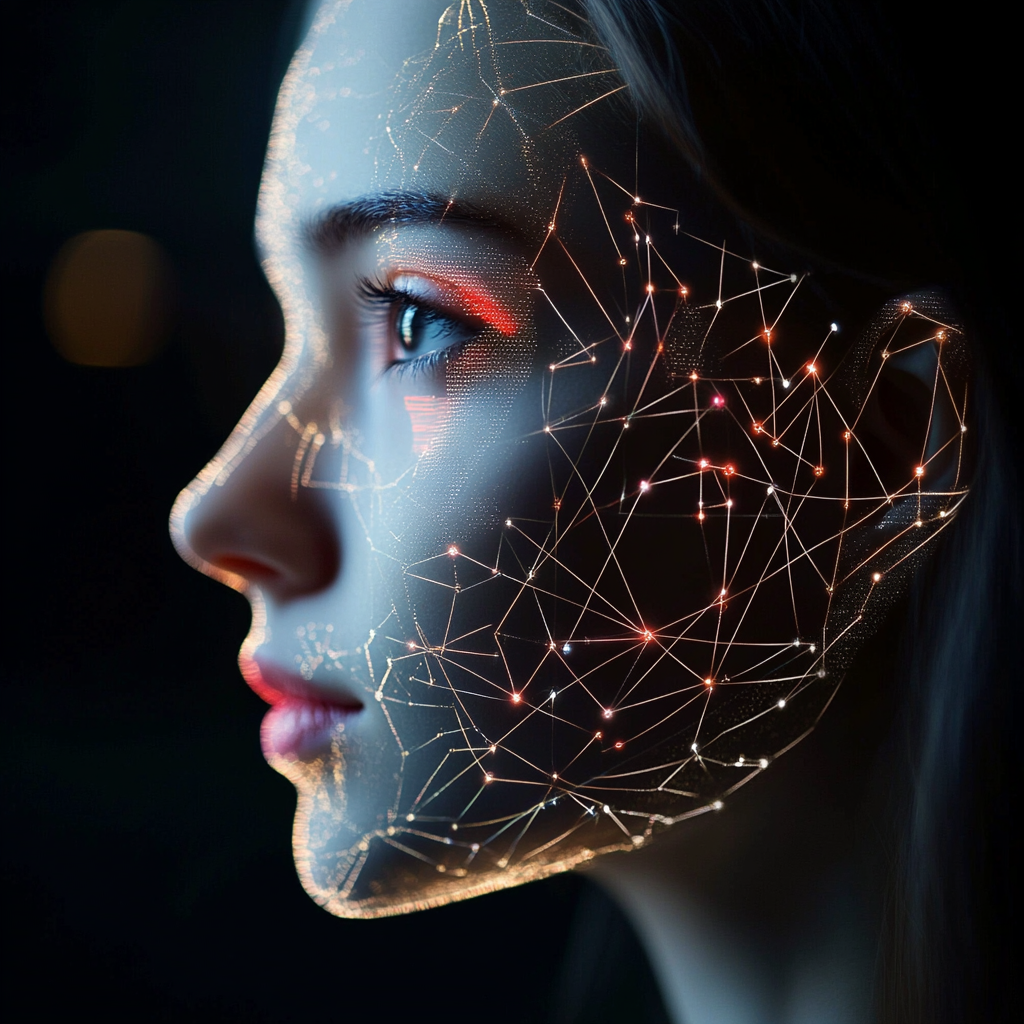
AI Influencers: How Virtual Personalities are Shaping the Future of Marketing
It’s 2025. We don’t ask, “How many friends do you have?” anymore. Instead, it’s “How many followers?”
Sounds familiar, right? Let’s be honest—we’ve all been there. And there’s nothing wrong with it!
Social media is no longer just a part of our lives—it shapes them. We don’t flip through old-school textbooks for skills anymore. Instead, we binge-watch quick tutorials from our favorite influencers. Need the latest fashion trends? Want to master iPhone photography? Thinking of diving into coding? There’s an influencer for that.
In fact, a whopping 77% of people trust influencers more for product recommendations over traditional ads and 85% trust influencers over celebrities. That’s how powerful influencer marketing has become.
But here’s where it gets even more interesting—AI influencers are taking over! These virtual personalities aren’t just a futuristic gimmick. They’re changing the game, redefining brand engagement, and making influencer marketing even more dynamic. And guess what? The global virtual influencer market is projected to hit $37.8 billion by 2030.
This article talks about what AI influencers are and how they are shaping the future of marketing. Let’s dive in
What are AI Influencers?
Artificial Intelligence (AI) Influencers are computer-generated virtual personalities who can do nearly everything a real influencer can do including:
- promoting products,
- engaging customers, and
- creating various forms of content far more quickly than humans.
As per the statistics of Influencer Marketing Hub data, 59.8% of marketing professionals have already worked with AI influencers.
Types of AI Influencers:
AI Influencers are divided into three main categories: lifelike CGI (computer-generated imagery), animated humans, and non-animated humans. Each of them offers a unique approach to audience engagement.
- CGI Humans: They are the computer generated human models that can be used as influencers, in movies, video games , and several other media.
- Animated Humans: Computer generated and digitally animated humans that have cartoonish appearance.
- Non-animated humans: These computer-generated virtual influencers look anything like a plant, animal, toy, or a mascot.
How AI Virtual Personalities are created?
Designing AI virtual personalities requires mixing advanced technologies with imaginative artistic strategies. Here are the 4-steps to design AI Influencers:
Step 1: Design the character
The first step involves designing the AI influencer’s look’s, personality including facial expressions, emotional responses, and other human-like traits.
Step 2: Implementation of realistic characters
Using NLP tools and AI chatbot development, AI Influencers are programmed to respond and engage in real-life conversations.
Step 3: Develop interesting content
AI influencers are designed to generate high quality content including written pieces, audio or video content, images and everything else that attracts the target audience.
Step 4: Introduction on social media
When they are all set, AI Influencers are introduced on social platforms like Youtube, Instagram, Facebook and Tik Tok to engage with the audience.
What Technologies are used to design AI Virtual Influencers?
A variety of cutting-edge technologies are used to design AI virtual influencers, such as Deep Learning, NLP (Natural Language Processing), Machine Learning, and Graphic designing.
Deep learning plays a significant role in designing facial expressions and realistic visual features of the AI Influencers. Natural Language Processing (NLP) helps AI Influencers to comprehend and react to user conversations. Machine Learning models assist them to continually enhance audience engagement techniques by learning from previous encounters. With modern graphic designs, AI Influencers make sure to look appealing, and realistic, and have life-like characteristics to easily integrate into digital environments.
Benefits and Disadvantages of Including an AI Influencer in Your Campaigns
Every business has the freedom to decide whether or not to include AI Influencers in their campaigns. However, before investing in any AI virtual personalities, every brand should understand the pros and cons of using them:
Benefits of using AI Influencers
-
Economical marketing campaigns
The cost of hiring a real-life social influencer for your marketing campaign can range from $25 to $1000, or even more, depending on how many followers the influencer has, how many posts your business needs, and other costs including travel and photo shoots.
However, if you invest in an AI Influencer, you might have to pay a sum upfront, but there won’t be any more fees or recurring charges and things like travel and logistics expenses.
According to a Gartner report, using AI Influencers instead of human ones may save marketing expenditures by 30%.
-
Total Control over the marketing and content
Regardless of the material promised to marketers, human influencers can deviate from the schedule, which might strain brand collaborations. AI Influencers, on the other hand, who are meticulously programmed and lack self-perception, precisely and consistently embody the company’s story and values through their social media content. Additionally, brands can use AI photo editor to enhance the visuals of AI Influencers, ensuring that their content remains high-quality and aligned with marketing aesthetics.
-
Global engagements and affiliate marketing
With human influencers, companies have restrictions regarding working hours, availability, language concerns, cultural differences, and many more. But with AI Influencers, brands can use them to interact with a global audience in various languages 24/7 without any breaks, off-time, holidays or any health concerns.
Also, AI virtual personalities can be designed to promote personalized content at scale to enhance affiliate marketing programs.
Disadvantages of using AI Influencers
-
Unrealistic lifestyle and body standards
With so many filters and picture-enhancing options, social media influencers are already subjected to unrealistically high lifestyle and physical body standards. By introducing AI virtual personalities, we are increasing the pressure, especially on the younger generation, to look like these AI characters, who have immaculate skin, color, and lavish lifestyles.
-
Lack of authenticity
Lack of authenticity can undermine trust since virtual influencers have never used or assessed the products they promote. Customers might be able to spot encounters that are not genuinely human. This might damage the brand’s reputation and cause a disconnect with the users.
-
Ethical issues
There may be ethical issues with using AI Influencers, especially regarding transparency. Concerns over possible data exploitation and ethical repercussions of AI-driven persuasive strategies may grow among users.
Real-World Examples of AI Influencers in Action
Many brands currently use virtual influencers to promote their goods and services, and their popularity in the marketing industry is only expanding. Here are some real-world examples of AI Influencers in action with their social media statistics:

Introduced in 2003, Lu is one of the world’s most favorite AI Influencers with 7.6 million followers. Her work resonates emotionally with a wide audience, including everything from software advice to product reviews and unboxing videos. One of her most significant collaborations, with ‘Anitta’ (popular singer of Brazil), for the video, ‘ Rio, O Magalu Chegou Geral’ was loved by the people all over the world.
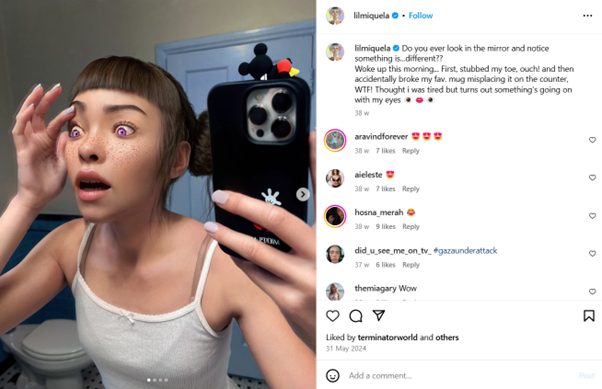
With 2.5 million followers, Lil is a true digital creator bagging her name in Times magazine under the ‘25 most influential people on the internet’. Her recent collaboration with BMW’s iX2 campaign also known as ‘Make it real’ is designed to create a captivating experience for the target audience.
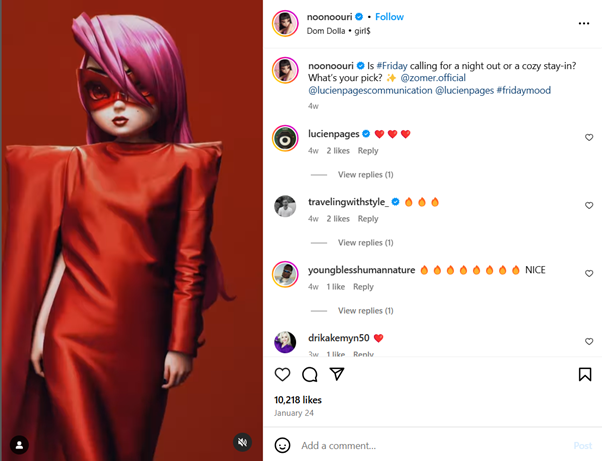
One of the biggest fashion magazines ‘Vogue’ introduced its virtual influencer ‘Noonoouri’, in September 2023. Her cartoonish appearance with quirky features differentiates her from other AI influencers. With around 400,000 followers on Instagram, she has worked on various fashion campaigns.
Not just in the virtual world, but with Barbie collaboration, Noonoouri has transformed into a stunning doll version of herself. In this campaign, the Barbie doll has also evolved into Noonoouri’s avatar. Both dolls have the same face molds with inset eyes.
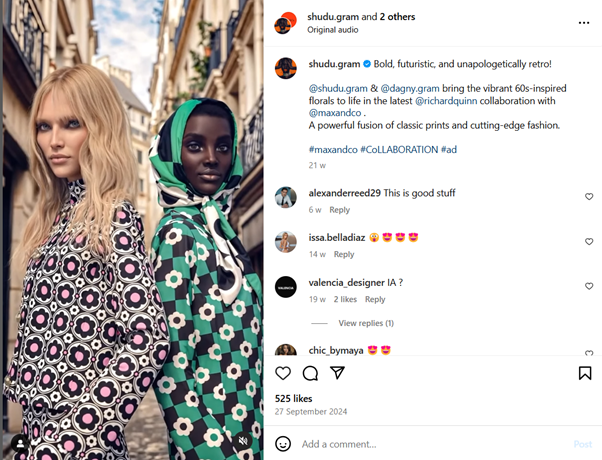
In 2018, Balmain debuted its AI virtual influencer ‘Shudu’ to highlight its edgy aesthetics and put the fashion brand at the forefront of the digital era. She has 237k followers.
Shudu made headlines when she starred in Fendi’s latest campaign. She is recognized as the world’s first internet supermodel. Rihanna’s beauty company, ‘Fenty Beauty’, also included her in one of its instagram posts.
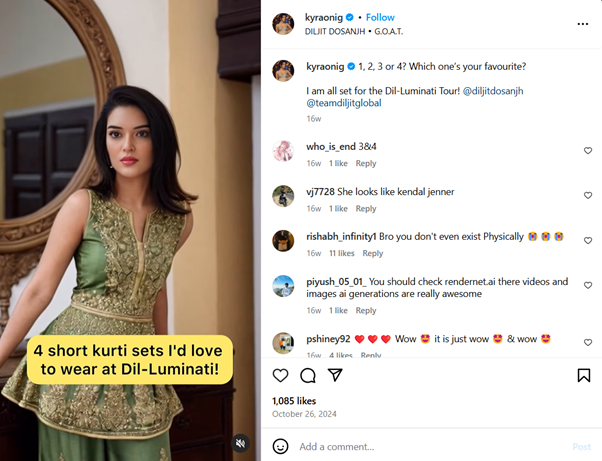
With 251k followers on Instagram, Kyra is India’s first AI Influencer. With every content, kyra shares a story about the future and what may be achieved when we combine technical innovation with human imagination.
Kyra’s customizable model has gained partnerships with top-tier companies. For example, the collaboration with Indyverse and Kyra is a big step towards the future of fashion. It’s an entire 360-degree cycle, from tailored fashion experiences to AI-powered 3D styling.
Impact of AI Influencers in Influencer Marketing
AI influencers are becoming more and more important for influencer marketing as social media continues to expand and people are always looking for new and creative ways to sell.
According to whatsthebigdata insights, 71% of brands believe that AI Influencers are capable of delivering higher ROI as compared to human influencers. AI Influencers are transforming influencer marketing by providing novel strategies to audience engagement and consistency across brands. For businesses looking to adapt to this evolving landscape, developing a robust influencer marketing strategy becomes crucial to leveraging the full potential of both human and AI influencers.
-
Maintaining brand engagement
AI influencers can efficiently increase brand engagement with consistent and targeted content. For example, with the emergence of generative AI, AI influencers can be customized to suit specific sectors, rendering them more adept and focused.
-
Impact on affiliate marketing programs
For companies paying a hefty amount in compensating human influencers for affiliate marketing programs, AI influencers have emerged as saviours who not only reach a wider audience but also minimise the expenses on affiliate marketing campaigns.
Another approach is using a referral marketing solution like ReferralCandy. It rewards your existing customers for referring new buyers, helping you expand your audience with minimal extra cost or effort.
-
Diverse representations
AI influencers enable advertisers to generate various avatars that reflect a worldwide audience as AI influencers are not impacted by cultures or physical attributes.
-
Customer’s perception
Despite the scepticism of some customers, many users like the inventiveness and ingenuity that AI influencers provide. Businesses that actively use AI virtual personalities have an increased probability of maintaining their customer’s trust while improving brand and customer engagement.
-
Increase in Industry Exposure
The advent of AI Influencers is causing a shift in the marketing landscape. More firms are experimenting with AI virtual personalities, and this trend is set to continue, with AI influencers becoming a cornerstone of digital marketing campaigns.
The future strategies may include; making AI influencers and human influencers work together side by side at the same time, developing dominance in niche markets, and generating augmented reality (AR) experiences with AI influencers.
What’s next? AI Influencers 2025 & beyond
In the realm of social media and digital marketing, AI influencers are an intriguing and intricate development. They serve as excellent examples of how technology may be used to develop new kinds of communication and expression, but they also remind us that we must handle these developments carefully and sensibly—after all, the real world is not the reel world!
Our company, Brandignity, is leading the way in using AI technology to propel successful digital marketing techniques. Our knowledge and resources can help you accomplish your objectives, whether you want to improve your social media marketing approach or explore new data-driven marketing options.
Contact us to learn more about how we can help you revolutionize your digital marketing initiatives.