How to Scale a Digital Marketing Agency
Scaling a digital marketing agency means expanding revenue, client capacity, and service delivery without a proportional increase in costs or headcount. The industry term for this is “agency growth architecture,” though most practitioners simply call it scaling. Done right, it means your agency earns more per employee, retains clients longer, and wins new business faster. Done wrong, it means chaos at every new contract. This guide covers the four pillars that separate agencies that grow sustainably from those that plateau: specialization, technology, operations, and client acquisition.
How to scale a digital marketing agency through specialization
Specialization is the single fastest way to accelerate agency growth. Agencies that scale successfully avoid the generalist trap by concentrating on specific industries or technical capabilities, such as SaaS, fintech, home services, or performance-led creative. The logic is straightforward: a prospect in the fintech space trusts an agency with five fintech case studies far more than one with fifty mixed-industry wins.
Specialization also creates repeatable playbooks. When your team has solved the same core problem for ten similar clients, they stop reinventing the wheel on every new account. Clear sales playbooks aligned with niche specialization shorten client acquisition cycles and improve conversion rates. That efficiency compounds over time, reducing the cost of winning each new client.
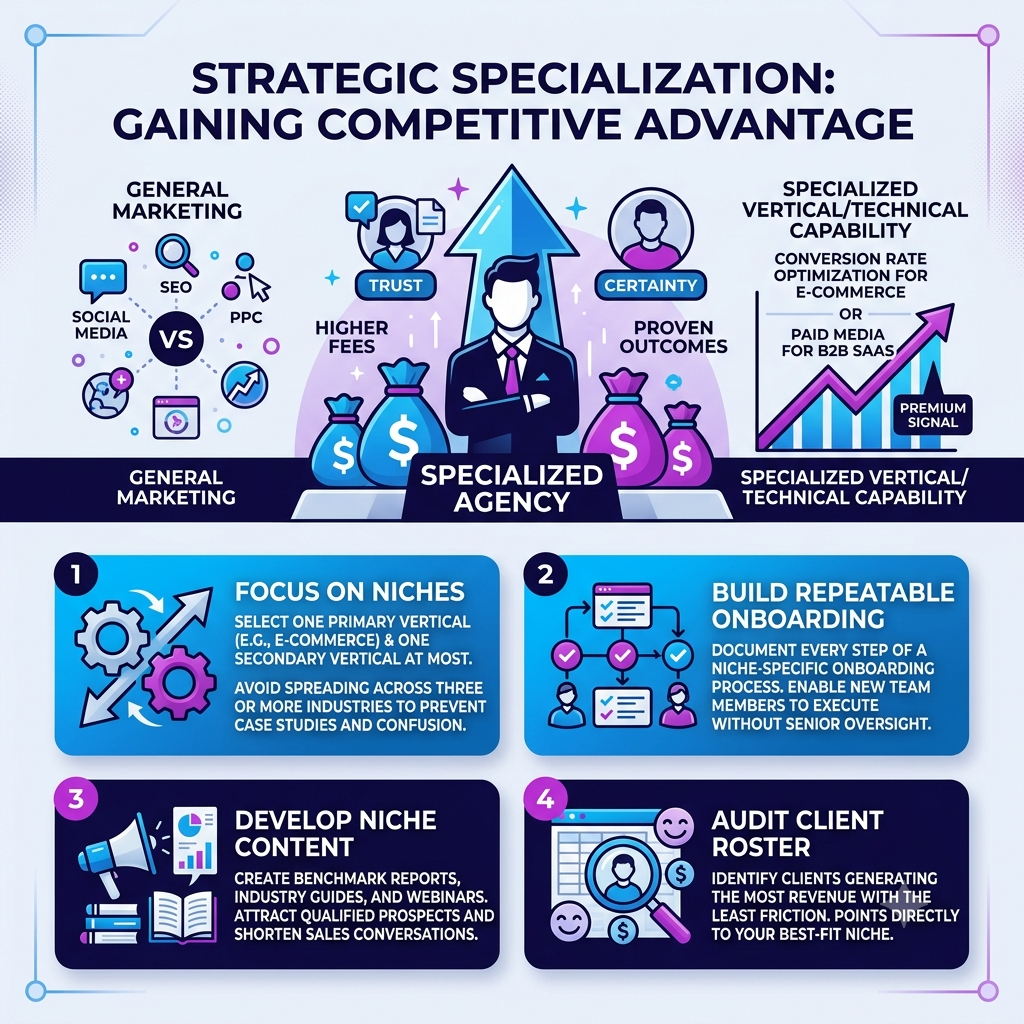
The competitive positioning benefit is equally significant. A specialized agency commands higher fees because it is selling proven outcomes, not general marketing services. Clients pay a premium for certainty. Positioning around a specific vertical or technical capability, such as conversion rate optimization for e-commerce or paid media for B2B SaaS, immediately signals certainty.
- Choose one primary vertical and one secondary vertical at most. Spreading across three or more industries dilutes your case study library and confuses prospects.
- Build a repeatable onboarding process specific to your niche. Document every step so new team members can execute it without senior oversight.
- Develop niche-specific content such as benchmark reports, industry guides, and webinars. This content attracts qualified prospects and shortens the sales conversation.
- Audit your current client roster. The clients generating the most revenue with the least friction usually point directly to your best-fit niche.
Pro Tip: If you are unsure which niche to commit to, analyze your last 12 months of client data. The vertical with the highest average contract value and lowest churn rate is your answer.
What technology does a growing agency need?
Technology platforms for project management, automation, and analytics are critical for agencies handling increased volume and complexity. A scalable tech stack reduces manual workload and increases agency agility. The goal is not to collect tools but to build a connected system where data, tasks, and deliverables flow without manual handoffs.
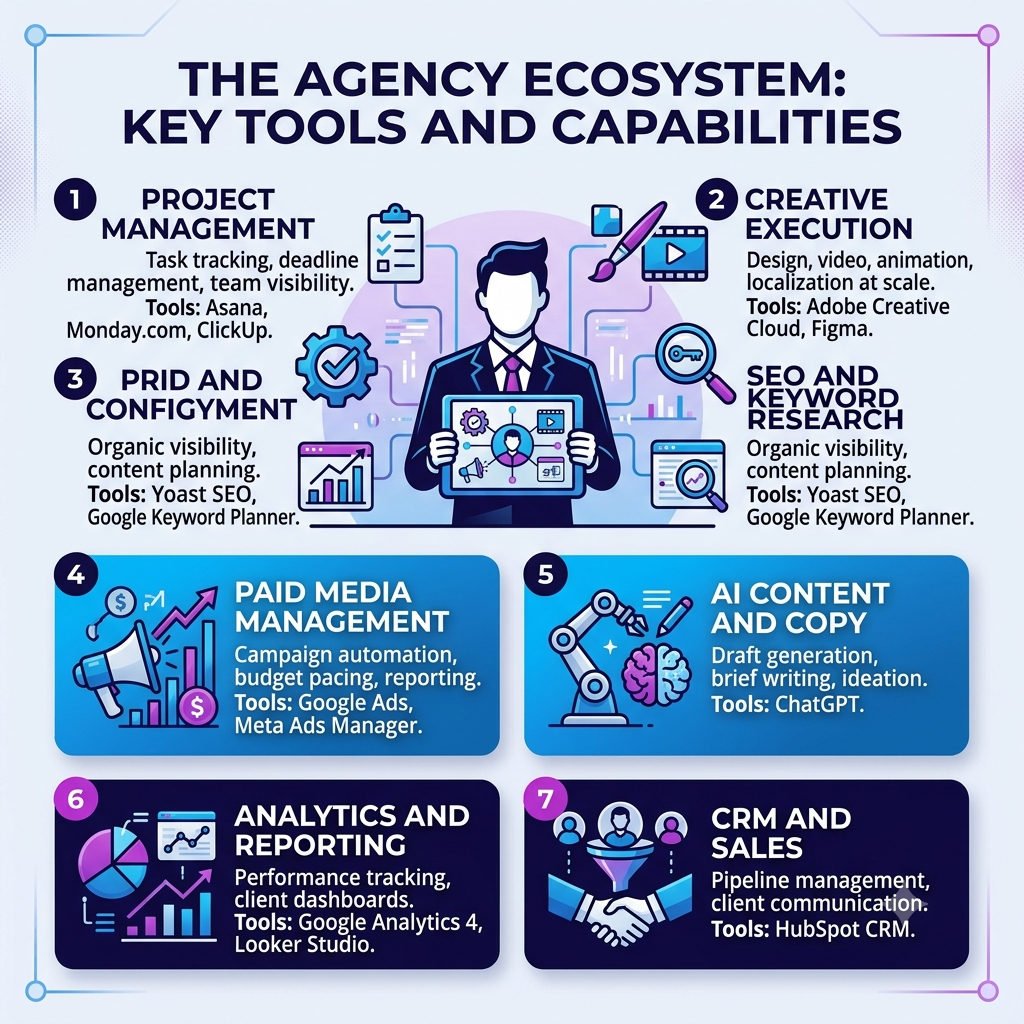
The table below maps the core technology categories every growing agency needs, along with their primary function.
| Tool category | Primary function | Examples |
|---|---|---|
| Project management | Task tracking, deadline management, team visibility | Asana, Monday.com, ClickUp |
| Creative execution | Design, video, animation, localization at scale | Adobe Creative Cloud, Figma |
| SEO and keyword research | Organic visibility, content planning | Yoast SEO, Google Keyword Planner |
| Paid media management | Campaign automation, budget pacing, reporting | Google Ads, Meta Ads Manager |
| AI content and copy | Draft generation, brief writing, ideation | ChatGPT |
| Analytics and reporting | Performance tracking, client dashboards | Google Analytics 4, Looker Studio |
| CRM and sales | Pipeline management, client communication | HubSpot CRM |
Agencies that integrate end-to-end creative support, including graphic design, video editing, animation, and localization, into a single production workflow deliver faster and more consistently than those using disconnected freelancers for each task. Consistency matters because the quality of brand assets directly affects client retention.
When selecting platforms, prioritize tools that offer API integrations with your existing stack. A project management tool that cannot talk to your reporting dashboard creates data silos. Data silos create billing disputes and missed deadlines.
Pro Tip: Audit your tech stack every six months. Remove any tool that duplicates a function already covered by another platform. Redundant tools waste budget and fragment team attention.
What operational strategies support agency expansion?
Operations are where most agencies stall. They win new clients but cannot deliver at the same quality they promised during the pitch. Embedding creative teams directly within client workflows solves this problem by eliminating the back-and-forth that slows production and erodes trust.
The staffing model an agency chooses determines its ceiling. Relying entirely on freelancers creates delivery risk. Dedicated embedded teams reduce reliance on unreliable freelancers and expedite delivery by keeping brand vision execution consistent. The practical middle ground is a core in-house team handling strategy, client communication, and quality control, with a vetted network of specialists for overflow work.
Process bottlenecks in creative production cost more than time. Creative delays impact client satisfaction and revenue potential directly. A client who misses a product launch window because your agency delivered assets late will not renew. Building production buffers and clear approval workflows into every project prevents this.
The following operational improvements have the most direct impact on agency capacity:
- Standardize project briefs. A one-page brief template that captures objectives, audience, tone, and deliverables halves revision cycles.
- Set internal deadlines earlier than client deadlines. A 48-hour internal buffer absorbs unexpected delays without affecting the client.
- Assign a dedicated account manager to each client. Single points of contact reduce miscommunication and speed up approvals.
- Conduct weekly capacity reviews. Know exactly how many hours each team member has available before committing to new work.
- Build a quality-assurance checklist for each deliverable type. A design QA checklist, a copy QA checklist, and a campaign launch checklist each prevent costly errors.
Strategic creative direction and oversight ensure brand messages stay consistent and assets meet high standards across every client account. Agencies that skip this layer produce inconsistent work as they grow, which accelerates client churn.
Proven strategies to grow your client base
Growing a client base requires a system, not a series of one-off efforts. The agencies that most reliably expand their client rosters treat business development as a repeatable process with defined inputs and measurable outputs.
- Build a structured referral program. Existing clients are the highest-converting source of new business. Offer a meaningful incentive, such as a service credit or a cash referral fee, and make the referral process as simple as a single email introduction.
- Use data-driven outreach. Identify your ideal client profile using firmographic data: company size, industry, tech stack, and growth stage. Outreach that speaks directly to a prospect’s specific situation converts at a far higher rate than generic cold email.
- Publish niche-specific thought leadership. A monthly benchmark report for your target vertical, distributed via LinkedIn and email, positions your agency as the authority in that space. Prospects who consume your content arrive at the sales conversation already sold on your expertise.
- Expand services within existing accounts. Selling a new service to a current client costs a fraction of acquiring a new one. Audit each account quarterly for service gaps. If a client runs paid media through your agency but manages SEO internally, that is a clear expansion opportunity.
- Form strategic partnerships. Web development agencies, PR firms, and management consultancies often need digital marketing partners for their clients. A formal referral agreement with two or three complementary firms creates a steady pipeline without advertising spend.
- Cultivate long-term relationships through quarterly business reviews. Clients who see clear ROI data and forward-looking strategy in a formal review meeting renew at higher rates. The review also surfaces upsell opportunities before a competitor does.
Brandignity applies this exact model across its client portfolio, combining AI-driven data analysis with structured account management to identify growth opportunities inside existing relationships before pursuing net-new acquisition.
Key Takeaways
Agencies that scale successfully combine niche specialization, a connected tech stack, embedded operational teams, and a systematic approach to client acquisition.
| Point | Details |
|---|---|
| Specialize to accelerate growth | Focusing on one or two verticals creates proven playbooks and shortens sales cycles. |
| Build a connected tech stack | Project management, creative, SEO, and analytics tools must integrate to eliminate data silos. |
| Embed teams in client workflows | Dedicated in-house teams deliver faster and more consistently than freelancer networks. |
| Treat business development as a system | Referral programs, data-driven outreach, and quarterly reviews create predictable pipeline growth. |
| Expand within existing accounts | Selling new services to current clients costs less and converts faster than acquiring new ones. |
What I have learned from watching agencies scale and stall
The agencies I have seen grow past the $1M revenue mark share one trait: they stopped trying to be everything to everyone before they hit that threshold. The ones that stall are almost always chasing the next shiny client in a new vertical, rebuilding their pitch deck from scratch each time, and wondering why their close rate is low.
Specialization feels risky because it means saying no to revenue. That discomfort is real. But the math is clear. A specialized agency closes faster, charges more, and retains clients longer. Those three factors compound. A generalist agency competes on price because it cannot compete on proof.
The technology piece is where I see the most waste. Agencies buy tools to solve problems they have not yet diagnosed. The right question is not “what tool should we use?” but “where does work slow down or break down in our current process?” Answer that first, then find the tool that fixes the specific failure point.
The hardest lesson is that operational discipline is not a phase you graduate from. It is the permanent foundation of growth. Agencies that treat process as a temporary inconvenience until they hire more people discover that more people without process creates more chaos, not less. Build the process first. Hire into it second.
If you are building a growth roadmap for your agency, start with your niche, then your operations, then your tech stack. Client acquisition strategy comes last because it only works when the delivery engine behind it can handle what it wins.
— Maciej
Brandignity’s approach to agency growth
Brandignity works with agencies and business owners who need more than a general marketing vendor. The firm combines AI-driven analysis with human expertise to build marketing programs that produce measurable results across SEO, paid media, content, and social channels.
For agencies looking to grow their client base and service capacity, Brandignity offers white label digital marketing services covering SEO, content creation, and web design. These services integrate directly into existing agency workflows, so delivery quality stays consistent as volume increases. Brandignity’s AI-driven marketing solutions are built for agencies that want to add capacity without adding overhead. The model is straightforward: you manage the client relationship, Brandignity handles the execution.
FAQ
What does it mean to scale a digital marketing agency?
Scaling a digital marketing agency means growing revenue and client capacity without a proportional increase in costs. The goal is higher output per team member and per dollar spent on operations.
How does specialization help an agency grow faster?
Specialized agencies close new clients faster because they sell proven outcomes in a specific industry. Niche-focused playbooks reduce sales friction and improve conversion rates compared to generalist pitches.
What tools are most important for agency scaling?
Project management, creative execution, SEO, paid media, and analytics platforms form the core tech stack. Tools must integrate with one another to avoid data silos and manual reporting.
How do agencies manage quality as they take on more clients?
Embedding dedicated teams within client workflows and applying standardized QA checklists on every deliverable type maintains quality at higher volume. Creative direction and oversight across all accounts prevent brand inconsistency.
When should an agency expand its service offerings?
Expand services only after the core offering is profitable and operationally stable. Audit existing client accounts for service gaps before building new capabilities, since selling to current clients converts faster than acquiring new ones.