The New SEO Frontier: Mastering Generative Engine Optimization (GEO)
For over two decades, the playbook for online visibility was clear: optimize for keywords, build high-authority backlinks, appease the Google algorithm, and secure a spot on page one. It was a world ruled by Search Engine Optimization (SEO).
But the landscape has fundamentally shifted. We are no longer just optimizing for traditional search engines; we are optimizing for AI engines.
With the rise of Google’s AI Overviews, Search Generative Experience (SGE), Perplexity, and OpenAI’s SearchGPT, users are bypassing lists of blue links in favor of direct, synthesized answers. If your brand isn’t cited inside those AI-generated summaries, you are effectively invisible. Welcome to the era of Generative Engine Optimization (GEO).
What is Generative Engine Optimization (GEO)?
Generative Engine Optimization (GEO) is the practice of optimizing digital content so that Large Language Models (LLMs) and AI search engines select, synthesize, and recommend your brand in their conversational responses.
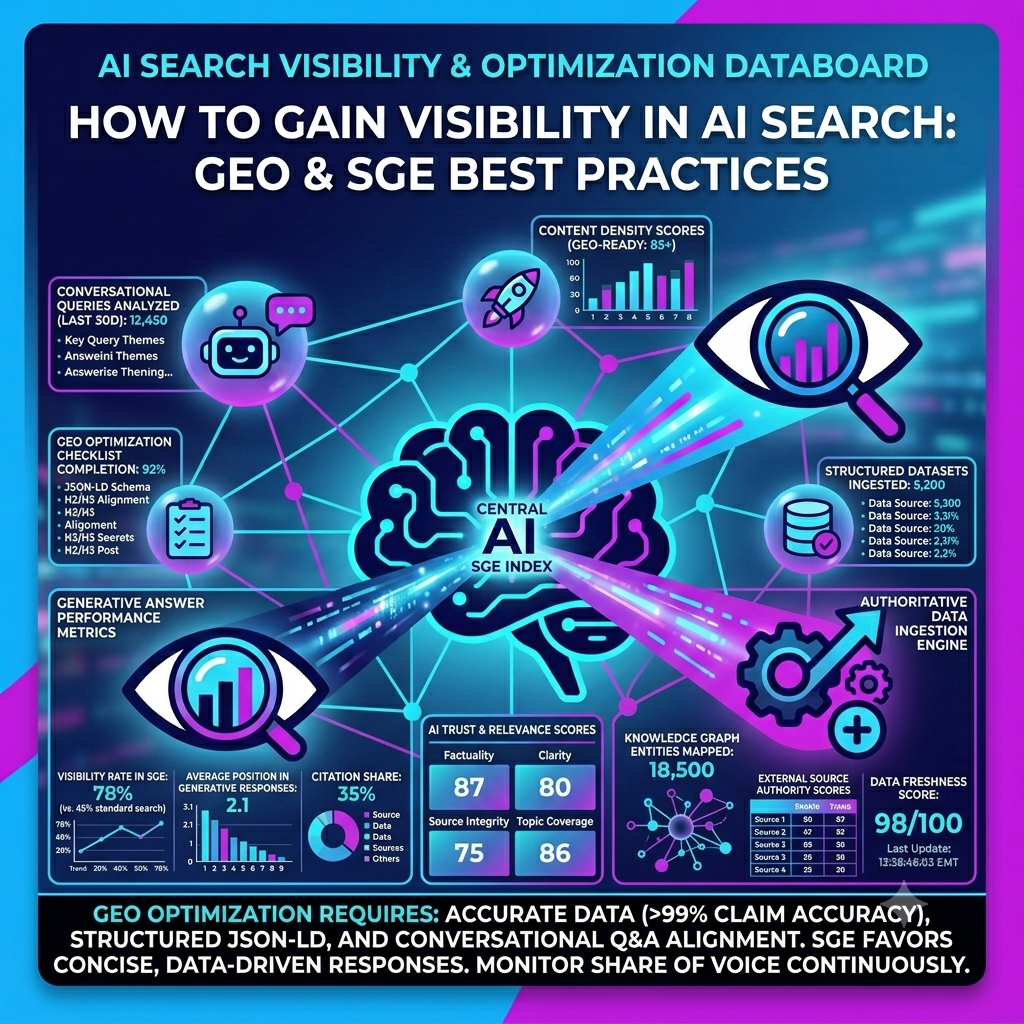
Unlike traditional search, which ranks websites based on crawlability and link signals, AI engines rank information based on relevance, statistical probability, context, and structural authority. They don’t just want a page that discusses a topic; they want a definitive answer that seamlessly integrates into a larger, multi-source summary.
If SEO was about winning the click, GEO is about winning the mention.
The Visibility Dilemma: Fly Blind or Adapt?
The hardest part about this shift for marketers, business owners, and digital agencies is data—or rather, the lack of it.
Traditional SEO tools are excellent at tracking keyword rankings, monthly search volumes, and click-through rates. However, they are fundamentally blind to AI search behavior. They cannot tell you whether ChatGPT is recommending your software to a buyer or whether Google’s AI Overview is pulling data from your blog post to answer a complex industry question.
Without visibility into these AI engines, businesses are playing a high-stakes guessing game. This is exactly where specialized AI visibility platforms like searchinsight.ai become mandatory pieces of the modern marketing tech stack.

As dedicated AI search visibility tools, platforms like searchinsight.ai act as a radar system for the GEO landscape. They allow brands to monitor their digital footprint across various LLMs, analyze whether their products are being recommended in conversational queries, and track their overall “share of voice” in AI-generated answers. It transforms GEO from an abstract concept into a measurable, data-driven strategy.
Core Strategies for Boosting Your AI Search Visibility
To win in the GEO ecosystem, your content strategy needs an upgrade. Based on emerging data and behavioral patterns of LLMs, here are the three most critical pillars for maximizing your AI search visibility:
1. Optimize for Technical and Statistical Closeness
AI models look for authoritative, data-dense content to back up their claims. To be cited, your content should include precise statistics, historical facts, and clear data points. Instead of writing broad generalizations, provide concrete numbers. AI engines favor structured data because it reduces their risk of “hallucinating” or providing inaccurate information to users.
2. Prioritize Natural, Conversational Language (The Q&A Format)
People talk to AI search engines differently than they type into Google. Instead of searching “best pool builder Naples FL,” a user might ask an AI, “I have an acre of land in the Naples Estates, what kind of permit do I need to add a concrete pool and screen cage?” To align with this behavior, structure your content using direct question-and-answer formats. Use Clear headings (H2 and H3 tags) framed as questions, followed immediately by concise, authoritative answers.
3. Build Source Diversity and Digital PR
AI search engines rarely rely on a single source; they synthesize answers by cross-referencing multiple domains. To convince an AI engine that your brand is the definitive answer, that engine needs to see your brand name mentioned consistently across independent review sites, forums, news outlets, and industry blogs. A robust digital PR strategy is no longer just for building backlinks—it is for training the AI models to recognize your brand as a market leader.
The Path Forward: Measure, Optimize, Repeat
The transition from SEO to GEO isn’t happening next year—it is happening right now. As AI search engines continue to capture massive chunks of traditional search traffic, early adopters of GEO will capture digital market share.
By shifting your content focus toward structured authority, leveraging conversational phrasing, and utilizing advanced tracking tools like searchinsight.ai to measure your actual AI visibility, you can ensure your business remains relevant, visible, and recommended in an AI-first world.
Frequently Asked Questions
While Search Engine Optimization (SEO) focuses on ranking your website at the top of a list of blue links on traditional search engines, Generative Engine Optimization (GEO) focuses on optimizing your content so it is selected, synthesized, and cited as a recommended source within AI-generated answers (like Google AI Overviews, Perplexity, and ChatGPT).
Traditional SEO tools track keyword positions and search engine results page (SERP) rankings based on static URLs. AI search engines generate unique, conversational answers on the fly for every user, creating a “black box” that traditional scrapers cannot read. Tools like searchinsight.ai are specifically engineered to monitor how LLMs behave and recommend brands.
No, GEO is an evolution of SEO, not a total replacement. Traditional technical SEO pillars—like fast page speeds, mobile responsiveness, secure hosting, and clean site architecture—remain vital because AI engines still need to crawl and understand your website to use your data as a source.
You should optimize for the major engines driving conversational search. This includes Google’s AI Overviews, Perplexity AI, OpenAI’s SearchGPT, Microsoft Copilot, and Meta AI, as well as the underlying foundational models like Claude and Gemini that power various search integrations.
AI models prioritize data density, structural clarity, and source authority. They favor content that provides specific statistics, direct quotes from verified experts, structured formatting (tables and bullet points), and information that is consistently validated by other independent sources across the web.
Searchinsight.ai is a specialized AI search visibility platform. It acts like a radar system for the generative web, allowing brands and marketers to track their “share of voice” inside LLM responses, see if their products are being recommended for specific queries, and get actionable data on how to improve their AI optimization.
Yes, heavily. Because large language models rely on mathematical probability to connect facts, highly structured data—such as Schema.org markup, tables, and clear bulleted lists—makes it much easier for an AI engine to extract information accurately without risking a “hallucination.”
Shift toward an authoritative question-and-answer format. Since users ask AI engines highly specific, long-tail questions, your content should mirror that natural phrasing. Use clear, conversational headings (H2s and H3s) that state a common question, and answer it directly in the very next paragraph.
AI engines synthesize answers by cross-referencing multiple domains to ensure accuracy. If your brand is only mentioned on your own website, an AI is unlikely to trust it. Digital PR ensures your brand is mentioned on independent blogs, news outlets, forums, and review sites, signaling to the AI that you are a trusted industry leader.
Because AI models are constantly updating their web-connected search indices, optimizations made to live web content can reflect in search-centric engines (like Perplexity or Google AI Overviews) within days or weeks. However, influencing the core training data of foundational static models can take months or until their next major architectural update.