
The Hidden SEO Issues in Your Site’s Technical Architecture That Could Be Holding You Back
Your site’s SEO performance could be hindered by hidden technical issues within its architecture. Lacking HTTPS security can erode user trust and hurt rankings. Improperly configured robots.txt files or absent XML sitemaps can prevent search engines from indexing vital pages, reducing visibility. Slow page speeds can increase bounce rates and decrease conversions, while broken links and duplicate content frustrate users and diminish search engine trust. Mobile optimization is essential, given that 60% of online traffic is mobile-based. Implementing structured data can boost click-through rates by up to 30%. Address these issues to enhance overall site performance and engagement.

HTTPS Security Issues
HTTPS security issues can severely undermine your site’s credibility and search engine performance. When your site lacks HTTPS security, browsers may flag it as non-secure, causing visitors to see warnings that erode user trust and deter engagement, ultimately hurting conversion rates. To prevent this, obtaining an SSL certificate is fundamental. This certificate not only encrypts data during transmission but also signals to both users and search engines that your site prioritizes security.
Google actively favors HTTPS-enabled sites, as evidenced by its ranking algorithms. Sites with robust HTTPS security are more likely to rank higher in Google search results, enhancing your visibility. A simple check for HTTPS implementation can be done by typing your domain into Google Chrome and looking for the secure lock symbol in the address bar.
However, ensuring site security goes beyond just installation. Regular audits of your HTTPS implementation are essential. Mixed content warnings can occur if not all pages are secured, adversely affecting user experience and rankings. Continual monitoring and proactive management of your site’s SSL certificate and overall security protocols are critical steps in maintaining a secure, trustworthy, and high-ranking online presence.
Indexing Problems
While HTTPS security provides a solid foundation for your site’s trustworthiness, indexing issues can still undermine your SEO efforts by preventing search engines from properly accessing and indexing your content. Indexing problems occur when search engine bots can’t access or recognize your web pages, leading to reduced visibility in search results and lost traffic.
One major cause of these issues is improper use of robots.txt files. If configured incorrectly, these files can inadvertently block bots from crawling essential pages. Similarly, pages with a “NOINDEX” meta tag won’t be indexed by search engines, so regularly check for misconfigured tags that could hinder visibility.

An XML sitemap is another vital tool. It helps search engines understand your website’s structure. Without a properly configured XML sitemap, some pages might remain unindexed, limiting your site’s reach.
To stay on top of indexing problems, conduct regular audits using tools like Google Search Console. This platform can help you identify indexing issues and make timely adjustments to improve your site’s visibility and performance. Ignoring these technical aspects can severely limit your SEO potential, so proactive management is key.
XML Sitemaps Missing
An XML sitemap is vital for guiding search engine crawlers through your website’s structure, guaranteeing that all significant pages are indexed effectively. Without an XML sitemap, you risk entire sections of your site being overlooked, severely impacting site visibility and search engine rankings. This technical SEO issue can cause search engines to miss valuable content, reducing your site’s indexability.
To check if your XML sitemap is missing, simply append /sitemap.xml to your domain. If this returns a 404 error, it’s a clear sign your sitemap is absent. This seemingly small oversight can lead to substantial SEO setbacks. An XML sitemap isn’t just a list of URLs; it’s a strategic tool that helps search engines understand your site’s hierarchy and new content, enhancing your overall SEO performance.
Regularly updating your XML sitemap is vital for maintaining high indexability. By doing so, you guarantee that search engines quickly discover new or updated content, boosting your site’s search engine rankings. In an era where site visibility is paramount, neglecting this fundamental element of technical SEO can hold you back from achieving optimal performance and engagement.
Robots.txt Errors
After confirming your XML sitemap is properly configured, it’s just as important to address potential errors in your robots.txt file. This critical file guides search engine crawlers on which pages to access and which to avoid. A missing or misconfigured robots.txt file can severely impact your site’s crawlability and indexability, affecting overall SEO performance.
Common issues include using “Disallow: /”, which blocks all pages from being crawled. This can lead to complete exclusion from search engine results. Regularly checking your robots.txt file helps identify directives that may inadvertently block important content. Using tools like Google Search Console can provide insights into how search engines interpret your robots.txt file and highlight any crawl errors.
Proper management of robots.txt guarantees that high-priority pages are crawled and indexed, while preventing access to duplicate or low-value content. This balance is essential for peak SEO performance. By proactively auditing your robots.txt file, you can avoid unnecessary crawl errors and enhance your site’s visibility. Remember, your robots.txt configuration directly influences how search engines perceive your site, making it a pivotal component in your technical SEO strategy.
Page Speed Concerns
Enhancing page speed is essential for both user experience and search engine rankings, with Google advising load times under 3 seconds to keep bounce rates low and boost conversions. A 1-second delay can slash your conversions by 7%, underscoring the critical impact of loading times on business performance.
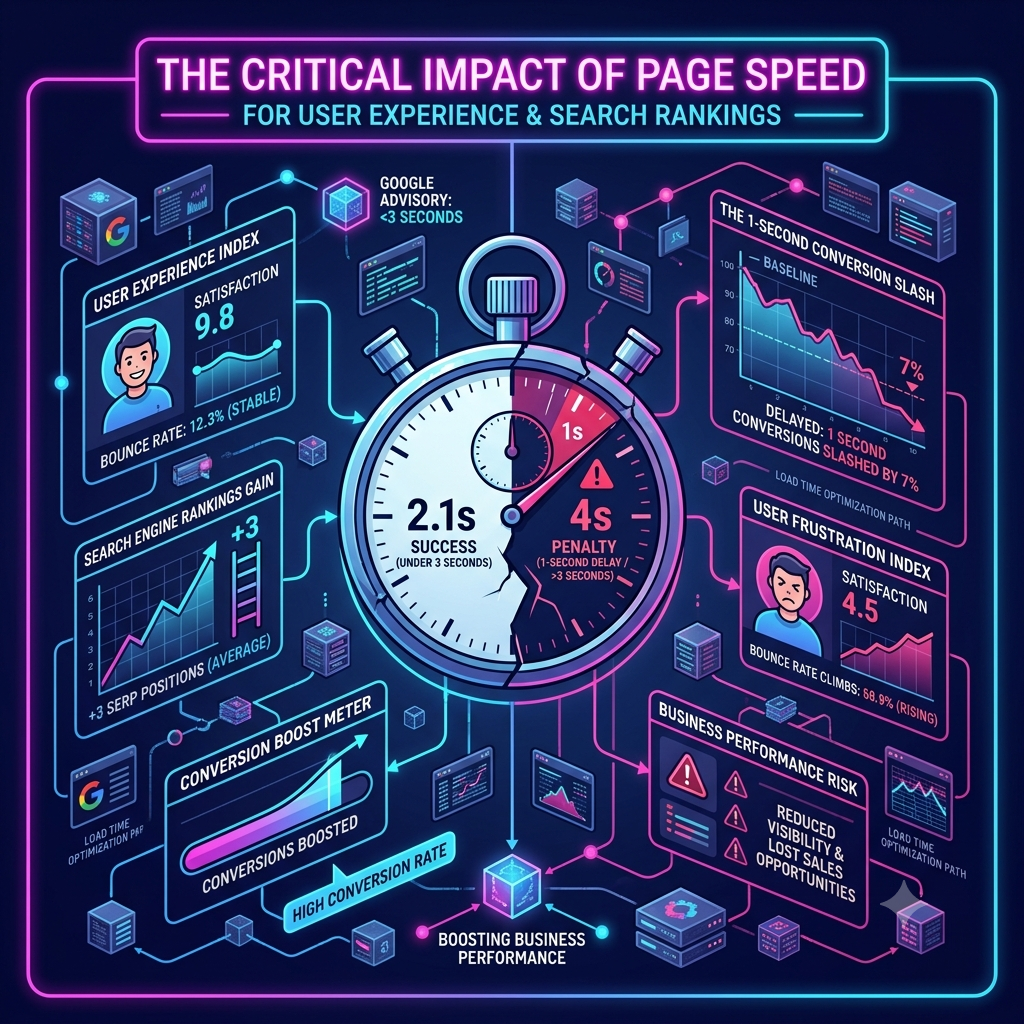
To optimize page speed, start by addressing images—compress and resize them to guarantee they don’t bog down your site performance. Leverage browser caching to store static files locally on a user’s device, reducing the need for repeated downloads. Additionally, minimize server response times by using a reliable hosting service and optimizing your backend code.
Technical SEO plays a pivotal role here. Utilize tools like Google PageSpeed Insights to diagnose speed issues and get actionable recommendations. Regularly monitor and tweak your site to guarantee it remains fast, as search engines increasingly prioritize quick-loading sites in their algorithms.
Duplicate Content
Duplicate content is a vital SEO issue that can severely impact your site’s search engine ranking. When search engines encounter duplicate content issues, they struggle to determine which version to index and rank, diluting the authority of your content. It’s estimated that 25-30% of all web content is duplicated, which can drastically reduce your site’s search engine visibility.
Implementing canonical tags is significant for mitigating these issues. These tags indicate the preferred version of content, guiding search engines and helping you avoid penalties. Not only do canonical tags clarify content priorities, but they also enhance site performance by guaranteeing that link authority is properly distributed.
Regular audits are essential in identifying and addressing duplicate content. By systematically reviewing your site, you can pinpoint and correct instances of redundancy, thereby improving your overall site performance. Search engines favor unique, high-quality content, and regular audits guarantee that your site remains compliant with these preferences.
Moreover, duplicate content can lead to a poor user experience. Visitors encountering multiple versions of the same information might get frustrated and lose trust in your website. Consequently, proactive management of duplicate content issues is key to maintaining both search engine visibility and user satisfaction.
Broken Links
Broken links are a hidden SEO issue that can greatly harm your site’s performance. When users encounter broken links, their user experience deteriorates rapidly, leading to increased bounce rates. Search engines like Google see these 404 errors as indicators of poor site maintenance, which can result in penalties and lower rankings. Letting broken links accumulate can markedly diminish your site’s performance and overall credibility.
Approximately 60% of users expect links to work seamlessly. When they don’t, trust in your website takes a hit. To avoid this, regular audits using specialized tools to scan for 404 errors are essential. These tools can help you identify and rectify broken links promptly. Fixing these issues, either by repairing the links or implementing 301 redirects to relevant content, can enhance both user experience and search engine crawlability.
Moreover, broken links disrupt the flow of link authority across your site, diluting the ranking potential of your pages. By maintaining a clean, error-free site, you guarantee a smoother navigation experience for users and an optimized crawling process for search engines. This proactive approach can markedly boost your site’s SEO effectiveness and performance.
Mobile Optimization
Given the increasing shift towards mobile-first indexing, mobile optimization isn’t just a best practice; it’s a necessity. With Google prioritizing the mobile version of your site for ranking, making certain your site is mobile-friendly is essential. Around 60% of global online traffic now comes from mobile devices, making it imperative to address any technical issues that could compromise the user experience on smaller screens.
If your site isn’t optimized for mobile, you risk higher bounce rates—53% of mobile users abandon sites that take longer than three seconds to load. This delay not only frustrates users but also affects your core web essentials and critical metrics that Google uses to assess the overall user experience. Sites that lag in mobile optimization often see lower visibility in search results, as poor mobile usability is a significant ranking factor.
Regularly testing for mobile compatibility with tools like Google’s Mobile-Friendly Test can help you identify and fix issues that hinder the user experience. By prioritizing mobile optimization, you guarantee your site meets Google’s standards, retains visitors, and ultimately ranks higher in search engine results.
Structured Data Usage
Mobile optimization sets a solid foundation for a seamless user experience, but enhancing search visibility doesn’t stop there. Structured data usage is a critical component of search engine optimization that can greatly boost your site’s visibility and ranking. By implementing schema markup, you enable search engines to better understand your content, which can lead to rich snippets in search results.
Rich snippets, derived from structured data, can increase your click-through rates by up to 30%, providing users with more context and relevant information directly in search results. This enhanced presentation not only draws attention but also improves your site’s overall visibility. In fact, approximately 80% of rich snippets are generated from structured data, underscoring its importance in technical SEO.
Regularly validating your structured data with testing tools is essential. Errors in implementation can prevent search engines from properly indexing your content, negatively impacting your visibility and ranking. Additionally, structured data plays a crucial role in voice search optimization, as voice assistants rely on it to deliver precise answers.
Conclusion
Imagine your website as a meticulously designed city. Without proper roads (XML sitemaps) and traffic signals (robots.txt), it’s chaos. Broken bridges (links) and slow-moving traffic (page speed) frustrate visitors. Regular audits act like city planners, identifying and fixing these hidden SEO issues, ensuring a smooth, efficient journey for both users and search engines. By addressing HTTPS security, indexing, and mobile optimization, you’ll transform your site into a streamlined, high-ranking powerhouse. Don’t let technical flaws sabotage your SEO efforts—take action now.
Frequently Asked Questions
HTTPS is essential because it encrypts data transmission, protecting user privacy and establishing trust. Beyond security, search engines like Google utilize HTTPS as a ranking signal, meaning non-secure sites may face visibility penalties. As noted in authoritative SEO literature, the transition to secure protocols is no longer optional but a baseline expectation for search engine indexing and user retention.
The robots.txt file acts as a set of instructions for search engine crawlers, defining which parts of a site should be accessed or ignored. If misconfigured—such as using a “Disallow: /” directive—it can inadvertently block search engines from crawling the entire site, leading to a complete loss of search visibility.
An XML sitemap serves as a roadmap for search engines, explicitly listing the URLs that should be indexed. Without one, search engines may struggle to discover new or updated content, particularly on larger, complex websites.
Search engines prioritize fast-loading sites to improve user experience. Research indicates that even a one-second delay in page load time can reduce conversion rates by approximately 7%. Maintaining load times under three seconds is a standard benchmark to minimize bounce rates.
Duplicate content forces search engines to choose which version to rank, often diluting link authority. Experts emphasize that canonical tags are the primary mechanism for signaling the preferred version of a page to search engines, thereby preventing ranking penalties.
Broken links (404 errors) frustrate users and signal poor site maintenance to search engines, which can negatively impact rankings. Proactive auditing and the use of 301 redirects are recommended to preserve link equity and ensure a seamless user experience.
With approximately 60% of global traffic originating from mobile devices, Google employs mobile-first indexing. Sites that are not optimized for mobile often experience higher bounce rates and lower search visibility, as mobile usability is a core ranking factor.
Structured data provides search engines with context about the content on a page, which can lead to the display of “rich snippets” in search results.[1] These snippets can increase click-through rates by up to 30%, making the site more prominent in search engine results pages (SERPs).
Regular audits using tools like Google Search Console are essential for identifying crawl errors, indexation issues, and security vulnerabilities.[1] Professional SEO practice involves consistent monitoring of site architecture to ensure that technical foundations remain sound as the site evolves.
The “noindex” meta tag explicitly instructs search engines not to index a specific page. While useful for private or redundant pages, accidental placement of this tag on important content will cause those pages to disappear from search results entirely.