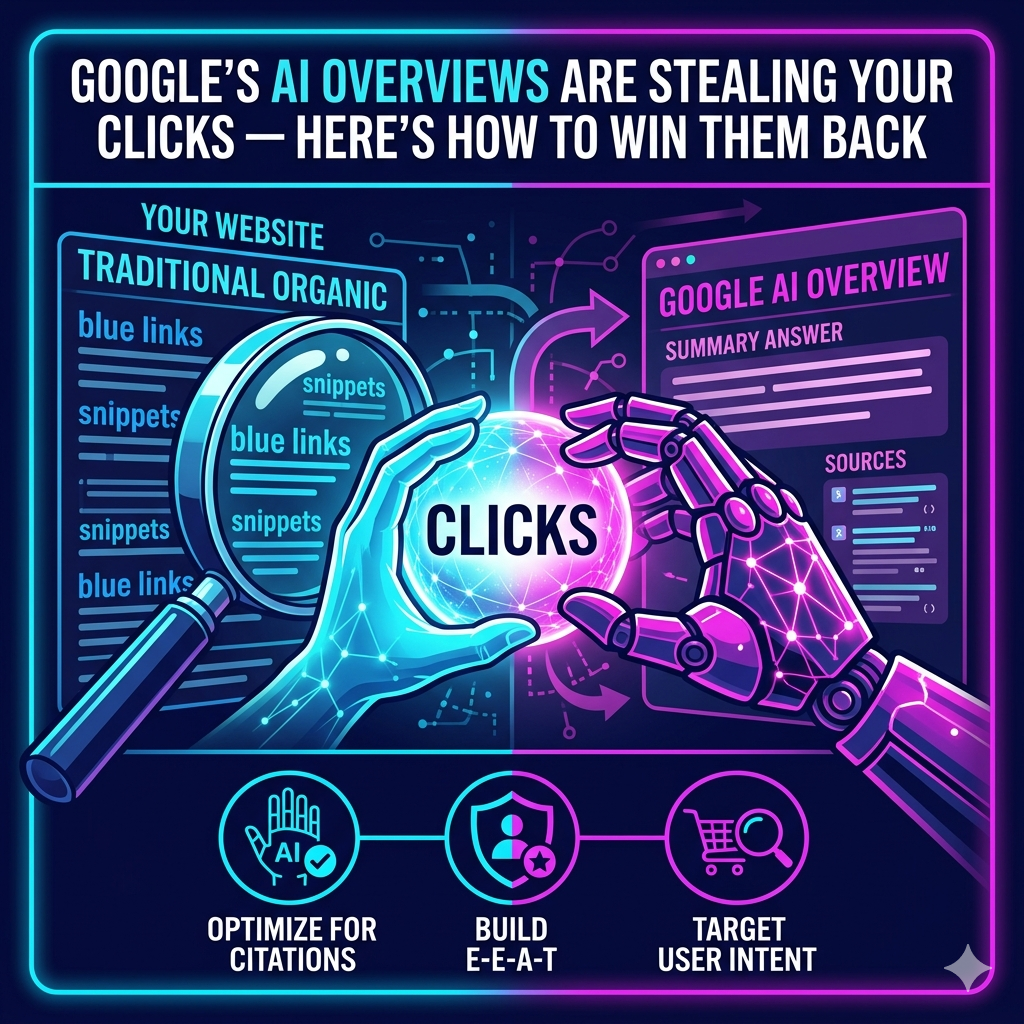
Google’s AI Overviews Are Stealing Your Clicks — Here’s How to Win Them Back
If you’ve noticed a steady slide in your organic traffic over the past 12 months and can’t figure out why, there’s a very good chance Google’s AI Overviews are the culprit. And you’re far from alone.
AI Overviews — Google’s AI-generated summaries that appear above traditional search results — have quietly become one of the most disruptive forces in digital marketing since the introduction of mobile search. What started as an experimental feature covering a small fraction of queries has exploded into a dominant fixture of the search experience. In January 2025, AI Overviews appeared in just 6.49% of Google searches. By April 2026, that number had skyrocketed to nearly 60%. In the U.S. specifically, 50% of all queries now generate an AI Overview response, and a staggering 58% of all Google searches end without a single click to an external website.
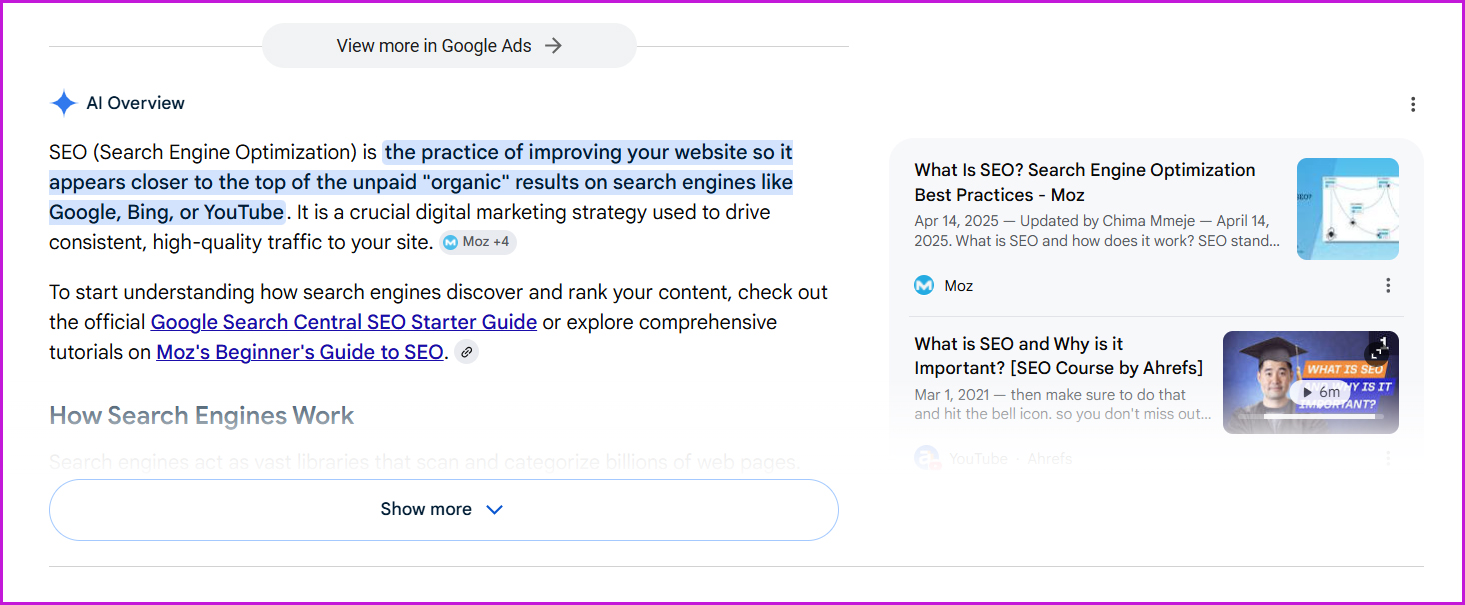
Let that sink in for a moment. More than half of Google searches are now resolved before users ever visit a website.
The Real Cost to Your Traffic
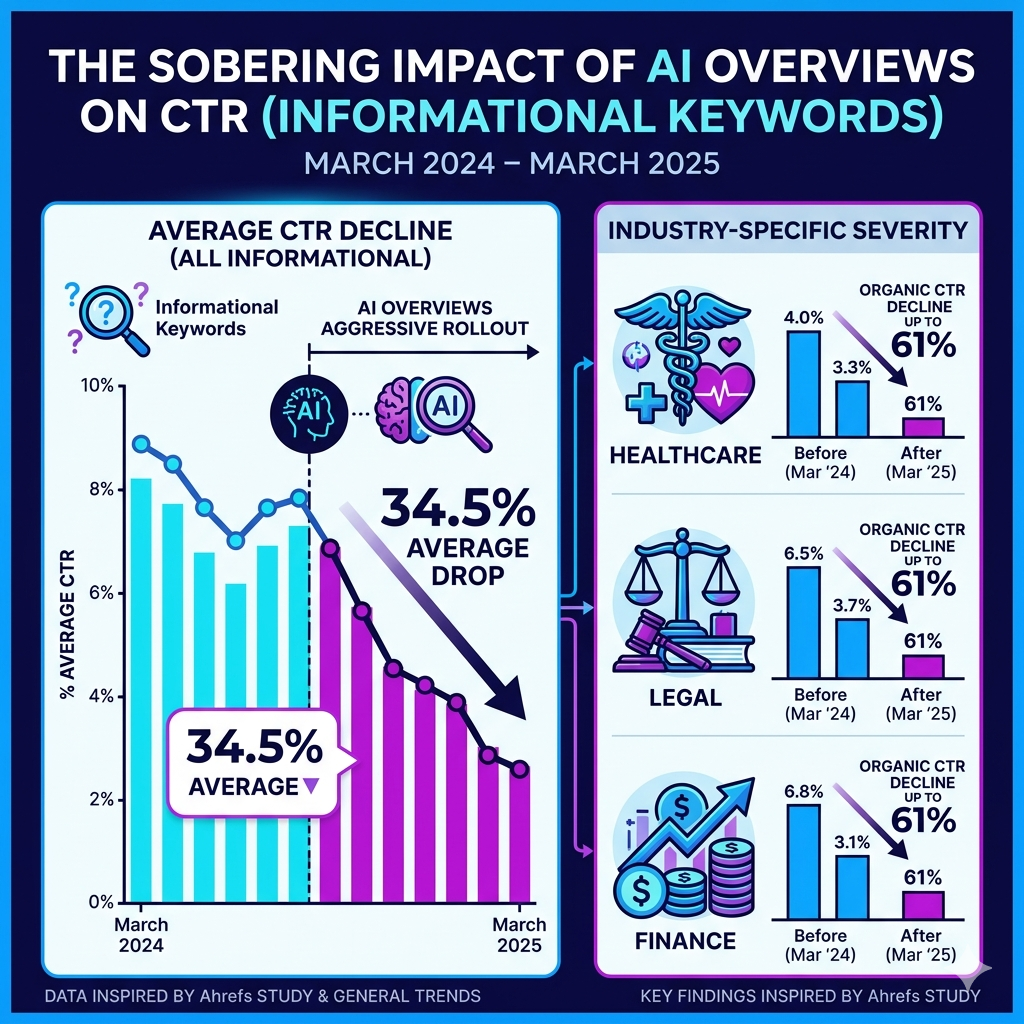
The data on the impact of click-through rate (CTR) is sobering. According to a study by Ahrefs, the average CTR for informational keywords dropped 34.5% between March 2024 and March 2025 — the period coinciding with AI Overviews’ aggressive rollout. For industries such as healthcare, legal, and finance, the damage has been even more severe, with some sites reporting organic CTR declines of up to 61% for informational queries.
Smaller publishers have been hit hardest. Research tracking global referral traffic shows a 33% decline in referrals to smaller content-heavy websites over the same period. For businesses that built their lead generation strategy around top-of-funnel informational blog content, this isn’t a dip — it’s a structural shift in how Google delivers answers.
But here’s the twist that changes everything: visitors who arrive at your site through an AI Overview convert at 23 times the rate of standard organic traffic. That means while volume is down, intent is way up. The people clicking through now are the ones who already trust you because Google essentially vouched for your content.
Why Being “Cited” Is the New #1 Ranking
The old goal was to rank on page one. The new goal is to be the source inside the AI Overview box. And the rules for getting cited are meaningfully different from traditional ranking factors.
AI Overviews currently cite multiple sources in 88% of cases, meaning there’s a real opportunity here — but you have to earn it. Google’s AI pulls from content that is:
- Structurally clear — answers questions directly, early, and without padding
- Topically authoritative — deep coverage of a subject rather than surface-level takes
- Well-organized — uses headers, bullet points, and logical content flow that an AI can parse
- Backed by data — includes statistics, research references, and expert perspectives
One important nuance: AI Overviews don’t always pull from the #1 organic result. The correlation between traditional ranking position and AIO inclusion has weakened. That means a piece of content sitting at position four or five can be cited in an AI Overview while the top-ranked page isn’t. Your content’s quality and structure now matter more than its rank.
6 Strategies to Win Back Your Clicks
Search is evolving fast, and ranking on page one is no longer the only goal. With Google’s AI Overviews changing how users discover and consume information, businesses need to optimize content not just for clicks, but for visibility inside AI-generated results. These six strategies can help improve your chances of being cited, surfaced, and trusted in this new search landscape.
- Answer the Question in the First 100 words. Google’s AI is scanning for direct, confident answers. Stop burying your key insight three paragraphs in. Lead with the answer, then expand with context.
- Use FAQ and Structured Content Formats. Content formatted around questions — especially using proper HTML heading tags (H2/H3) and FAQ schema markup — is significantly more likely to be cited. Think of every section of your blog as a potential pull quote for an AI Overview.
- Build Topical Depth, Not Just One-Off Posts. AI Overviews favor sites with demonstrated expertise on a subject. A single blog post won’t cut it. Build content clusters around your core topics — a pillar page with supporting articles that link to each other signals real authority.
- Add Structured Data (Schema Markup). Schema helps Google understand exactly what your content is about. Article schema, FAQ schema, How-To schema, and Local Business schema all increase your visibility in AI-generated responses.
- Target Conversion-Stage Queries Harder. Since informational queries are increasingly being answered without clicks, shift more content energy toward middle- and bottom-of-funnel queries: comparisons, “best [service] in [city],” and specific problem-solution searches. These tend to carry more transactional intent and are less likely to be fully resolved by an AI Overview.
- Monitor Your AIO Visibility Separately From Rankings. Traditional rank tracking tools won’t tell you if you’re being cited. Use tools that specifically track AI Overview inclusion and measure citation frequency as a key performance indicator alongside organic position.
The Bottom Line
Google’s AI Overviews aren’t going away. They reached 2 billion monthly users in 2026, and Google is rapidly expanding its scope. The businesses that will thrive aren’t the ones mourning lost traffic — they’re the ones engineering their content to be the answer the AI cites.
The click is still valuable. But getting your brand inside the overview box, even without the click, is now a legitimate brand-building and trust-building signal in its own right. The playbook has changed. The question is whether your content strategy has changed as a result.
Frequently Asked Questions
Google AI Overviews are AI-generated summaries displayed at the top of certain search results pages that answer a user’s question directly without requiring them to click a website. While convenient for users, this creates more zero-click searches, meaning businesses may still rank highly but receive fewer organic visits because the answer is already surfaced in the SERP.
To improve your chances of being cited in AI Overviews, structure your content around direct answers, clear headings, FAQs, schema markup, and authoritative supporting information. Google’s AI appears to favor content that is easy to parse, factually clear, and topically relevant, rather than content that buries answers deep inside long-form articles.
Traditional rankings still matter, but AI Overviews now sit above standard organic listings for many informational searches. This means even top-ranking pages can lose clicks if Google answers the query directly. Modern SEO requires both ranking well and being structured in a way that makes your content eligible for AI citation.
Top-of-funnel informational content is typically hit hardest. Searches like “what is,” “how to,” “why does,” and beginner educational queries are often answered directly by AI, reducing click-through rates significantly. Businesses overly dependent on blog traffic from informational queries may see the largest declines.
Middle- and bottom-funnel content remains highly valuable. Comparison pages, service pages, local landing pages, pricing pages, case studies, and solution-focused content tend to retain stronger click intent because users still need deeper evaluation before making decisions.
Yes, schema markup helps search engines better understand page structure, intent, and context. While schema alone won’t guarantee inclusion, implementing FAQ, Article, How-To, Organization, and Local Business schema can improve content clarity and machine readability, which may increase eligibility for AI citations.
No—blogging is still valuable, but strategy matters more than volume. Instead of publishing generic educational content, focus on expertise-driven articles, niche insights, original research, opinion pieces, localized content, and supporting topic clusters that reinforce authority in your industry.
Local businesses should prioritize geo-targeted service pages, location-specific FAQs, Google Business Profile optimization, review generation, and content built around high-intent local queries like “best [service] in [city]” or “[problem] near me.” These searches often retain stronger conversion intent and are less easily satisfied by AI summaries alone.
Traditional rank trackers often do not measure AI Overview visibility. Businesses should use tools specifically designed to monitor AI citations, SERP feature inclusion, and generative search presence. Tracking inclusion frequency, branded visibility, and citation share is becoming just as important as keyword rankings.
AI SEO builds on traditional SEO but places greater emphasis on structure, clarity, authority, and machine readability. Ranking signals still matter, but content now needs to be optimized for both human readers and AI systems that extract, summarize, and cite information directly in search results.