
Local SEO Citation Building Strategies and NAP Management
You know that feeling when your business is practically invisible in local search results? That’s where local citations enter the chat—and trust us, they’re far more exciting than they sound for local SEO. A citation is essentially your business’s name, address, and phone number appearing across the web, from Google My Business to industry directories and review platforms. But here’s the plot twist: not all citations are created equal, and scattered, inconsistent listings can actually hurt your local search visibility more than help it.
Building a strong citation strategy requires understanding which platforms matter most for your industry, maintaining perfectly consistent information across every mention, and managing the tedious task of tracking them all. Some businesses tackle this manually, painstakingly updating each listing like digital archaeologists. Others turn to specialized software tools that automate the heavy lifting and identify citation gaps in seconds. Then there are professional services that handle the entire operation, leaving you free to focus on actually running your business. The real question isn’t just how to build citations—it’s finding the right approach that fits your resources and goals.
What Are Local Citations and How Do You Build Them Correctly?
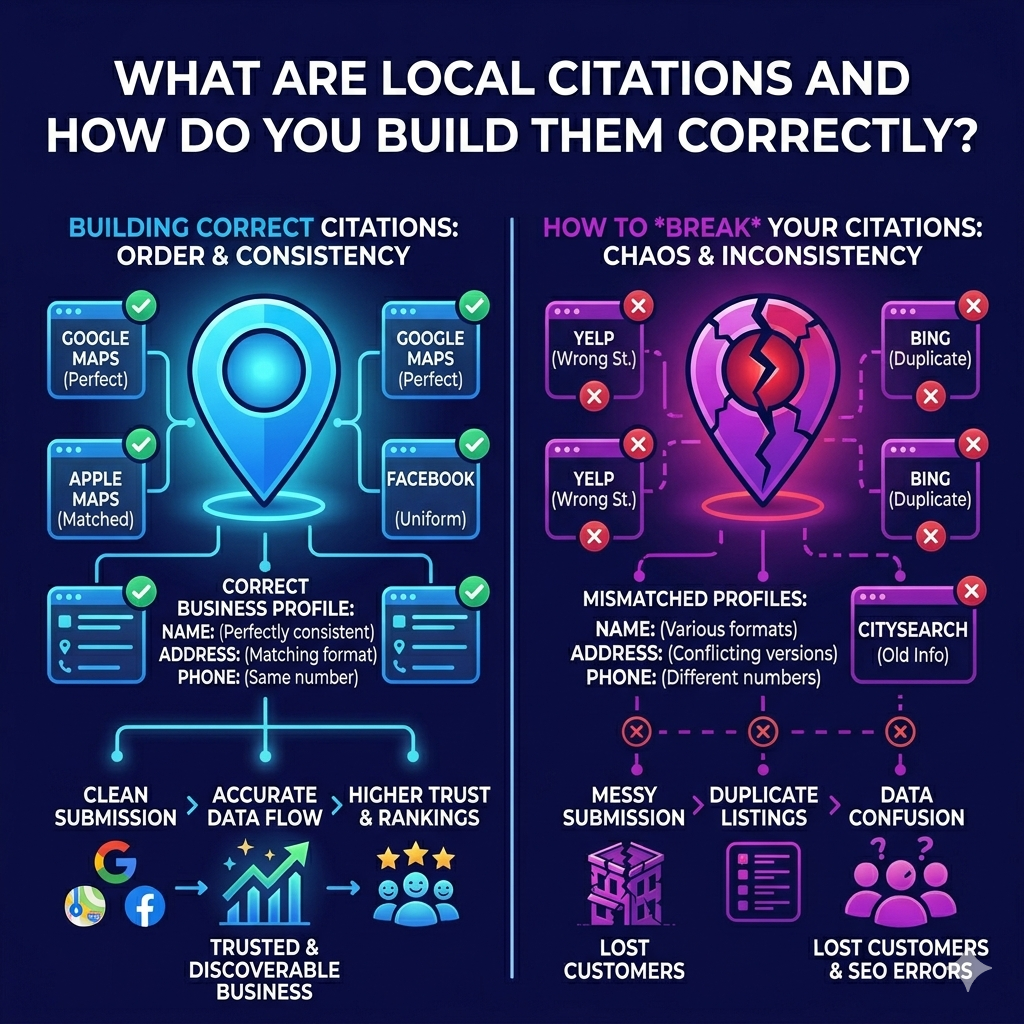
Local citations are online mentions of your business’s name, address, and phone number across the web. They appear in two forms: structured citations (directory listings like Yelp or Google Business Profile) and unstructured citations (blog posts, news articles, or social mentions). In today’s AI-driven digital landscape, citation building remains a powerful trust signal that reinforces your domain authority and local SEO performance.
Citations typically show up in these key places:
- Business directories and review platforms
- Local chamber of commerce websites
- Industry-specific listing sites
- Data aggregators that distribute your information broadly
Getting your citations placed correctly across these sources sends strong relevance signals to search engines. The citation building process becomes far more effective when approached systematically rather than randomly.
Follow these steps to build citations the right way:
- Gather all your business information, including the exact business name, full address, and phone number.
- Identify high-authority directories relevant to your industry and geographic location.
- Submit your business details manually or through trusted aggregator platforms.
- Track every submission inside a spreadsheet to monitor listing status.
Each citation you earn strengthens your local SEO footprint and signals credibility to both search engines and AI-powered discovery tools. A complete guide to local SEO citations always includes regular auditing to keep your listings accurate and competitive. When implemented strategically, local seo checklist for higher rankings helps you prioritize and maintain high-quality citations across all key directories. This structured approach ensures your business information stays consistent, boosts trust signals, and supports better visibility in local search results.
NAP Consistency: The One Thing That Can Make or Break Your Local Citations
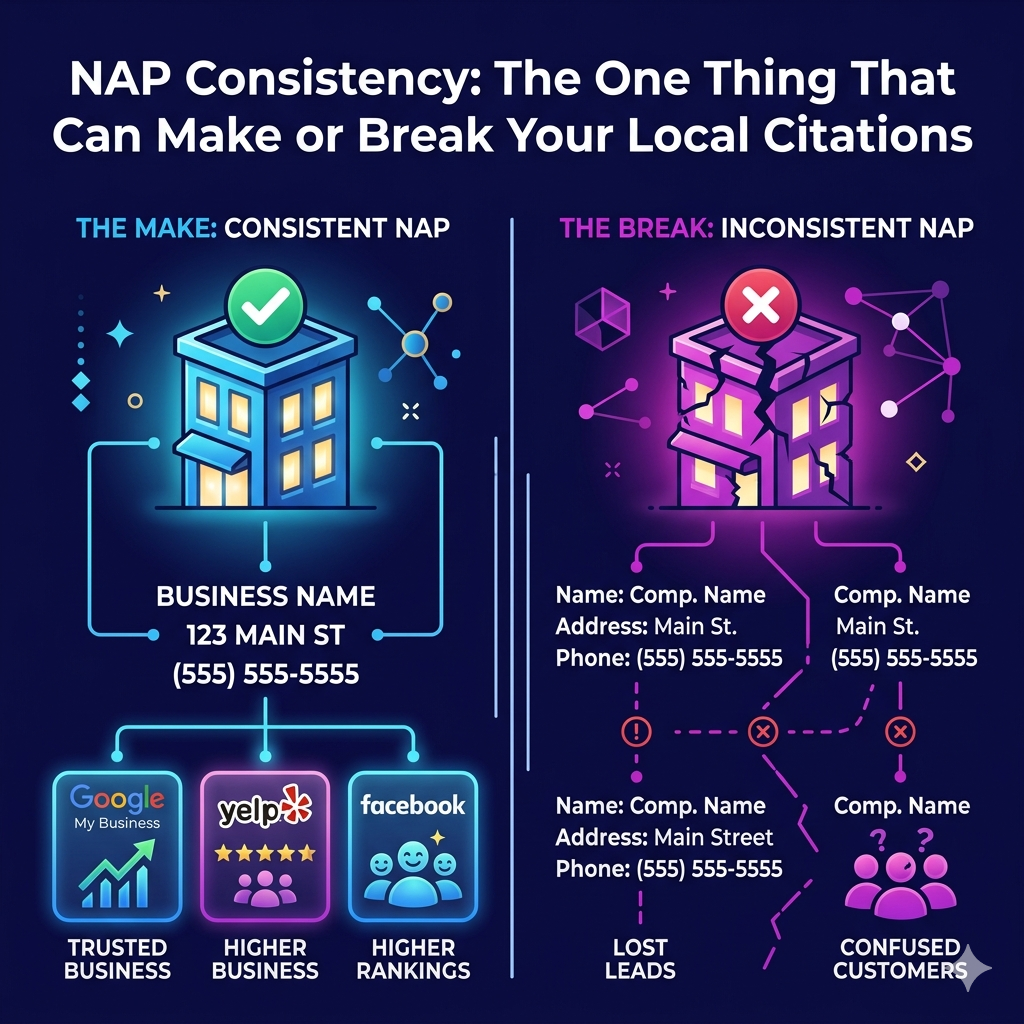
Your business name, address, and phone number form the holy trinity of local search — and search engines take this data very seriously. When your NAP data is inconsistent across directories, Google gets confused, your rankings take a hit, and potential customers end up calling your competitor instead. We’ve seen this pattern repeat across countless local businesses, and the culprit is almost always sloppy citation management.
Some of the most common sources of NAP inconsistency include:
- Abbreviations vs. full words — “St.” versus “Street” sounds harmless, but creates a data mismatch that search engines flag
- Old phone numbers left dangling across outdated directories like digital ghosts
- Business name variations, such as adding “LLC” or “Inc.” inconsistently across platforms
- Address formatting differences between suite numbers, floor designations, or unit labels
These inconsistencies chip away at your local authority score and erode trust signals that Google’s local algorithm relies on. Even one rogue listing with a wrong phone number undermines your entire citation profile.
Getting your NAP data squeaky clean requires a structured audit process. Here’s how to tackle it:
- Pull a full list of your existing citations using a reliable data aggregator review
- Standardize your exact business name, address format, and phone number in one master document
- Cross-reference every citation against your master record and flag discrepancies
- Submit corrections directly to major data aggregators like Data Axle and Foursquare for broad distribution
Which Citation Sources Actually Move the Needle for Local Rankings?
Let’s be real, building local citations can feel like shouting into the void. You could list your business on a thousand different websites, but only a handful are the cool kids that actually get Google’s attention. We’ve all learned that chasing every directory is a fool’s errand. Instead, smart local SEO focuses on the platforms that have the clout. It’s about quality over quantity, a VIP list for your business info. The goal is to be seen on the digital A-list, not just any old registry.
To make sense of this popularity contest, let’s break down where the real power lies. Think of it as choosing the right party to attend; some have all the influencers, while others are just… there.
Citation Showdown: Where to Place Your Bets
| Citation Type | Authority Level | Relevance Factor | Geographic Punch |
|---|---|---|---|
| Tier-1 Platforms | God-Tier | Broad | Strong (But Global) |
| Industry-Specific | Niche Famous | Laser-Focused | Varies |
| Local & Regional | Hometown Hero | Varies | Hyper-Specific |
These factors directly influence how much SEO juice a citation gives you. Think of Google Business Profile, Yelp, and Apple Maps as the undisputed champions in the Tier-1 category. They hold immense authority and are foundational for visibility. Then, you have the specialists.
- Industry-specific directories are like your business’s fan club. A listing on Houzz for a contractor or Avvo for a lawyer screams relevance to search engines.
- Local directories, such as the chamber of commerce, act as your neighborhood’s official stamp of approval, powerfully signaling your geographic roots.
- High domain authority from any source essentially acts as a letter of recommendation, boosting your business’s credibility in the eyes of search engines.
How to Find and Fix Duplicate or Incorrect Citations Before They Hurt Your Rankings
Duplicate and incorrect citations are like the evil twins of your business profile, running amok online and telling everyone you’ve moved into a swamp. These digital doppelgängers don’t just confuse potential customers; they actively sabotage your local SEO. Search engines see this conflicting information and might just throw up their hands, penalizing your rankings or, worse, splitting your hard-earned authority between multiple listings. We’ve seen this chaos lead to fragmented customer reviews and a serious drop in trust, ultimately impacting revenue and foot traffic.
It’s time to go on a digital scavenger hunt to clean up this mess. Think of it as a citation audit, but with more detective work and less boring paperwork. Here’s how you can track down every last rogue listing:
- Put on your detective hat and start with manual searches. Scour major platforms like Google, Yelp, and Bing for your business name, including any old variations. You’d be surprised what ghosts of business-past are still lurking.
- Bring in the professionals—the automated citation audit tools. Services from Moz Local, BrightLocal, or Whitespark can scan countless directories way faster than a human, sniffing out inconsistencies you might have missed.
- Go straight to the source by checking the main data aggregators. Companies like Acxiom and Factual feed information to hundreds of other sites, so correcting an error here can have a widespread effect.
Once you’ve rounded up the usual suspects, it’s time for the final showdown. The next phase is all about taking back control and setting the record straight.
- Claim Your Turf: Start by claiming your official listings on essential platforms like Google Business Profile and Yelp. This gives you the keys to the castle, allowing you to edit information and prevent unauthorized changes.
- Correct and Conquer: Log in to your claimed profiles and update any incorrect info. If you can’t claim a listing, submit a correction request directly to the platform’s support team.
- Eliminate the Duplicates: Most sites have a “report duplicate” button. For the stubborn ones, a polite but firm email to the webmaster is your next move. When direct removal isn’t an option, contacting their support teams is the best way to request a merge or deletion.
Choosing Between Local Citation Tools and Services for Your Business
So, you’re ready to tackle the wild world of local listings. The big question is: do you grab the steering wheel yourself with some shiny software, or do you hire a chauffeur to handle the driving? Let’s break down your options.
Citation Management Tools (The DIY Dream… or Nightmare?)
Think of DIY software as your personal robot butler for citations. You tell it what to do, and it zips off to manage local citations across the web. To boost local SEO with citations, these tools are fantastic, but you’re still the one in charge.
- The Good Stuff: You get total control, automation for days, and cool reports that make you look like a data wizard.
- The Catch: Some can have a subscription fee that stings a little, and you’re the one who has to learn how to use the gadget.
Outsourced Citation Services (The “Done-for-You” Magic)
This is the “sit back and relax” option. You hire a team of citation ninjas who handle everything from finding errors to manually submitting your info. They often act as a human local citation builder, ensuring everything is pixel-perfect.
- The Perks: Saves you a ton of time, taps into expert knowledge, and is great for cleaning up a massive mess of inconsistent listings.
- The Trade-off: It can be pricier, and you’re handing over some control to the pros.
How to Decide: The Ultimate Showdown
Choosing between a tool and a service really comes down to a few simple things. It’s like deciding between cooking a gourmet meal yourself or ordering fancy takeout. To truly optimize local citations, you need the right approach for your situation.
- Budget: Are you on a shoestring budget or ready to make it rain?
- Time & Team: Do you have the time and in-house know-how, or is your team already swamped?
- Control Freak Level: Do you need to be in the driver’s seat for every single decision, or are you happy to delegate?
Citation Building for Multi-Location Businesses: What Changes and What Doesn’t
Managing citations across multiple locations is honestly a beautiful chaos — and we’ve seen businesses lose rankings simply because they treated every branch like a copy-paste job. Each location deserves its own structured identity in the local search ecosystem.
Here are the most common mistakes multi-location businesses make:
- Using the same phone number across all locations instead of unique, location-specific numbers
- Submitting identical business descriptions without any location-relevant customization
- Ignoring category selections that reflect each branch’s actual services
These errors signal inconsistency to search engines, and search engines are brutally unforgiving about that. Getting your citation structure right from the start saves enormous cleanup headaches later.
Follow these steps to build citations correctly for each location:
- Create a dedicated landing page for every physical location before submitting to any directory.
- Assign unique, verifiable contact details — address, phone number, and URL — to each location profile.
- Submit each location individually to high-authority, industry-relevant directories.
- Audit each location’s listings quarterly to catch drift, outdated hours, or ownership changes.
What doesn’t change across locations is your brand-level consistency: business name formatting, brand voice, and category alignment stay uniform. The business name must appear identically across every platform — no abbreviations, no creative spelling, no surprises. Multi-location citation management isn’t glamorous work, but it’s the structural backbone of your entire local presence strategy. Teams that treat every location as its own citation entity consistently outrank competitors who wing it.
Frequently Asked Questions
Local SEO citation building is the process of creating and managing online mentions of your business across directories, maps, and review platforms. These listings typically include your business name, address, and phone number (NAP) to help search engines verify business legitimacy and improve local visibility.
NAP consistency helps search engines trust that your business information is accurate across the web. Inconsistent business details can create confusion, reduce trust signals, and weaken your ability to rank in local search results and map packs.
Yes. While citations are no longer a standalone ranking shortcut, they remain foundational for local SEO. Accurate citations strengthen entity trust, validate business data, and support visibility in Google Business Profile and local search results.
The most important citation sites typically include Google Business Profile, Yelp, Apple Maps, Bing Places, Facebook, Better Business Bureau, and relevant industry directories. The best citation sources depend on your industry and target location.
There is no fixed number, but most businesses benefit from focusing on 20–50 high-quality, accurate citations rather than hundreds of low-quality directory listings. Quality and relevance matter more than quantity.
Structured citations appear in business directories with dedicated listing fields for NAP data, while unstructured citations are business mentions found in blog posts, news articles, local guides, and other content without formal listing formats.
Yes. Duplicate listings, outdated phone numbers, old addresses, and inconsistent business names can dilute business trust signals and negatively affect local rankings, especially for map pack performance.
Businesses should audit citations at least quarterly or whenever they change locations, phone numbers, hours, or branding. Regular audits help catch duplicates, outdated listings, and incorrect directory data.
Citation building services can save time and improve listing consistency when managed correctly. The best providers focus on accuracy, directory quality, and ongoing maintenance instead of mass submissions to low-value directories.
Citation management is the ongoing process of monitoring, updating, correcting, and optimizing business listings across directories to maintain consistent business data and maximize local search visibility.