
To dominate the Map Pack, lock in NAP consistency, pick “Tire Shop” + alignment/brakes as categories, and target high-intent “near me” keywords with geo pages. Earn a 4.6+ rating via fast review requests and 24-hour responses. Post weekly GBP offers with UTM links, real-time hours, and geo-tagged photos. Audit citations (Bing, Yelp, aggregators) and fix duplicates. Track calls, direction requests, and ZIP-level ROAS with dynamic call tracking. Then use those insights to outpace nearby competitors fast. Read more below to get a better understanding of tire shop marketing ideas.
Map Pack Ranking Factors Every Tire Dealer Must Master
Even with strong site SEO, you won’t win the Google Map Pack without nailing the core local signals: proximity, relevance, and prominence. Prioritize ranking optimization with precision: tighten NAP consistency across citations, use a geo-specific primary category (Tire shop), and add service attributes (wheel alignment, flat repair). Build prominence through a steady cadence of local reviews; target a 4.6+ average and mention neighborhoods in responses.
Deploy map pack strategies that move needles: publish Google Posts tied to city events, add UTM parameters, and track impressions/calls in GBP Insights. Upload geotagged photos of inventory and installations weekly. Structure location pages with embedded maps, driving directions, and localized schema. Acquire links from chambers, auto clubs, and sponsorships. Measure lift via rank trackers using ZIP-level grids.
Keyword Research for High-Intent Tire and Auto Services
Start by targeting map-pack intent keywords that signal buyers are ready to book, such as “tire repair near me,” “24-hour tire shop,” and “wheel alignment same-day.” Layer service + geo modifiers to capture local demand: “winter tire installation Chicago,” “brake service Denver,” “run-flat tires Miami.” Use search volume, CTR, and proximity data from GMB Insights and keyword tools to prioritize phrases that rank within 3 miles of your shop and convert.
Map-Pack Intent Keywords
While broad keywords can drive impressions, you’ll win the Google Map Pack by targeting high-intent, geo-modified queries that signal immediate need—terms like “tire repair near me,” “flat tire service [city],” “24-hour tire shop [ZIP],” “wheel alignment [neighborhood],” and “mobile tire change [city].” Analyze your GMB/GBP Insights and Search Console to surface queries with high local impressions and calls, then layer on city, neighborhood, and landmark modifiers (e.g., “near [mall],” “[highway] exit”).
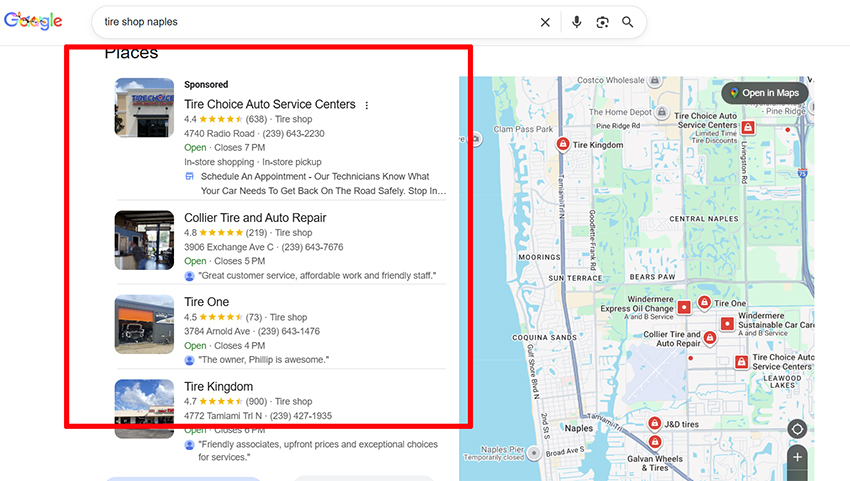
Cluster keywords by service + urgency: repair, replacement, alignment, rotation, balancing, roadside assistance. Prioritize “near me,” “open now,” and “same-day” variants with high call-through. Map each cluster to a dedicated page and GBP service, aligning titles, CTAs, and attributes for map pack optimization. Use UTM-tagged GBP links to validate conversions. Build topical depth by answering FAQs on costs, ETA, and warranty. Track rankings by ZIP and neighborhood to identify gaps, then deploy internal links and localized reviews to win local search.
Service + Geo Modifiers
You’ve identified map-pack intent; now expand it into a scalable list of service + geo modifiers that mirror how customers search in the moment. Build combinations like “mobile tire repair near [neighborhood]” or “[city] winter tire installation” to align search intent with your service area. Use keyword modifiers (city, ZIP, neighborhood, landmark) to sharpen local targeting and geographic relevance. Run competition analysis to prioritize gaps, then deploy optimization techniques in titles, H1s, and internal links to lift business visibility.
- “Run-flat tire replacement [ZIP]” — urgent, high-intent, measurable conversions.
- “Brake repair near [landmark]” — precise local targeting, minimal waste.
- “All-season tires [city] same-day” — speed-driven clicks, stronger CTR.
- “Wheel alignment [neighborhood]” — hyperlocal relevance, repeat visits.
Google Business Profile: Conversion-Focused Setup and Optimization
Because tire shoppers often decide within hours, optimize your Google Business Profile (GBP) to convert nearby searchers at the moment of intent. Start with Google My Business category accuracy (Primary: Tire Shop; Secondary: Wheel Alignment, Auto Repair). Execute Profile Optimization: add UTM-tagged URLs, services with prices, real-time hours, and geo-specific attributes like “Free Parking” or “Drive‑Thru.” Enable messaging and call tracking to quantify Customer Engagement.
Use Visual Content strategically: upload 10–15 geo-tagged photos monthly—tire inventory, mounting/balancing, before/after alignments—and a 30‑second shop tour video. Publish GBP Posts weekly with limited-time offers and city names. Build Products for top tire SKUs with pricing and availability. Activate Booking/Requests for same‑day installs. Monitor Insights: calls, direction requests, and discovery queries by city to double down on high-converting neighborhoods.
Review Generation, Response, and Reputation Management
Build a streamlined request strategy that texts every customer within 2 hours of service with a short link to your city-specific Google review page; shops doing this see 2–3x more reviews in 30 days. Use a timely response playbook: reply to all reviews within 24 hours, mention the service and location (“flat repair in Mesa”), and include a soft CTA for return visits. Track response time, star trends by ZIP code, and keywords mentioned so you can correct issues and boost local ranking signals fast.
Streamlined Request Strategy
Although tire shoppers rely on proximity, they choose shops with strong, recent reviews in their city, so implement a streamlined request strategy that reliably generates, monitors, and responds to feedback. Trigger review requests via streamlined customer communication immediately after service, tied to efficient appointment scheduling and POS timestamps. Use geo-specific links (Google, Apple, Yelp) and UTM tags to measure city-level conversions. Automate reminders at 24/72 hours, cap at 2 touches, and route negatives to private resolution.
- Win trust fast—deliver personalized SMS with city and service details to spark authentic responses.
- Protect ranking—maintain steady monthly review velocity across priority neighborhoods.
- Reduce friction—one-tap links and QR codes onsite boost completion rates by over 30%.
- Prove impact—dashboard cohorts show review growth by ZIP, service type, and technician.
Timely Response Playbook
When reviews hit your profiles, respond fast and locally to convert searchers in your ZIP codes and protect map-pack rank. A 24-hour reply window correlates with higher visibility, so lock in SLAs by platform. Lead with neighborhood cues: mention the street, cross-streets, or service bay to reinforce proximity signals. For five-star reviews, amplify keywords (tire rotation, flat repair, alignment) and invite timely follow-ups to sustain customer engagement.
For less-than-perfect reviews, triage by severity: safety issues within 2 hours, pricing disputes within 12. Move specifics offline, then close the loop publicly with the resolution. Automate alerts via GMB, Yelp, and Facebook, and tag themes in a CRM. Track response time, review velocity, and star-average by ZIP. Iterate weekly to neutralize noise and compound trust.
Local Content Strategy That Drives Calls and Directions
Because searchers want nearby solutions now, your content should target high-intent, location-specific queries that trigger “Call” and “Directions” actions. Build pages and posts around queries like “flat tire repair near [Neighborhood]” or “24/7 tire shop by [Landmark].” Publish geo-tagged service updates, showcase local events you support, and highlight community partnerships to boost relevance and trust. Use real wait times, inventory by size, and on-site photos with EXIF geo-data.
- Relief: “We’re 6 minutes away—tap Directions, and we’ll prep your bay now.”
- Confidence: “Verified 4.9 rating from 327 drivers in [ZIP].”
- Urgency: “Roadside help ETA 15 minutes in [District]. Call now.”
- Pride: “Local events sponsor keeping [City] rolling.”
Measure clicks-to-call, direction requests, CTR by neighborhood, and conversion by page.
Citations, NAP Consistency, and Data Aggregator Cleanup
Blueprint: Lock down your tire shop’s NAP (name, address, phone) the same across Google Business Profile, Apple Maps, Bing, Yelp, Facebook, and top industry sites, then push that canonical data through aggregators (Data Axle, Neustar Localeze, Foursquare, and Yelp/OpenStreetMap).
Run a citation audit to identify duplicates, inconsistencies, and legacy listings tied to outdated phone numbers or suite numbers. Prioritize fixes in your primary city, then expand to nearby suburbs you serve.
Standardize NAP formatting (ST vs. Street), hours, categories (Tire Shop, Tire Repair), and services. Execute aggregator submissions to overwrite stale data at scale, then manually update high-value directories. Suppress duplicates and request merges.
Track impact: impressions, calls, and directions from Google Business Profile, plus ranking gains for “tire shop near me” within 1–5 miles. Recheck quarterly to prevent data drift.
Geo-Targeted Link Building and Partnerships
How do you earn links that move the needle within a 5–10 mile radius of your tire shop? Build geo-targeted partnerships that produce measurable authority and referral traffic. Start with a radius report: list chambers, neighborhood associations, auto clubs, tow yards, detailers, and fleet managers. Pitch co-branded content (seasonal tire guides, pothole alerts) and offer data: average flat repairs by ZIP, winter tire installs by week—secure links on partner blogs, event pages, and resource directories with city and neighborhood anchors.
- Sponsor a Little League or first-responder fundraiser; earn a homepage logo link.
- Launch local influencer collaborations, testing tread wear; publish results.
- Host a “Free TPMS Check Week”; get listed on city calendars.
- Create a “Road Hazard Map” microsite; invite nearby businesses to embed and link.
Call Tracking, UTM Tagging, and ROI Measurement
Even if your phones ring nonstop, you can’t optimize local spend without tracking every source by neighborhood. Assign dynamic numbers by ZIP code and campaign, then feed call recordings and Call analytics into your CRM. Use tracking software to tag outcomes: appointments booked, tire size requested, revenue. Add UTM parameters to every GBP post, Local Services ad, and geo-targeted landing page. Audit Conversion metrics weekly: call-through rate, qualified-call rate, booked-job rate, average ticket, and cost per booked appointment by neighborhood.
Build ROI strategies around actual margin. Attribute revenue to first click (map, ad, organic) and last touch (call, chat). Score calls with AI to flag price shoppers vs. emergencies. Double down on neighborhoods producing >20% ROAS lift; pause sources generating low-intent, sub-two-minute calls.
Multi-Location Playbook: Scaling Local SEO Across Markets
Although each shop serves a unique neighborhood, you need one scalable framework that enforces consistency while localizing for demand signals. Start with market analysis to segment territories by tire demand, vehicle mix, weather, and commuter flows. Build a master NAP schema, GBP SOPs, and UTM conventions, then localize services, inventory cues, and promos to each micro-market. Standardize citation management, review prompts, and geo-tagged photos. Feed inventory, pricing, and wait-time data into location pages to boost relevance and conversion—critical during franchise expansion.
- Win the block: outrank rivals within a 1–3 mile radius and feel the surge of walk-ins.
- Earn trust: consistent data turns searches into calls.
- Capture storms: seasonality-ready pages convert urgency.
- Scale smarter: replicate wins, kill noise, and dominate maps.
Conclusion
So, you want to “accidentally” dominate the Map Pack? Funny—because when you nail keywords, tighten NAP, optimize GBP for conversions, earn geo-relevant links, and track every call with UTMs, you’ll rank “by chance.” Stack reviews, publish location pages with service + city intent, clean citations, and build local partnerships that pass authority. Then measure ROI per market and scale the winners. Do this, and your competitors will wonder how luck keeps calling your tire shop.