Why Branding Matters More Than Ever in the AI Search Era
Branding matters more in the AI search era because you’re judged before the click. AI surfaces summaries, citations, reviews, and “best for” lists, so you win when your name, claims, and proof stay consistent across trusted sources. Generic “best-in-class” messaging gets compressed and blurred, but sharp positioning, expert-led authority, and verifiable outcomes get repeated. Track share of answer, sentiment, and citation quality, and you’ll see what to fix next.
What AI Search Shows Before Your Website
Before a user ever lands on your site, what do they actually see in AI search? You’re being represented by summaries, citations, knowledge panels, review snippets, pricing callouts, and “best for” lists that compress your positioning into a few lines. If your claims aren’t consistent across trusted sources, the model fills gaps with whatever signals it can verify.
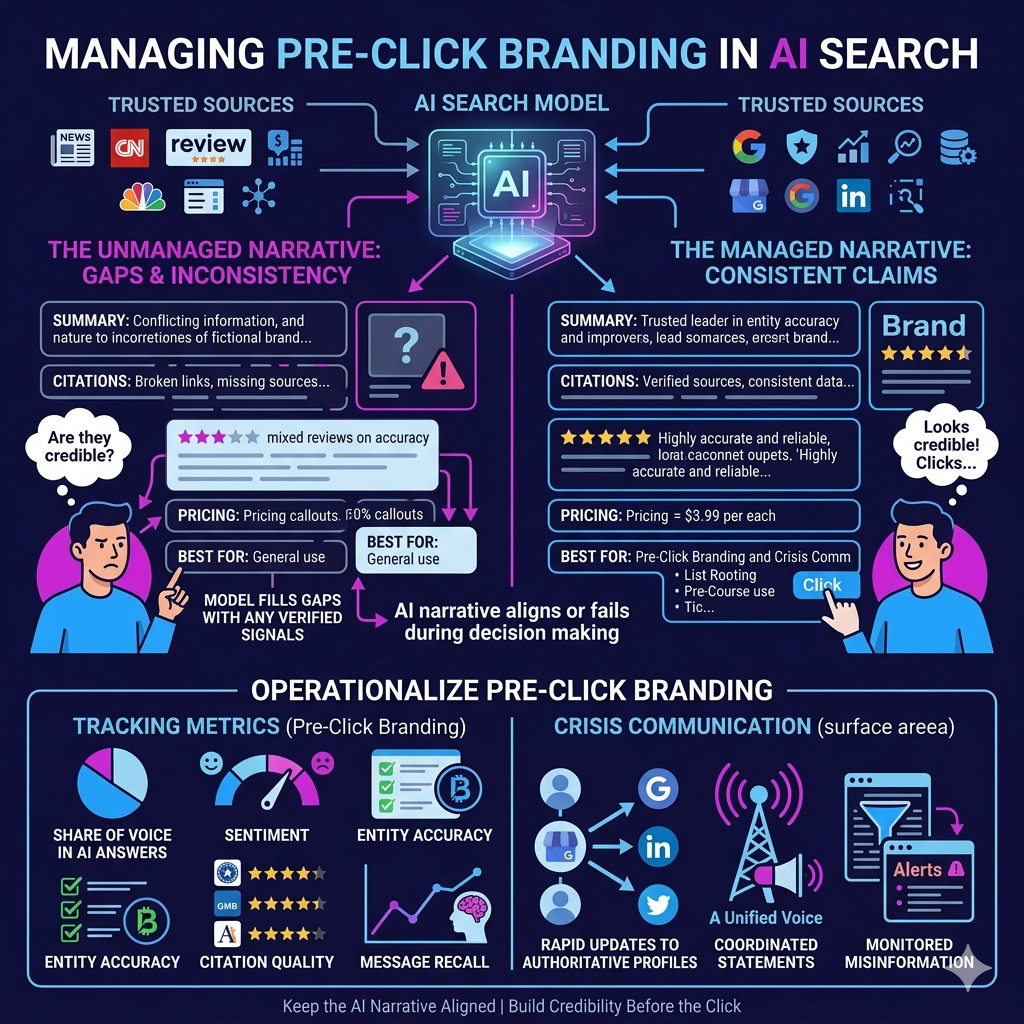
You can’t manage this layer with page tweaks alone. Track pre-click branding metrics: share of voice in AI answers, sentiment, entity accuracy, citation quality, and message recall. Then operationalize crisis communication for the same surface area—rapid updates to authoritative profiles, coordinated statements, and monitored misinformation—so the AI narrative stays aligned while users decide whether you’re credible.
Why Branding Wins When Clicks Drop
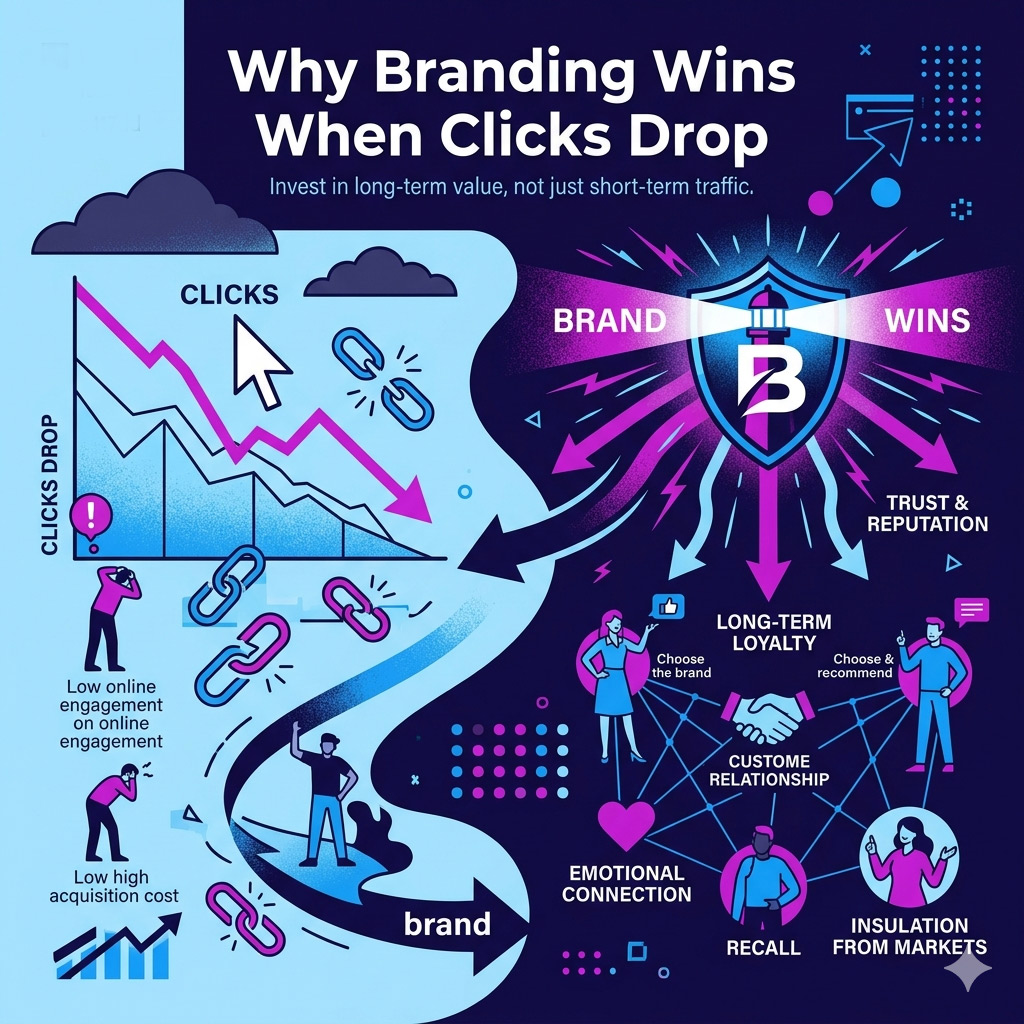
When AI answers push clicks down, you don’t win by chasing rankings—you win by being the name people remember. In a zero-click moment, your trust signals (credible reviews, consistent messaging, recognizable authority) drive the choice before anyone visits your site. If you’ve built real preference, it survives the SERP shift and keeps demand flowing even when traffic doesn’t.
Brand Recall Beats Rankings
As AI answers compress the search results into a single summary, rankings don’t guarantee traffic the way they used to. If users don’t click, you still need them to remember you—and recall is built long before the query. You win by engineering mental availability: consistent naming, distinctive visuals, repeatable product stories, and sharp category associations that AI can echo and users can recognize instantly. Track brand metrics like direct traffic lift, share of search, branded query growth, and unaided recall, then tie them to conversion and retention. Use that feedback loop to refine your competitive positioning: own a clear “why you,” not a generic feature list. When clicks drop, recall becomes the moat that keeps demand flowing to you.
Trust Signals Drive Choice
Even if an AI summary mentions you, users still choose the option that feels safest to act on, and that safety comes from trust signals your brand has banked over time. When clicks drop, you can’t rely on comparative browsing; you have to earn the “yes” instantly.
You do that by making credibility legible: consistent visual identity, clear pricing, strong guarantees, recognizable experts, and proof points that AI can’t fake. Data backs it: buyers overweight risk reduction in high-stakes categories, and familiar brands convert more because they’re mentally “pre-vetted.” If your reviews, security badges, and customer logos align across the board, you reduce uncertainty in seconds. That repeat reassurance compounds into brand loyalty, so when AI compresses choices, you’re the low-friction decision.
Preference Survives Zero-Click
Why does preference still decide outcomes when AI steals the click? Because the answer box can summarize facts, but it can’t replace your buyer’s mental shortlist. When users don’t visit ten sites, they default to what feels familiar, safe, and category-leading. That’s where brand consistency pays: the same promise, tone, and proof across every surface trains recognition at the moment of choice.
Zero-click shifts the battlefield from traffic to selection. You win when your name gets mentioned, cited, and remembered inside AI outputs and human conversations. Track citation velocity—how often your brand appears in trusted sources and model-visible content—and improve it with authoritative PR, expert bylines, and partner references. Make the decision effortless: clear positioning, distinctive assets, and repeatable value claims that AI can quote and people can trust.
How AI Chooses Brands to Mention
When an AI answer engine decides which brands to name, what signals does it trust? It tends to surface brands it can quickly verify across many sources, because it has to answer with confidence and speed. You influence that shortlist by making your footprint easier to triangulate and harder to contradict.
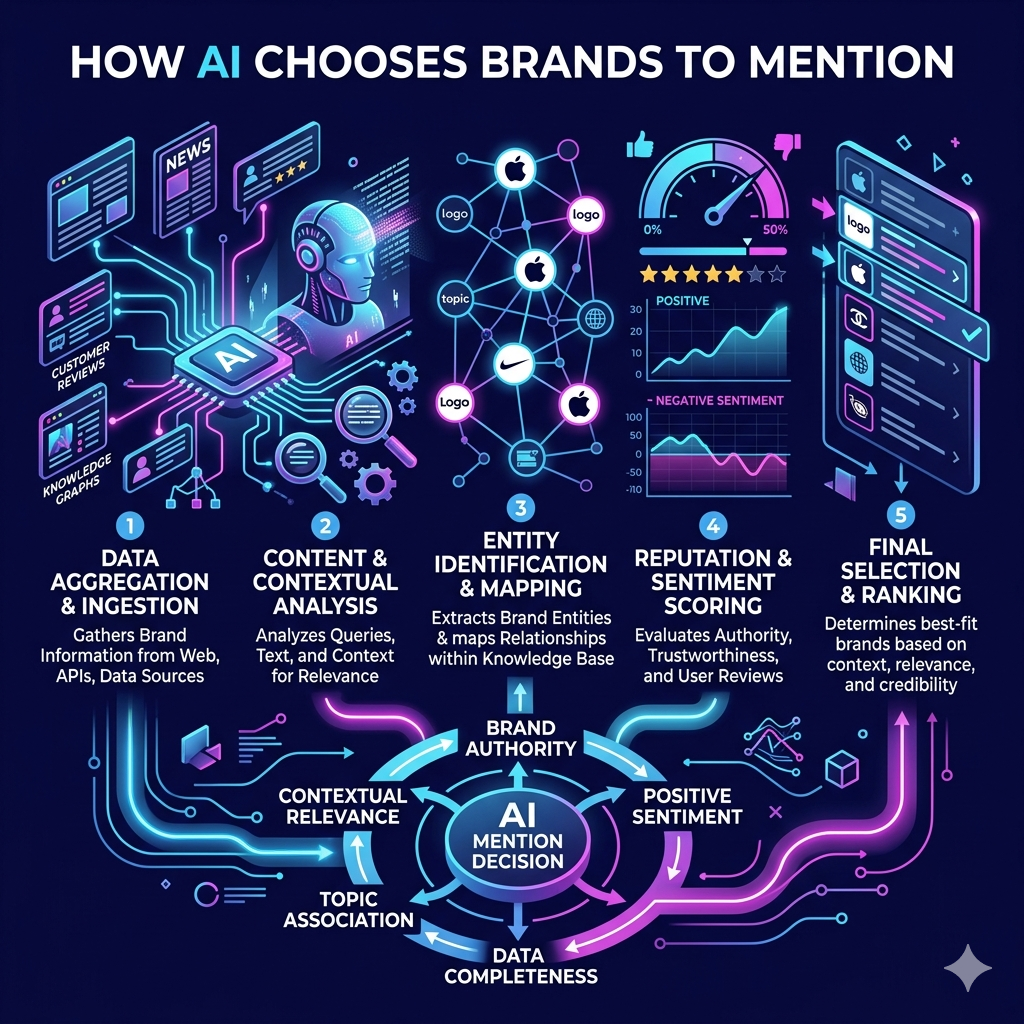
If your naming, positioning, and product claims vary by channel, the model hesitates; brand consistency reduces ambiguity and raises “mention-worthiness.” Just as important, citation velocity—how fast authoritative references to you accumulate—helps you look current, not legacy. You can’t rely on one big campaign; you need steady, compounding proof. Think in systems: align your narrative, ship updates that earn coverage, and ensure third parties can repeat you accurately. That’s how you get named.
Brand Signals AI Search Trusts (and Repeats)
To show up in AI answers, you need signals the models can verify and repeat: consistent brand mentions across reputable sources, not one-off spikes. You also need an authoritative content footprint—clear expertise, original research, and pages that earn citations and links over time. Finally, you’ll win more mentions when your brand connects to credible entities (people, organizations, categories) that AI systems already trust and can reliably map to you.
Consistent Brand Mentions
How often does AI “decide” your brand is the safe answer worth repeating? It happens when your name shows up predictably across the web with the same signals—logo, product naming, tagline, and descriptors—so models can cluster mentions and reduce ambiguity. That’s brand consistency shaping AI perception.
You can engineer this by standardizing how partners, press, listings, and communities reference you: one canonical company name, one product taxonomy, one short value line. Track mention volume and co-occurring terms, not just clicks, because LLMs learn from patterns, not intent. If your mentions fragment (old names, mixed acronyms, inconsistent categories), AI hedges or swaps you for a clearer competitor. Make every mention machine-readable and repeatable, at scale.
Authoritative Content Footprint
Consistent mentions make your brand legible; an authoritative content footprint makes it believable. You earn that belief when your content repeatedly answers the same high-value questions with depth, freshness, and consistent framing across channels. AI systems don’t just index pages; they infer patterns: topic coverage, update cadence, engagement signals, and whether you match author intent with clear outcomes.
Build a footprint by publishing flagship explainers, opinionated frameworks, and test-backed playbooks, then linking them into a coherent hub. Standardize your visual typography, voice, and terminology so summaries stay accurate when models compress your message. Use structured headings, concise definitions, and cited numbers to reduce ambiguity. When your content behaves like a reliable system, AI search repeats you.
Credible Entity Associations
Why do some brands get repeated by AI even when they don’t rank first? Because AI systems don’t just read pages; they resolve entities. If your brand is consistently linked to trusted people, organizations, products, and categories across the web, you create credible entity associations that models can safely reuse. That’s brand credibility at machine speed.
You strengthen those associations by aligning your name, founders, locations, and offerings across your site, Wikipedia-style references, Crunchbase, LinkedIn, app stores, and reputable press. You also earn entity signals through citations, co-mentions, awards, partnerships, and consistent schema markup. Track them like growth metrics: mention velocity, source authority, and topic consistency. When those signals converge, AI summarizers pick you as the “safe” answer—and repeat you.
How to Prove E-E-A-T in an AI Summary
In AI summaries, credibility gets compressed into a few lines—so where does your trust signal show up? You can’t rely on tone; you must surface verifiable proof that survives e e a t evaluation and lifts AI summary credibility. Treat every snippet as a micro-audit: can a model confirm who you are, what you’ve done, and why it’s reliable—fast?
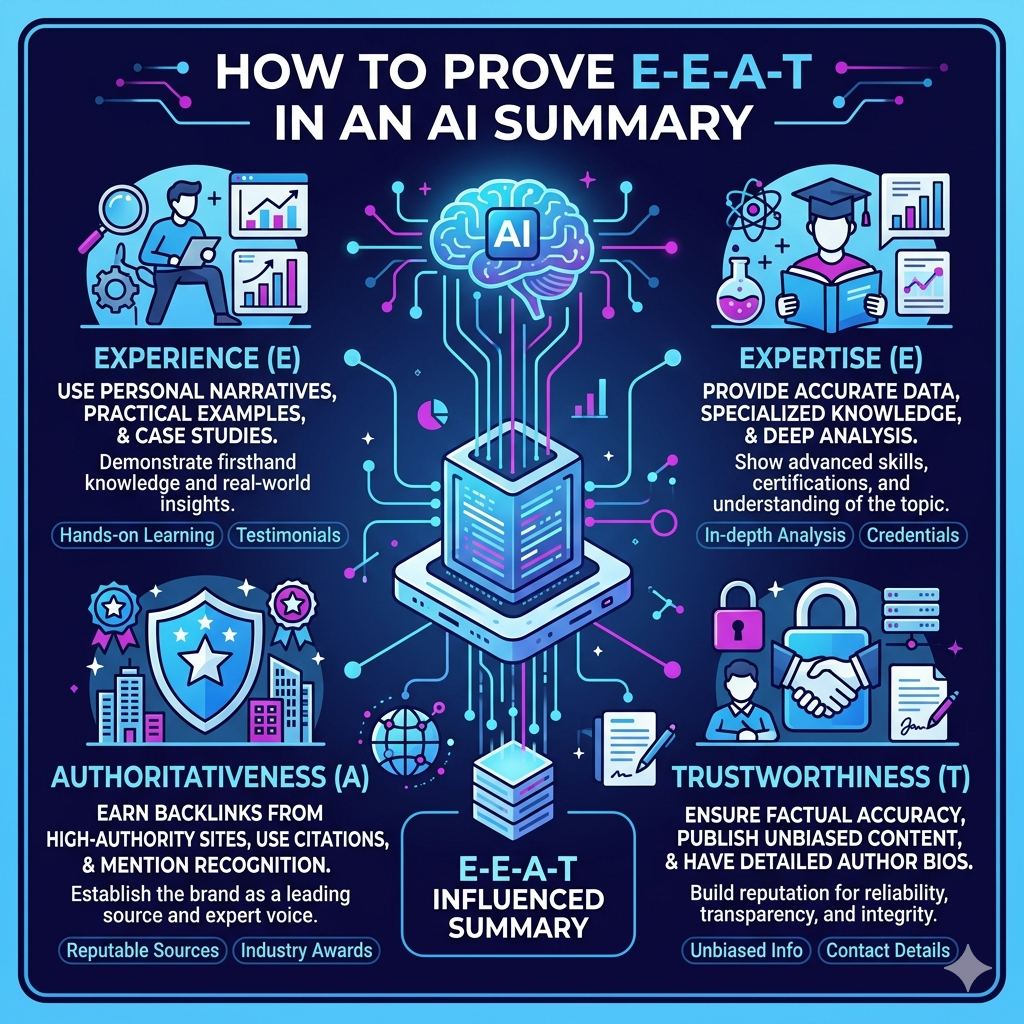
- Put named experts front and center, with roles, credentials, and traceable bios.
- Cite primary data, methodology, and dates; don’t bury sources behind vague claims.
- Show real-world experience: case outcomes, constraints, and measurable impact.
- Publish consistent entity signals across your site, profiles, and citations.
When these cues repeat across channels, models compress you into “trusted,” not “generic.”
Write the “AI-Ready” Brand Narrative and Proof
Proving E-E-A-T gives you the receipts; now you need a brand narrative that AI can compress without losing the point—or the proof. Treat it like an executive abstract: who you serve, what you change, how you do it differently, and why it’s credible—stated in plain language.
Build AI readiness by pairing every claim with a verifiable artifact: benchmarks, methodology notes, customer outcomes, and third-party validation. Use consistent numbers, not adjectives; AI models summarize what they can quantify. Codify three “always-true” pillars, then attach proof points and a one-line takeaway to each. Write in reusable modules (50–80 words), so summaries stay accurate under truncation. If your story can’t survive compression, it won’t survive AI search.
Align Branding Across Sources AI Search Pulls From
Consistency becomes your competitive edge when AI search stitches answers from dozens of places at once. If your site says one thing, your app another, and review sites something else, the model averages you out. Fix that with brand mapping: inventory every surface AI can read, then align the same promises, terms, and product facts across all channels. Pair it with data governance, so updates propagate fast, approvals stay tight, and contradictions don’t ship. Track drift like you track performance—because it is performance in AI results.
- Audit top citations: docs, FAQs, listings, marketplaces
- Standardize naming, benefits, and proof points across channels
- Version-control claims, specs, and policies with owners and SLAs
- Monitor AI-visible mentions for variance and resolve within days
Avoid Generic Positioning AI Can’t Distinguish
Why does “all‑in‑one,” “best‑in‑class,” or “innovative” hurt you more in AI search than in classic SEO? Because AI systems compress you into vectors, summaries, and side‑by‑side comparisons where vague claims collapse into sameness. If your positioning sounds like everyone else’s, the model can’t reliably separate you, so it defaults to whoever has clearer, repeated signals.
You win by giving the model sharp, testable distinctions: a specific job you own, a named method, a distinctive promise, and proof points tied to outcomes. Lock that into your brand voice across every snippet AI might quote, and reinforce recognition with logo consistency wherever your product appears. Replace empty superlatives with concrete language, proprietary terms, and customer‑mirrored phrasing that’s hard to substitute.
Measure Branding Impact in AI Search Results
How do you know your branding actually shows up when an AI answers for you? You measure it like a product metric: consistent prompts in, consistent brand signals out. Start by defining a brand taxonomy—names, categories, benefits, proof points—then test how often models return those elements across platforms and query types. Track whether your visual identity survives in AI-generated previews, citations, and image results.
- Share-of-answer: % of relevant queries where you’re named first
- Attribute recall: which taxonomy terms does AI repeat accurately
- Citation quality: domains, recency, and specificity of sources used
- Sentiment + differentiation: Does the summary match your positioning
Run weekly audits, log deltas, and tie changes to content or PR moves.
A 90-Day Plan to Grow AI Search Mentions
In the next 90 days, you’ll grow AI search mentions by tightening your entity signals and locking in a narrative that models can consistently attribute to you. Then you’ll expand your structured content footprint—schema, FAQs, knowledge assets, and consistent publisher profiles—so retrieval systems have more high-confidence paths back to your brand. Finally, you’ll accelerate mention and citation velocity with targeted PR, partner co-marketing, and expert contributions, tracking weekly lift in attributed mentions, linked citations, and branded query growth.
Establish Entity And Narrative
Where do AI search engines look first when they decide whether to mention your brand? They scan for a stable entity they can trust: consistent names, aligned claims, and repeatable proof across the open web. In your first 90 days, you’re not chasing rankings—you’re building a machine-readable story through branding consistency and rigorous entity mapping.
Focus on signals that reduce ambiguity and increase confidence:
- Lock one canonical brand name, tagline, and descriptor set
- Align leadership bios, product positioning, and customer outcomes
- Seed verifiable third-party mentions (partners, associations, analysts)
- Track the share of voice in AI answers and refine the narrative
Treat every touchpoint as training data. When your narrative stays coherent, AI systems cite you more often—and with fewer hallucinated details.
Expand Structured Content Footprint
Why do AI search engines keep surfacing the same brands—even when your product outperforms them? Because models reward brands with dense, machine-readable signals. In the next 90 days, expand your structured content footprint so you’re easier to identify, compare, and trust across the web.
Start with a schema-first audit: Organization, Product, FAQ, HowTo, Reviews, and SoftwareApplication. Then standardize your entity fields—name, founders, locations, pricing, availability, and category—across site pages, app listings, docs, and partner directories. Publish “single-source-of-truth” explainers that map features to outcomes, include measurable benchmarks, and disclose limitations. Add a transparent data ethics section describing training data boundaries, consent, retention, and mitigation plans for privacy risks. Finally, validate markup, fix crawl gaps, and monitor rich-result eligibility weekly.
Accelerate Mention And Citation Velocity
How do you get AI search engines to “notice” you fast when they already favor entrenched brands? You engineer an accelerator cadence that spikes credible mentions and lifts citation velocity within 90 days. Don’t chase virality; chase repeated, verifiable references across sources LLMs trust. Set weekly targets, track share of voice, and iterate based on what gets quoted.
- Ship 2 “quotable” assets weekly: benchmarks, calculators, or original mini-studies
- Pitch 10 niche publications and podcasts per week with one data point + angle
- Seed 20 expert comments weekly on relevant articles, forums, and LinkedIn threads
- Convert wins into structured citations: press pages, author bios, and Wikipedia-safe references
Frequently Asked Questions
How Do Trademarks and Brand Names Affect AI Search Visibility?
Trademarks and brand names boost your AI search visibility by giving models unambiguous entities to recognize, cite, and recommend. When you invest in trademark strategy, you reduce confusion with lookalikes and strengthen attribution across sources. Smart brand naming improves recall and increases consistent mentions, which often correlate with higher brand visibility in summaries and assistants. Because AI search dynamics reward consistency, you should align names, domains, schemas, and citations across the board.
What Branding Investments Deliver the Fastest ROI for Small Businesses?
You’ll see the fastest ROI by tightening your positioning, upgrading your website’s message, and systemizing reviews. Like a coffee shop that painted one bold sign and doubled foot traffic in a week, quick visibility lifts results fast. Invest in a crisp value proposition, consistent visuals, and a review engine (ask-after-purchase + QR). These moves build brand equity and customer trust, converting more clicks into sales without big ad spend.
How Can Regulated Industries Maintain Compliance While Strengthening Brand Voice?
You maintain compliance and strengthen brand voice by baking compliance governance into your content workflow—through pre‑approved messaging blocks, clear substantiation of claims, and fast legal SLAs. Build risk-aware branding with tiered voice guidelines to help teams innovate safely across channels. Use audit trails, version control, and AI-assisted review to cut cycle time while reducing errors. Track complaint rates and approval times, then adapt. Factor AI search implications into your search: ensure consistent, citable language.
Do Brand Colors, Logos, and Design Systems Influence AI Search Outcomes?
Like a telegraph in a cloud server room, yes—your brand colors, logos, and design systems can influence AI search outcomes indirectly. You boost brand color significance and logo recognition impact by improving recall, click-through, dwell time, and repeat queries—signals that many ranking and recommendation systems learn from. You also strengthen entity consistency across images, metadata, and UI patterns, which helps models connect mentions to your brand with higher confidence.
How Should Startups Rebrand Without Losing Existing AI Search Recognition?
You should rebrand in phases, not a big-bang switch, so you preserve legacy recognition while updating signals. Keep your name, URL structure, and core topical entities stable; change visuals and messaging gradually. For rebranding AI, publish clear transition content: announcements, FAQs, and updated schema, plus 301s where needed. Maintain consistent brand mentions across profiles and press. Monitor query-level impressions and citations, then iterate fast weekly.
Conclusion
In the AI search era, you’ll often get fewer clicks—because answers show up before your site does. You might think branding’s “fluffy” and hard to visualize, but it’s measurable: track how often AI summaries mention your name, link to you, and repeat your proof points. When you align your story, expertise, and customer proof across the sources AI pulls from, you become the default citation. That’s how you win visibility—even without the click.