
AI Generated Content for Shopify: 4 Ways to Automate Your SEO Strategy
Writing a unique meta description for every product in your Shopify store sounds straightforward until you have 500 products and realize it would take weeks. Writing alt text for every image, product descriptions for every SKU, and keeping it all fresh as your catalog grows isn’t a realistic manual task for most store owners.
This is exactly the problem AI generated content was built to solve for ecommerce businesses. Not to replace good writing, but to make it possible to maintain quality SEO across a large catalog without hiring a team of writers or spending every evening at a keyboard.
This guide covers four practical ways Shopify merchants can use AI-generated content to improve search rankings, increase click-through rates, and avoid the one thing every merchant fears: a Google penalty.
Summary
- Section 1: Why AI generated content is reshaping ecommerce SEO in 2026
- Section 2: Does Google penalize AI generated content
- Section 3: 4 smart ways to use AI generated content for Shopify SEO
- Section 4: Beyond content: speed and schema still matter
- Section 5: Best practices for keeping humans in the loop
- Section 6: Tools that make Shopify AI SEO practical at scale
Why AI Generated Content Is Reshaping Ecommerce SEO
The volume problem in ecommerce SEO is real. A Shopify store with 200 products has 200 product pages, each needing a unique title tag, meta description, and product description. Add collection pages, blog posts, and image alt text, and the total number of SEO elements requiring attention can reach into the thousands.
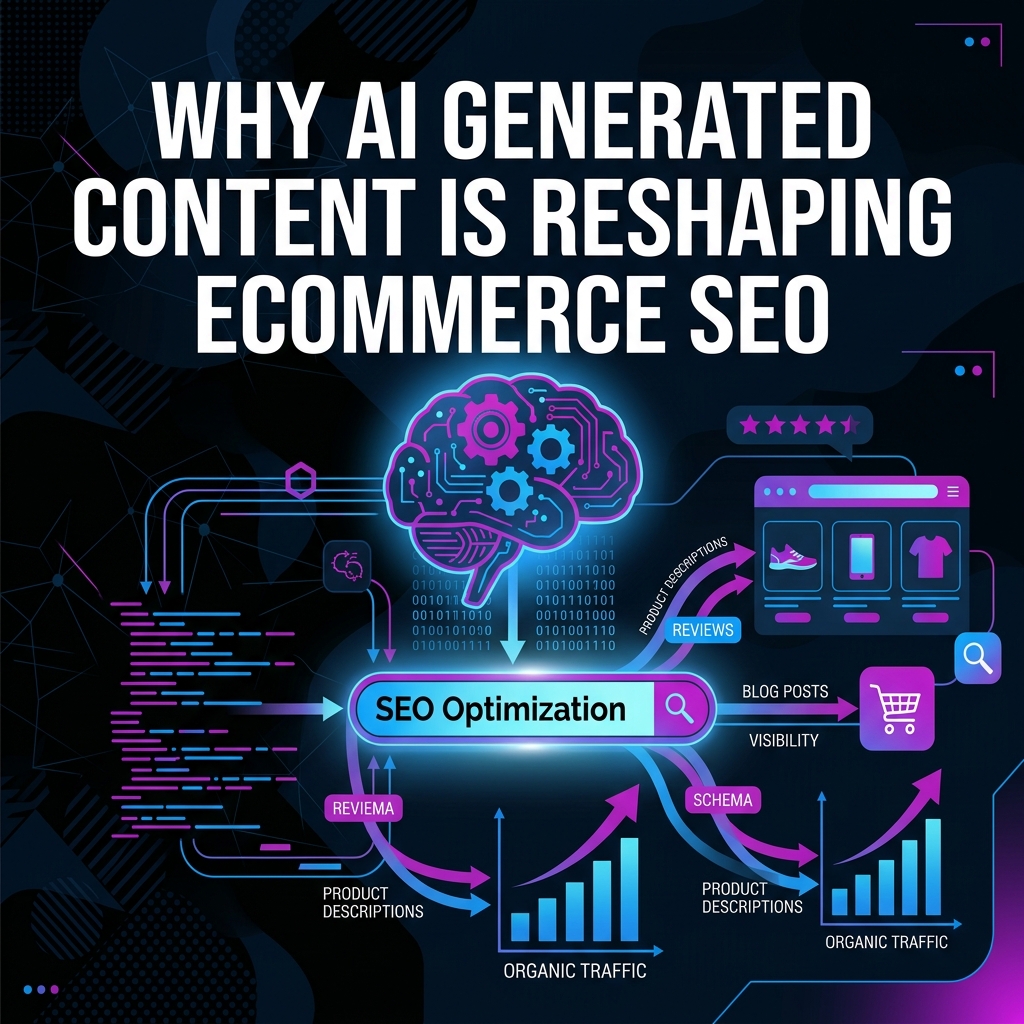
For most store owners, this creates a choice: do the work manually and move slowly, skip it and leave Google to guess what your pages are about, or use AI content optimization to do it efficiently and consistently.
The third option is winning. According to McKinsey research, generative AI can add significant value to marketing tasks by reducing content production time by 40% or more while maintaining consistency. For Shopify merchants, that time saving translates directly into more optimized pages, more targeted keywords, and more organic traffic over time.
The shift is also happening at the platform level. Shopify’s own ecosystem now includes multiple AI-powered SEO apps designed specifically to generate and apply content at scale across product pages, collection pages, and blog posts without requiring merchants to write each element manually.
What AI generated content handles well in Shopify SEO:
| SEO task | Manual time per page | AI generated time per page |
| Meta title writing | 5 to 10 minutes | Under 30 seconds |
| Meta description writing | 5 to 10 minutes | Under 30 seconds |
| Image alt text | 2 to 5 minutes per image | Under 10 seconds |
| Product description draft | 20 to 40 minutes | 1 to 3 minutes with review |
| FAQ section | 15 to 30 minutes | 2 to 5 minutes with review |
The math makes a compelling case for using AI generated content as part of any serious Shopify SEO strategy.
Does Google Penalize AI Generated Content
This is the question every merchant asks before adopting AI generated content, and the answer requires some nuance.
Google does not penalize AI generated content by default. Google penalizes low-quality content, regardless of whether a human or an AI produced it. The distinction matters because it means AI-generated content can be entirely safe and beneficial, provided it meets Google’s quality standards.
Google’s helpful content guidelines state that content should be created primarily to help people, not primarily to rank in search results. An AI-generated meta description that clearly communicates what a product is, who it is for, and why someone should click is useful content. A block of AI generated keyword spam that reads like random phrases assembled together is harmful content.
The same standard applies to both human-written and AI generated content. Penalties depend on intent and outcome, not the tool used to produce it.
Google’s stance in plain language:
Google’s documentation explicitly states that it rewards high-quality content that demonstrates expertise, experience, authoritativeness, and trustworthiness. It also explicitly supports automation, including AI, when it helps create content that serves users well. Google cites examples like automatically generated weather reports and sports scores as legitimate AI generated content that provides genuine value.
For Shopify merchants, this means:
AI generated meta tags that accurately describe products and include relevant keywords are not only safe but align with what Google wants. AI generated alt text that helps visually impaired users understand images is actively encouraged. AI generated product descriptions that expand on manufacturer details with unique benefits and buyer-focused language are entirely legitimate.
What crosses the line is using AI generated content to publish hundreds of near-identical pages, stuffing keywords into AI output without review, or producing content that answers no real question a shopper would ask.
4 Smart Ways to Use AI Generated Content for Shopify SEO
Way 1: Automate Meta Titles and Descriptions at Scale
The single highest-impact use of AI generated content for Shopify SEO is bulk generation of meta titles and meta descriptions. These two elements appear directly in Google search results and determine whether a searcher clicks your listing or a competitor’s.
Most Shopify stores leave meta descriptions blank, which means Google pulls whatever text it finds on the page, usually the first sentence of the product description. That default text is rarely optimized for click-through rate, rarely includes the primary keyword in the right position, and rarely includes a reason to click like free shipping or a specific benefit.
AI generated content solves this by allowing you to generate optimized meta titles and descriptions for every product in your catalog using a consistent template that incorporates your target keyword, product name, and a call to action.
What an AI-optimized meta title looks like:
Before: “Product – MyStore” (Shopify default)
After (AI generated): “Waterproof Hiking Boots Women | Free Shipping | MyStore”
What an AI-optimized meta description looks like:
Before: (blank, Google pulls random text)
After (AI generated): “Shop women’s waterproof hiking boots with free next-day shipping. Rated 4.8/5 by 2,000 hikers. Find your size today.”
Instead of doing this manually for every product or writing prompts in ChatGPT all day, you can use a dedicated Shopify SEO app to auto-generate SEO-friendly meta tags with AI in one click. SearchPie’s AI metadata generation applies your target keywords, product details, and brand voice across hundreds of pages simultaneously, with the option to review and adjust before publishing.
Time saved on a 500-product store:
| Task | Manual approach | With Shopify AI SEO automation |
| Write 500 meta titles | 40 to 80 hours | 1 to 2 hours including review |
| Write 500 meta descriptions | 40 to 80 hours | 1 to 2 hours including review |
| Total time investment | 80 to 160 hours | 2 to 4 hours |
That time difference is the reason AI generated content has become a standard part of competitive Shopify SEO strategies.
Way 2: Generate Contextual Image Alt Text Across Your Entire Catalog
Image alt text is one of the most consistently overlooked SEO elements in any Shopify store. Research suggests that fewer than 20% of ecommerce product images have meaningful alt text. This matters for two reasons: accessibility and Google Image Search traffic.
Alt text tells screen readers and search engines what an image contains. For accessibility, it means visually impaired shoppers can understand your product images. For SEO, it helps your images rank in Google Image Search, which drives a meaningful share of product discovery for many categories including fashion, home decor, beauty, and electronics.
Writing alt text manually for a catalog with thousands of images is simply not realistic. A merchant with 300 products and four images per product has 1,200 image alt text fields to fill in.
Modern AI generated content tools can analyze product images and generate descriptive, keyword-relevant alt text automatically. The AI reads the image, identifies the main subject, and outputs a description that includes the product name and relevant context.
Before and after for alt text on a product image:
Before: “IMG_4822.jpg” (no alt text)
After (AI generated): “Women’s waterproof red hiking boots side view on rocky trail”
SearchPie’s AI-powered image optimization feature scans your entire product image library and automatically generates and applies alt text across all images. For Shopify stores with large image catalogs, this single feature can unlock Google Image Search traffic that the store was never capturing before.
Way 3: Write Unique Product Descriptions That Avoid Duplicate Content
Duplicate content is one of the most common SEO problems in Shopify stores that sell products also sold by other retailers. When every store that carries a product uses the same manufacturer description word for word, Google has no way to determine which store deserves to rank for that product.
As a result, no store ranks particularly well for that product on its own merits. The stores that win invest in unique product descriptions that go beyond the manufacturer’s copy and focus on buyer-focused benefits.
AI generated content makes this possible at scale. Instead of rewriting descriptions manually for every product, you can use AI to take the existing manufacturer description as an input, rewrite it in your brand’s voice, add buyer-focused benefit language, and output a unique version that Google treats as original content.
Structure for an AI generated product description that avoids duplicate content:
- Opening benefit statement: what problem does this product solve
- Key features with buyer context: not just “waterproof construction” but “keeps feet dry in wet trails and light rain”
- Use case paragraph: who this product is best suited for
- Technical specifications listed clearly
- A closing line that reinforces the brand or a trust signal like “backed by our 30-day return policy”
This structure keeps the output unique enough to avoid duplicate-content penalties while staying comprehensive enough to rank for the long-tail keyword variations that make up most product-level search traffic.
Way 4: Build FAQ Sections That Capture Long-Tail Keyword Traffic
FAQ sections on product pages are one of the most underused Shopify SEO tactics available. They capture long-tail, question-based searches shoppers make before buying; they qualify for FAQ schema markup, which can earn rich snippets in search results; and they reduce pre-purchase hesitation, improving conversion rate.
Writing FAQ sections manually for every product takes time most merchants do not have. AI-generated content changes this by letting you create relevant questions and answers for each product based on common buyer queries in your category.
Example AI generated FAQ for a hiking boot product page:
Q: Are these hiking boots waterproof?
A: Yes. These boots use a waterproof nylon shell with sealed seams rated for moderate rain and wet trail conditions. They are not designed for submersion.
Q: How do these boots fit compared to standard sizing?
A: These boots run true to size. If you are between sizes, we recommend sizing up for comfort with thick hiking socks.
Q: What is the return policy for hiking boots?
A: We offer free returns within 30 days. Boots must be unworn with the original packaging.
These FAQ answers target the specific questions shoppers type into Google before buying, such as “are [brand] hiking boots waterproof” or “how do hiking boots fit.” When marked up with FAQ schema, these questions and answers can appear directly in Google search results, driving clicks without requiring the product page to rank in the top organic positions.
Beyond AI Generated Content: Speed and Schema Still Matter
AI-generated content improves the quality and scale of your on-page SEO. But content is only one part of what Google evaluates when ranking your Shopify store, so a technical SEO expert’s expertise matters just as much.
No matter how well-written your AI generated meta titles, product descriptions, and alt text are, a slow-loading store will rank below a faster competitor. A product page without schema markup will miss out on rich snippets even if the content is excellent. Broken links, crawl errors, and poor Core Web Vitals scores drag down rankings that your AI generated content investments should be lifting.
The three pillars that work alongside AI generated content:
Page speed. Google’s Core Web Vitals measure how fast your pages load (LCP), how quickly they respond to clicks (INP), and whether the layout shifts while loading (CLS). All three affect rankings, and all three are independent of content quality. A store with excellent AI generated content and poor Core Web Vitals will lose rankings to a store with average content and fast pages.
Schema markup. Product schema tells Google the specific price, availability, rating, and category of each product in a machine-readable format. This structured data enables rich snippets in search results that show star ratings, pricing, and availability before a shopper clicks. AI-generated content improvements increase clicks; schema markup makes listings more visually compelling in the first place.
Technical SEO health. Broken links, duplicate URLs from product tags, and indexing errors all limit how effectively Google can crawl and rank your pages. Even the best AI generated content cannot overcome technical errors that prevent Google from reading the page correctly.
This is why using an all-in-one solution like SearchPie: SEO, Speed and Schema is practical for Shopify merchants who want AI generated content benefits alongside technical SEO health. SearchPie combines AI metadata generation, image alt text automation, page speed optimization, and automatic Product JSON-LD schema markup in one app. Instead of using one tool for AI content, another for images, and a third for schema, the workflow stays in one place, and the outputs work together.
Best Practices: Keep a Human in the Loop
AI generated content is a production tool, not a publishing tool. The distinction matters because AI and human marketers work best together to review content quality and maintain brand authenticity.
Common AI generated content issues that require human review:
- Incorrect product specifications that come from training data rather than your actual product details
- Brand voice inconsistencies where the AI defaults to a generic marketing tone
- Keyword over-optimization where the AI repeats target phrases more than necessary
- Factual claims about materials, certifications, or compatibility that need verification
- Descriptions that do not match your current product variants or pricing
A practical review workflow for Shopify merchants:
- Generate AI content in batch for a group of products using a Shopify AI SEO app.
- Spot-check 10% of the output before approving the full batch.
- Review any product descriptions for high-value items individually.
- Confirm all pricing, availability, and specification claims against your actual product data.
- Check that the brand voice in AI generated descriptions matches your existing content tone.
This workflow adds a small amount of time to the process but protects against errors that could undermine the trust AI-generated content is supposed to build.
The goal is not to check every word AI writes. It is to establish a process that catches the high-impact errors quickly so you can publish confidently at scale.
Tools That Make Shopify AI SEO Practical at Scale
For a broader look at how artificial intelligence can support search optimization, see our guide to AI and SEO. The workflow described in this guide requires a tool that connects AI generation directly to your Shopify product catalog rather than requiring manual copy-pasting from an external AI tool.
What to look for in a Shopify AI SEO app:
| Feature | Why it matters |
| AI meta title generation | Applies keyword-optimized titles at bulk scale |
| AI meta description generation | Improves click-through rate across all products |
| AI image alt text | Captures Google Image Search traffic |
| Bulk application controls | Lets you review before publishing across all pages |
| Schema markup (Product JSON-LD) | Enables rich snippets in search results |
| Page speed optimization | Supports Core Web Vitals alongside content improvements |
| Broken link detection | Fixes technical issues that limit content effectiveness |
| Google Search Console integration | Monitors whether AI generated content is being indexed and ranking |
SearchPie combines all of these features in one Shopify app designed for merchants who want AI generated content benefits without managing multiple tools. Its AI metadata generation creates keyword-rich meta titles and descriptions in one click across your full product catalog. Its image optimization feature automatically generates and applies alt text. Its Product JSON-LD schema markup ensures your optimized pages also appear in rich search results with pricing and ratings visible before the click.
For merchants working on AI search visibility as well as traditional Google rankings, SearchPie’s Optimize for AI feature structures product content so that AI-powered search tools like ChatGPT, Copilot, and Perplexity can surface your products in AI-generated shopping answers.
Ready to scale your Shopify SEO with AI generated content?
SearchPie’s AI features handle meta generation, image alt text, schema markup, and page speed optimization in one app so your AI generated content investments are supported by a complete technical SEO foundation.
Try SearchPie free today and see how much ground your Shopify store can cover with AI generated content done right.