Google Trusts Brands—Here’s How to Turn Your Site Into One
Google trusts your site more when it can confirm one clear brand identity across every touchpoint. You build that trust by keeping your business name, contact details, categories, and messaging consistent on your site, Google Business Profile, and directories. Add structured data, real team details, reviews, testimonials, certifications, and easy contact options to prove you’re legitimate. Then track branded SERP signals like sitelinks, FAQs, and review results to see trust strengthen before rankings fully follow.
Understand What Google Trusts in Brands
Why does Google trust some sites as brands while treating others like interchangeable pages? Because you earn entity status through repeatable, corroborated signals. Google looks for consistent naming, stable contact details, and clear service categories across your homepage, About page, Business Profile, and directories. Those trust signals help search systems understand exactly who you are.
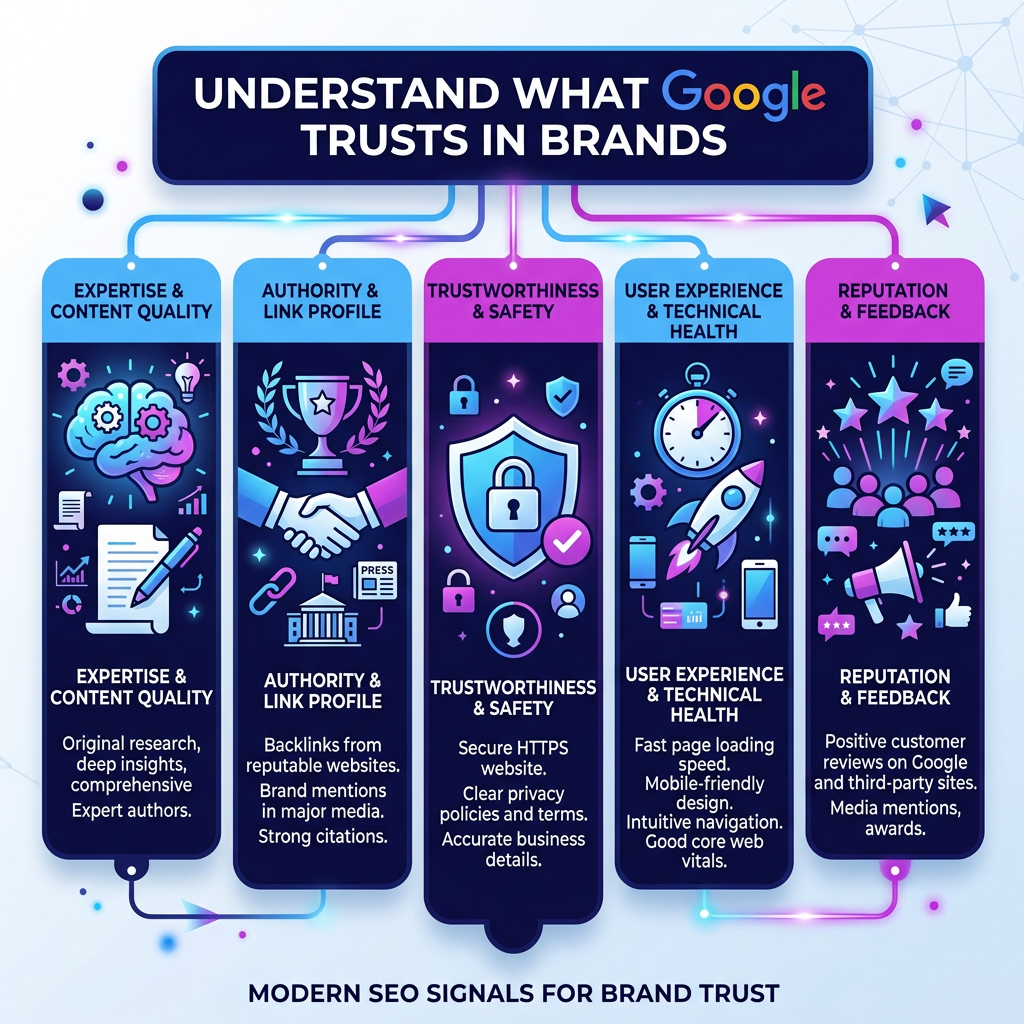
You strengthen that understanding when your content is topically connected, and your structured data maps your scope through Organization, LocalBusiness, Product, Service, FAQ, and Breadcrumb markup. Credible third-party mentions, reviews, testimonials, and honest tradeoffs show real-world expertise without demanding endless links. Most importantly, trust expands through brand coherence: consistent messaging, comprehensive coverage, and proof across pages. That’s how you escape commodity status and become a trusted source in search, across AI surfaces too.
Audit the Brand Signals on Your Site
Start by auditing every brand signal Google can reconcile across your site and the broader web. Check your homepage, About page, Google Business Profile, and major directories for matching names, categories, descriptions, and contact details. Inconsistent brand signals weaken recognition and dilute trust signals that should compound over time.
Upgrade your About page with real faces, team details, service clarity, and direct contact paths. Add verified reviews, testimonials, certifications, and client logos to quickly establish credibility. Implement structured data—Organization, LocalBusiness, Product or Service, FAQ, and Breadcrumb—to help search engines accurately map your entity. Then review your content: does it answer real questions, explain tradeoffs honestly, and show expertise clearly? When every signal aligns, you stop depending on hacks and start building the kind of authority that frees your growth.
Make Your Brand Message Consistent
How consistently does your site present the same brand every time Google or a customer encounters it? Freedom starts with alignment. Keep your business name, positioning, and contact details identical across your homepage, About page, Google Business Profile, and major directories. That brand consistency sharpens recognition and strengthens entity signals that Google can trust.
You also need proof, not slogans. Show real team members with names, faces, and authentic stories. Add verified reviews, testimonials, certifications, and case snapshots that confirm your claims. Then support that identity with structured data such as Organization, LocalBusiness, and Service markup, so your site conveys the same truth in machine-readable form. When every page echoes one clear promise, you reduce ambiguity, increase trust, and give Google a stable, memorable brand it can confidently surface.
Build Topic Coverage Google Can Follow
When Google scans your site, can it quickly see the full shape of what your brand actually knows? If not, your expertise stays trapped. Build topic coverage with a clear content map that groups services, questions, and locations into one connected system. Use structured data, stable terminology, and internal links so Google can quickly follow your brand narrative.
- Map every core service and customer question, so nothing important stays invisible.
- Connect pages with consistent language that strengthens brand authority across the cluster.
- Answer tradeoffs and real scenarios to earn longer engagement and stronger search signals.
- Reinforce your scope with aligned off-site mentions that expand recognition beyond your domain.
This frees your brand from thin-page chaos and helps Google understand your full market position with confidence.
Show Proof That Your Brand Is Trustworthy
Clear topic coverage helps Google understand what you know; proof helps it trust that your brand is real, credible, and consistent. You need visible evidence across your site: real names, real faces, a truthful About page, and service descriptions that explain exactly what you do and how you help.
Strengthen trust signals by keeping your business name, address, and phone number identical on your homepage, About page, Google Business Profile, and directories. Add certifications, partner logos, and testimonials that show measurable results. Make contact easy with clear email, phone, chat, or form options so people can verify you’re reachable. When your brand story, support access, and proof points align across pages, you reduce doubt, increase conversion confidence, and give Google stronger reasons to treat your site like a legitimate brand.
Turn Reviews Into Strong Trust Signals
Why do reviews matter so much? They convert customer experience into measurable trust signals that Google and buyers can verify. You should feature verified reviews and testimonials on key pages, pair them with certifications, logos, and case snapshots, and mark them up with structured data. That consistency strengthens credibility, improves local visibility, and lifts click-through rates.
- You stop guessing because authentic reviews reveal what buyers actually value.
- You earn confidence by responding to every review, especially critical ones.
- You reduce friction by placing review-rich CTAs beside real outcomes and honest tradeoffs.
- You create freedom from weak positioning by showing living proof, not empty claims.
Train your team to request feedback after every transaction. Then align on-page messaging with those reviews so search and conversion signals reinforce each other.
Build Google Trust Without New Backlinks
How do you build Google trust if you’re not chasing new backlinks? You tighten the signals you already control. Keep your name, address, phone number, and brand description consistent across all places Google can verify them. Align your About page, service pages, directories, podcast bios, event listings, and trade associations so they describe the same business, expertise, and promise.
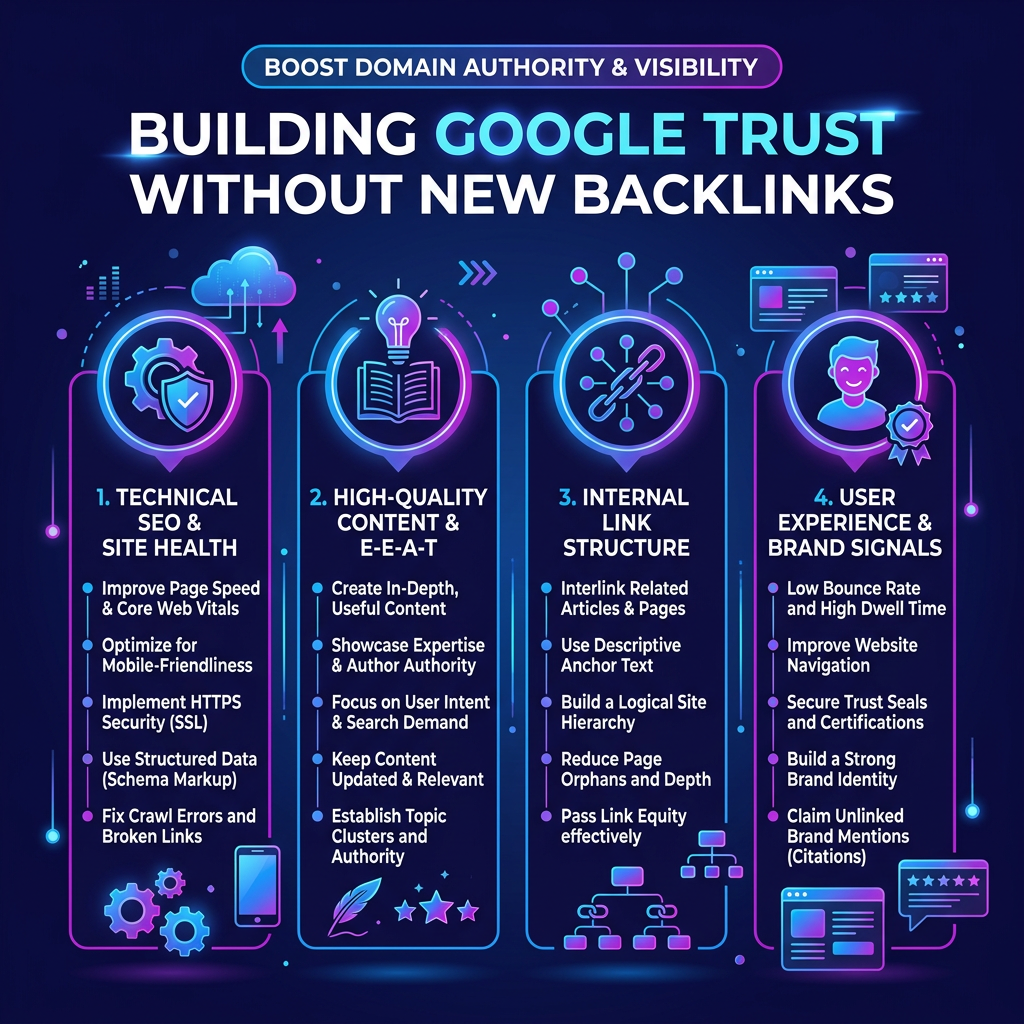
That consistency compounds into stronger brand signals. It also limits backlink dilution, which can weaken entity recognition when descriptions are scattered. You don’t need endless link volume if credible local publications, regional directories, and industry sites corroborate who you are. Add faces, contact options, and clear on-site services so external mentions link back to a trustworthy source. This frees you from link-chasing and builds a brand that Google can recognize faster, consistently over time.
Measure Whether Google Trusts You More
When does Google trust become visible? You’ll see it in branded search behavior, richer SERP treatments, and cleaner entity alignment. Check Google Search Console for rising impressions and clicks on your company name, brand-plus-service, and brand-plus-city queries. Review branded results for sitelinks, FAQs, and review snippets; those brand signals show Google understands you more completely.
- Audit name, address, phone, and descriptions across your site and directories to strengthen entity confidence.
- Measure mention quality from credible publications, trade sites, and associations to validate authority signals.
- Watch branded CTR, impression growth, and topic spread in dashboards over time.
- Compare traffic, conversions, and assisted-channel performance to confirm that trust is freeing your brand from dependence on a single ranking.
That visibility creates momentum you can feel and scale fast.
Track Trust Signals Before Rankings Rise
Often, Google’s trust shows up in brand signals before your category rankings move. So don’t wait for head terms to validate progress. In Search Console, watch branded impressions and clicks for your company name and core brand phrases. Then track brand-plus-service and brand-plus-city queries; they reveal whether users connect your brand to solutions and locations.
You should also monitor SERP features tied to your name, including sitelinks, FAQ snippets, and review-rich results. These trust signals often appear before broader ranking gains. At the same time, audit your website, Google Business Profile, and directories for consistent business details, because clean entity data strengthens credibility. Finally, build a monthly dashboard that connects branded visibility to CTR, inquiries, and conversions. That’s how you spot momentum early and earn strategic freedom.
Frequently Asked Questions
Brand building services encompass a comprehensive set of strategies and creative elements designed to establish and strengthen a company’s brand identity. These services typically include brand strategy development, visual identity creation (such as logo design, color palettes, and typography), messaging frameworks, and positioning strategies that clearly communicate a brand’s unique value. Additionally, brand building may involve the creation of brand guidelines, style guides, and templates to ensure consistent application across all marketing channels and customer touchpoints. Beyond visual and messaging elements, brand building services also focus on establishing trust and coherence across digital platforms and offline presence. This includes optimizing business details, implementing structured data, integrating real customer testimonials and reviews, and ensuring consistency in contact information and brand story across websites, directories, and social profiles. Such comprehensive coverage helps Google and customers recognize the brand as legitimate and authoritative.
The 3 7 27 rule of branding is a psychological model that explains how people form impressions about a brand or individual based on different communication channels. According to this rule, 3% of the message is conveyed through words, 7% through tone of voice, and 27% through body language or visual cues. While originally applied to personal communication, this concept underscores the importance of consistent and compelling visual branding, messaging tone, and overall presentation in building a brand’s identity. In practical brand building, this means that while your brand’s messaging (words) matters, the visual identity and how the brand ‘feels’ through design, tone, and experience play a significantly larger role in how customers perceive and trust your brand. Effective brand building services leverage this understanding to create cohesive brand assets that resonate emotionally and visually with target audiences.
Pricing for white label digital marketing services varies depending on the scope and complexity of services required. Most providers offer partner pricing models that you can review in detail, often allowing agencies to markup the wholesale cost by 50-100% to generate profit.Because these services are outsourced, you save on hiring and training specialized staff, which can significantly reduce operational expenses. Many white label programs provide transparent pricing and detailed monthly reporting so you can clearly demonstrate ROI to your clients.
The cost of branding services varies widely depending on the scope and depth of services provided. Basic branding packages, such as logo design and simple visual identity creation, can start from a few hundred to a few thousand dollars. More comprehensive brand building services that include full brand strategy development, messaging frameworks, visual identity systems, and brand guidelines typically range from several thousand to tens of thousands of dollars. Factors influencing cost include the agency’s expertise, the complexity of the brand’s needs, deliverables such as brand audits, customer research, and ongoing support or consulting. Some providers offer tiered packages to accommodate startups with limited budgets as well as established companies seeking extensive brand development. It is important to consider branding as a long-term investment that strengthens trust, recognition, and ultimately, business growth.
Brand building services are specialized marketing solutions focused on creating and enhancing a company’s brand identity to foster recognition, trust, and customer loyalty. These services include developing a clear brand strategy that defines the brand’s purpose, target audience, and market positioning. They also incorporate crafting visual elements such as logos, color schemes, and typography, along with messaging frameworks that communicate the brand’s core values and unique selling propositions. Additionally, brand building services often involve auditing existing brand signals to ensure consistency across websites, social media, directories, and Google Business Profiles. They include implementing structured data and content strategies that help search engines and customers identify the brand as credible and authoritative. This holistic approach ensures that every touchpoint reflects one clear, consistent brand message that builds long-term equity.
The timeline for seeing results from brand building services depends on the scope of the project and the specific goals of the brand. Basic visual identity components like logo design or style guides can take between 2 to 4 weeks to complete and can start impacting brand recognition shortly after launch. Comprehensive brand strategy development, which includes messaging, positioning, and content mapping, generally requires 2 to 3 months and aims for deeper, longer-term brand equity and trust. It’s important to note that while some improvements in brand awareness and customer engagement may be noticeable relatively quickly, the full benefits of brand building—such as enhanced search engine trust, increased branded search traffic, and stronger customer loyalty—often materialize over several months to a year. Measuring early trust signals like branded search impressions, review snippets, and site engagement can help track progress before broader ranking and sales gains occur.
Brand building focuses on establishing and strengthening the fundamental identity, trust, and recognition of a company or product. It involves defining who the brand is, what it stands for, and how it communicates consistently across all platforms and customer touchpoints. Brand building services include creating core elements like logos, messaging frameworks, brand guidelines, and ensuring consistent entity signals that search engines and customers can rely on. Marketing services, on the other hand, typically use the established brand identity to promote products or services and drive sales and conversions. Marketing tactics include advertising campaigns, social media management, SEO, content marketing, and paid media. While marketing aims at short- to medium-term customer acquisition and revenue growth, brand building is a foundational process that supports marketing efforts by creating a trustworthy and recognizable presence that resonates with audiences over time.
Yes, brand building services can be highly beneficial for new e-commerce businesses. Establishing a clear and consistent brand identity from the outset helps differentiate your business in a crowded market and builds trust with potential customers. Early investment in brand strategy, visual identity, and messaging frameworks ensures that your e-commerce store presents a professional and cohesive image across your website, social profiles, and marketplaces. Moreover, brand building lays the groundwork for better search visibility and customer loyalty. By aligning your business name, contact details, and service descriptions consistently across online listings and implementing structured data, you enable search engines like Google to recognize your brand as legitimate and authoritative. This foundational trust can lead to increased branded search traffic, higher conversion rates, and long-term growth.
When you engage a brand building service provider, typical deliverables include a comprehensive brand strategy document outlining your brand’s purpose, target audience, positioning, and key messaging. You can also expect visual identity assets such as logos, color palettes, typography guidelines, and templates for marketing materials. Many providers include brand guidelines that ensure consistent application of your brand across all channels and touchpoints. Additional deliverables often involve audits of your existing brand signals on your website, Google Business Profile, and directories to ensure uniformity in business name, contact details, and category descriptions. Providers may also offer structured data implementation (such as Organization and LocalBusiness markup) to improve search engine understanding of your brand entity. Some services include content frameworks, FAQ development, and reputation management strategies, such as review integration and testimonial collection, to reinforce trust and credibility.
Measuring the ROI of brand building services involves tracking a combination of quantitative and qualitative indicators over time. Key metrics include increases in branded search impressions and click-through rates (CTR) on Google Search Console, which demonstrate growing brand recognition and trust. You should also monitor improvements in SERP features such as sitelinks, FAQ snippets, and review-rich results that indicate stronger brand authority. Beyond search visibility, ROI can be evaluated through enhanced customer engagement, higher conversion rates, and increased customer lifetime value. Tracking inbound inquiries, sales attributed to branded traffic, and improvements in premium pricing ability also reflect brand strength. Additionally, positive shifts in customer reviews, testimonials, and third-party mentions contribute to sustained brand equity, which supports long-term growth and reduces dependency on paid advertising.