Let People See – Making Video Content with AI for Business
If your team is under pressure to produce more video without adding headcount, making video content with AI probably sounds less like a trend and more like a survival tactic at budget meetings. Fair enough. AI can absolutely reduce production time, simplify repetitive tasks, and help marketing teams move faster. It can also flood your brand channels with polished-looking content that says very little.
That tension matters for businesses. Volume is easy to admire in a dashboard. Relevance is what gets results.
Where Making Video Content with AI Actually Helps
AI is most useful when it removes friction from the production process, not when it pretends strategy is optional. For business video, that usually means speeding up early-stage development, handling tedious post-production tasks, or supporting content repurposing across channels.
Script drafting is a good example. If your team needs a first-pass outline for a product overview, recruiting video, internal communications update, or event recap, AI can give you a workable starting point in minutes. That does not mean the script is ready. It means the blank page is gone, which is often half the battle.
Storyboarding is another practical win. AI tools can help visualize scenes, suggest shot sequences, and create rough concepts for stakeholder review. For corporate teams, this can make approvals faster because people react better to something they can see than to a paragraph in a planning document.
The Problem with Fully Automated Video
Here is the part people tend to skip in the pitch deck. AI can make a video. It cannot automatically make your company look credible.
Business audiences are quick to spot generic messaging, fake-sounding voiceover, unnatural visuals, and scripts that feel like they were assembled by a committee of autocomplete tools. If your video is supposed to build trust with buyers, recruits, investors, channel partners, or employees, that kind of content can work against you.
This is especially true in sectors where accuracy, safety, process, and reputation matter. Manufacturing companies, healthcare organizations, financial firms, and enterprise brands rarely benefit from looking fast and cheap. They benefit from looking clear, competent, and intentional.
That is why fully AI-generated content often struggles with high-stakes communication. It can imitate the format of a brand video, testimonial, culture piece, or executive message, but it usually lacks the specifics that make those videos persuasive. It tends to flatten the story. Everybody sounds confident. Nobody sounds real.
Making Video Content with AI Works Best in a Hybrid Model
For most organizations, the smartest approach is not AI versus production. It is AI plus professional production, used with some discipline.
Let AI handle the repetitive and administrative work. Let people handle the parts where judgment matters.
That usually means humans should still lead the messaging strategy, interview development, on-camera direction, visual standards, pacing, and final brand review. If the content represents your company meaningfully, those decisions are too important to outsource to chance.
A hybrid model also makes practical sense across content tiers. Not every video needs the same level of production. A quick internal update may benefit from AI-assisted scripting and captioning. A customer-facing brand film, executive interview, or manufacturing overview probably needs a stronger production process, a real crew, and sharper oversight.
That distinction matters because business video is not one category. A recruiting video has a different job than a trade show opener. A plant tour has a different risk profile than a social clip. Treating every use case the same is how teams waste money or inadvertently lower standards.
Where AI Fits in the Business Video Workflow
The most effective teams use AI at specific points, not everywhere, all at once. In pre-production, it can help organize research, generate draft messaging options, summarize stakeholder interviews, and build planning documents. This speeds up alignment, especially when multiple departments are involved, and everyone has notes. Which they will. They always do.
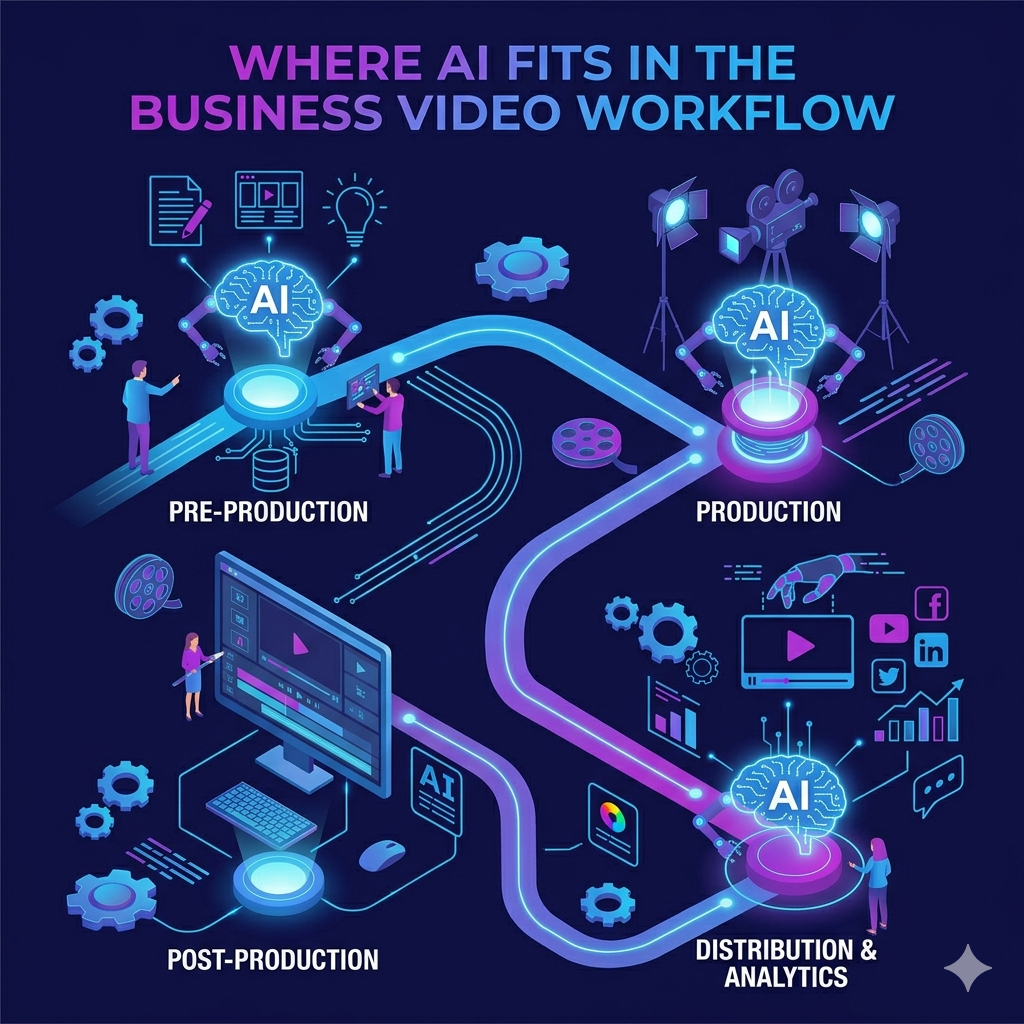
During production, AI has a smaller role. It can support teleprompter prep, shot planning, and live transcription, but it does not replace a good producer, director, or crew. Real production still depends on understanding lighting, sound, pacing, location constraints, brand presentation, and how to get a useful performance from people who are not professional talent.
The Brand Risks Nobody Mentions in the Demo
AI video tools are usually sold on the basis of convenience. Fair enough. Convenience has value. But convenience can create brand problems when nobody is watching the details.
The first risk is inconsistency. If different team members use different prompts, tools, voices, avatars, visual styles, and editing settings, your video library starts to look like several brands sharing one logo.
The second risk is factual drift. AI-generated scripts and voiceovers can introduce vague claims, incorrect descriptions, or legally awkward wording. In internal communication, that can create confusion. In external marketing, it can create a much more expensive conversation.
The third risk is creative sameness. AI tools are trained to produce what looks familiar, which means your content can start resembling everybody else who uses the same shortcuts. That may be fine for low-priority assets. It is a poor strategy for brand differentiation.
Then there is the problem of audience reaction. Some viewers do not care how a video is made. Others care a lot. If the content feels synthetic in the wrong context, trust drops. That is not a philosophical issue. It is a conversion issue.
How to Decide What Should be AI-Assisted
A simple test helps. Ask two questions: how important is this video to brand perception, and how costly is a mistake?
If the video is low-risk, short-lived, and operational, AI can likely handle more of the workload. If the video is customer-facing, reputation-sensitive, or central to a campaign, human oversight should increase fast.
This is where experienced production partners still matter. The real value is not just cameras, crews, or editing software. It is judgment. It is knowing when speed helps, when polish matters, and when a message needs a real human interview instead of a generated voice that sounds like it learned empathy from a software update.
For companies in Greenville, SC, and beyond, that balance is becoming the real competitive advantage. The question is no longer whether AI belongs in video production. It does. The better question is whether you are using it to improve communication or just to manufacture more content.
What Smart Companies Will Do Next?
The businesses that get the most from AI will not be the ones that automate everything. They will be the ones who build a clear production system around it.
That means setting standards for script review, visual identity, voice and tone, approval workflows, and content tiers. It means deciding which videos can be produced quickly, which need stronger creative development, and which represent the brand too directly to leave to automation. It also means having someone in the room who can say, with a straight face and good judgment, this sounds efficient, but it does not sound like us.
AI is a strong production assistant. It is not a brand steward.
Used well, it helps teams create more useful content, faster. Used poorly, it creates a larger pile of average videos in less time than ever before. If your business already has enough average content, the opportunity is not to produce more of it. The opportunity is to use AI where it saves time, then spend that time improving the message.
Frequently Asked Questions
AI video content for business refers to videos that are created or enhanced using artificial intelligence tools. These tools can assist with everything from scriptwriting and storyboarding to generating visuals, voiceovers, subtitles, and editing. Instead of relying solely on traditional production methods, businesses can use AI to streamline the entire process, making video creation more accessible, cost-effective, and scalable for marketing, training, and communication purposes.
AI significantly reduces the time required to produce video content by automating repetitive and technical tasks. For example, AI can generate scripts based on prompts, automatically edit footage, add transitions, create voiceovers, and even produce complete videos from text input. This allows businesses to move from idea to finished product much more quickly, enabling faster campaign launches and more consistent content production without requiring a large creative team.
Businesses can create a wide range of video content using AI tools, depending on their marketing goals. This includes explainer videos that break down products or services, social media clips designed for engagement, product demonstrations, customer testimonials, training videos, and brand storytelling content. AI also makes it easier to repurpose existing content into multiple video formats, helping businesses maximize the value of their marketing assets across different platforms.
AI does not replace human creativity—it enhances it. While AI can handle production tasks and generate ideas, human input is still critical for shaping the message, tone, and overall strategy. Businesses need creative direction to ensure that videos align with their brand identity and resonate with their target audience. The most effective approach combines AI efficiency with human storytelling to produce content that is both high-quality and authentic.
Using AI for video marketing offers several key benefits. It reduces production costs by minimizing the need for expensive equipment or large teams, and it speeds up content creation so businesses can publish more frequently. AI also enables scalability, allowing companies to create multiple versions of a video for different audiences or platforms. Additionally, AI tools can incorporate data insights to help tailor content, making videos more relevant and effective in driving engagement and conversions.
To ensure AI-generated videos stay consistent with your brand, it’s important to provide clear guidance to the tools you’re using. This includes defining your brand voice, visual style, messaging, and target audience. Many AI platforms allow you to customize templates, colors, fonts, and tone, which helps maintain consistency. Reviewing and refining the final output is also essential to ensure the video accurately reflects your brand and meets your quality standards.
Yes, AI-generated video content can be highly effective for both marketing and SEO when used strategically. Video content tends to increase user engagement, keep visitors on your website longer, and improve overall user experience—all of which are positive signals for search engines. Additionally, videos can enhance your presence across platforms like social media and YouTube, helping drive traffic and brand awareness. When optimized with proper titles, descriptions, and keywords, AI-created videos can play a valuable role in a comprehensive SEO strategy.