Cost Per Lead vs. Cost Per Sale: The Trap Ruining Solar Ad Campaigns
Imagine this scenario: You sit down with your marketing team or agency for your monthly performance review. The account manager beams as they pull up the dashboard. “Great news!” they tell you. “We’ve optimized the campaigns, and your Cost Per Lead (CPL) dropped from $80 to just $20. We generated 300 leads this month!”
You should be thrilled. On paper, it looks like a massive win.
But when you walk out onto your sales floor, the reality doesn’t match the data. Your top sales reps are sitting back, looking frustrated. When you ask how the new leads are looking, they roll their eyes. “They’re garbage,” one tells you. “Half of them don’t remember filling out a form, a quarter of them don’t own their homes, and the rest are just ghosting us.”
This is the solar marketing mirage—and it is currently draining ad budgets all over the industry.
Solar business owners and digital marketing agencies have become universally obsessed with Cost Per Lead. It’s an easy metric to track, it looks great in a report, and it provides immediate validation. But measuring your business’s health by CPL is like judging a restaurant solely by how many people walk past the front door.
If you want to scale a profitable solar installation company, you have to stop chasing cheap clicks. You need to focus on the only metric that actually impacts your bottom line: Cost Per Sale (CPS). Interested in understanding more about Google Ads vs Meta Ads? Read more.
Manufactured Demand vs. Captured Intent
To understand why a cheap lead can be incredibly expensive, we have to look at the psychology of the platforms that generate these leads. In the digital space, all traffic is not created equal. It generally falls into one of two categories: Captured Intent or Manufactured Demand.
Captured Intent (The Google Search Model)
When a homeowner opens Google and types in “best solar panels for a 4-bedroom house” or “solar panel installation cost near me,” they are actively looking for a solution to a problem. They have likely seen their electricity bills skyrocket, talked to a neighbor, or decided they are ready to invest.
When they click your Google Search ad, read your landing page, and fill out a form, they are pulling your business toward them.
Because this intent is incredibly high, competition for these users is fierce. Bidding on those search terms costs a premium. As a result, a Google Search lead might cost you $80, $120, or even $150. It feels expensive, but you are paying for proximity to a buying decision.
Manufactured Demand (The Meta/Social Media Model)
Now think about how Facebook or Instagram ads work. A homeowner is sitting on their couch, scrolling through their feed to see family photos or watch funny videos. They aren’t thinking about their utility bill. Suddenly, an ad pops up with a flashy graphic: “New Government Stimulus Program Pays Homeowners to Go Solar! Click to see if your zip code qualifies.”
Curiosity piqued, they click. Meta uses “Instant Forms,” meaning the platform automatically autofills their name, email, and phone number from their profile. With two taps of their thumb, they’ve submitted their data. They didn’t wake up wanting solar; the ad pushed the idea onto them.
Because the friction to submit this form is incredibly low, you can easily generate these leads for $15 to $25 apiece. But remember: their intent level is drastically lower than the person who searched Google.
The Math That Breaks the Trap
Let’s look at a side-by-side comparison of how these two distinct lead sources play out in a real solar business. Suppose you allocate $5,000 in ad spend to two different campaigns.
Look closely at the final numbers. Campaign A gave you 200 leads—plenty of data to look at and plenty of names for your CRM. But it cost you $2,500 in marketing spend to acquire a single customer.
Campaign B gave you a measly 50 leads. Your dashboard might look “empty” compared to the social campaign. Yet, because those users were already in a buying mindset, your team closed 5 of them. Your cost to acquire a customer dropped to $1,000.
Which campaign actually grew your business?
The Hidden Costs of Flooding Your Pipeline with Garbage
The financial drain of a high Cost Per Sale is obvious, but the secondary damages of chasing a low CPL are often hidden in your operational overhead.
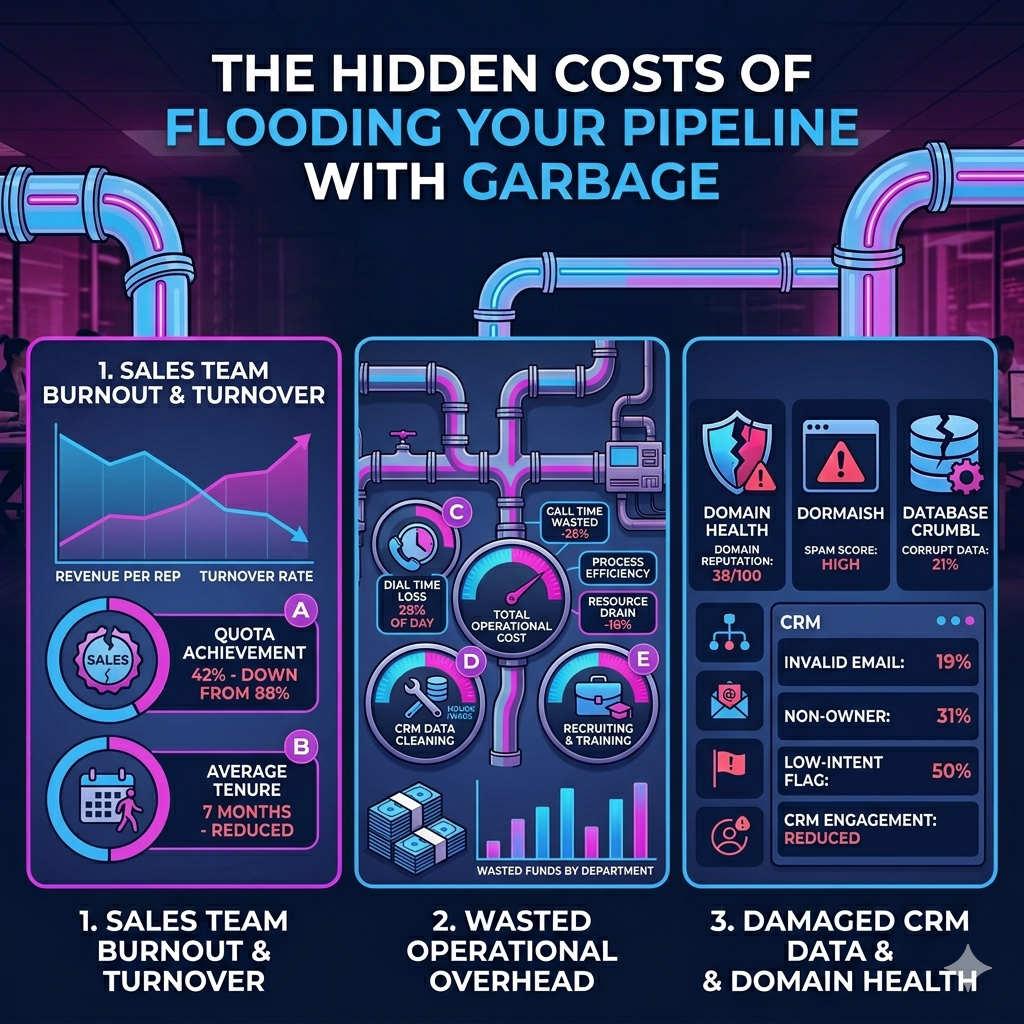
1. Sales Team Burnout and Turnover
Good solar sales professionals are hard to find, hard to train, and hard to keep. If you hand a top-tier sales rep a list of 100 low-intent leads, you are forcing them to spend their days playing telephone tag, dealing with wrong numbers, and getting yelled at by people who claim they “never filled out a form.”
Morale plummets. When reps spend 95% of their time filtering through noise instead of closing deals, they get burnt out and leave for competitors who value their time.
2. Wasted Operational Overhead
Time is money. If you have an internal call center or pre-qualifying team dialing dead numbers and chasing un-nurtured social media leads for 40 hours a week, you are paying for thousands of dollars in wasted labor hours. A cheap lead suddenly becomes incredibly expensive when you factor in the hourly wages required to filter it out.
3. Damaged CRM Data and Domain Health
When your CRM is flooded with fake phone numbers, placeholder emails (like test@gmail.com), and unengaging contacts, your automated email sequences take a hit. High bounce rates and low open rates flag your email domain as spam, meaning even your legitimate emails to good customers stop hitting the inbox.
How to Pivot Your Marketing for True Return on Investment
If you realize your business has fallen into the CPL trap, you don’t need to shut off your ads entirely. You simply need to change the rules of engagement.
Force “Good Friction” on Social Media
If you want to keep running Meta ads because the volume is high, you must stop making it easy to submit a form. Turn off “Instant Forms” and direct users to a custom landing page. Add qualifying questions that require effort to answer:
- What is your average monthly electric bill? (Must be over $150)
- Do you own the home, or do you rent?
- What type of roof do you have?
Your Cost Per Lead might jump from $25 to $60, but your sales team will instantly notice that the people who complete the form actually want to talk.
Implement Offline Conversion Tracking
Stop letting Google and Meta optimize your ads based on who clicks or who submits a form. Use Offline Conversion Tracking (OCT) to connect your CRM directly back to the ad platforms.
When a lead moves from “New Lead” to “Consultation Booked” and finally to “Contract Signed,” that data should feed back to the ad algorithm. This teaches the AI to stop looking for people who just love clicking on bright buttons, and instead target users whose digital profiles mirror your actual buyers.
Hold Your Agency Accountable to Business Metrics
The next time your marketing agency reports on cost per click or cost per lead, change the conversation. Ask them: “What was our cost per booked appointment this month? What was our cost per signed contract?”
If an agency cannot or will not review your pipeline beyond the initial form submission, they are driving blind with your money.
The Bottom Line
A high Cost Per Lead shouldn’t scare you if the revenue it generates leaves a healthy margin. Conversely, a pipeline bursting with hundreds of cheap leads is a liability if none of them ever buy a panel.
Log into your CRM today. Pull a report on your last 20 or 30 closed sales and trace them back to their original traffic source. Find out where your true revenue is coming from, cut the vanity metrics, and start investing your ad dollars where they actually convert into profit.
1. If Google Ads have higher intent, should I just shut off my Meta (Facebook/Instagram) ads completely?
Not necessarily. Meta ads are highly effective for brand awareness and retargeting. The trick is to stop using Meta as a primary source for raw, unqualified leads. Use Google to capture the buyers who are ready right now, and use Meta to stay in front of people who visited your website but weren’t quite ready to book a consultation yet.
2. My marketing agency says they can’t track my actual sales. Is that true?
No, that is a major red flag. While an agency can’t see into your bank account, they absolutely can use Offline Conversion Tracking (OCT). By linking your CRM (such as HubSpot, Salesforce, or JobNimbus) to Google and Meta, the ad platforms receive an encrypted signal whenever a lead converts to a “Booked Consultation” or “Closed Sale.” If your agency claims this isn’t possible, they are falling behind modern marketing standards.
3. What is a “good” Cost Per Lead (CPL) for a high-intent Google Search ad?
Because competition varies heavily by region, a high-intent Google Search lead typically ranges anywhere from $80 to $150+. While this number shocks business owners used to $20 social media leads, you have to look at the close rate. A $120 lead that closes at 10% is vastly more profitable than a $20 lead that closes at 1%.
4. How exactly do I add “good friction” to my social media lead forms?
Stop using Meta’s standard “Instant Forms” that auto-populate user data with two clicks. Instead, require users to complete a custom questionnaire on your website. Ask specific qualifying questions, such as:
- “Are you the homeowner?”
- “What is your average monthly electricity bill?”
- “Is your roof shaded by trees?”
This weeds out accidental clicks and window-shoppers before they ever hit your sales team’s desks.
5. Why do Facebook leads ghost my sales team so much more than Google leads?
It comes down to psychology. A Google searcher was actively hunting for solar when they found you. A Facebook user was looking at a friend’s vacation photos when your ad interrupted them. Because submitting a social media form takes almost zero effort, they often forget they even did it by the time your sales rep calls them 24 hours later.
6. What is a normal closing rate for Google solar leads versus Meta solar leads?
While every sales team is different, standard industry benchmarks show that cold, low-friction Meta leads typically close at 1% to 2%. High-intent Google Search leads, on the other hand, frequently close at 8% to 15% because the prospect is already deep in the buying cycle.
7. Our sales team prefers volume over quality so they have more people to call. Shouldn’t we stick to cheap leads?
This is a common illusion. While it feels good for a sales team to be “busy,” calling hundreds of low-intent leads results in high rejection rates, repetitive administrative work, and rapid burnout. Shifting to fewer, higher-quality leads allows your reps to spend more time doing deep discovery, building custom proposals, and properly nurturing serious buyers.
8. Does a high Cost Per Sale (CPS) mean my marketing is failing or my sales team is failing?
It can be both, which is why tracing the data is so important. If your marketing is bringing in high-intent Google traffic but your CPS is still sky-high, the issue likely lies in your sales process (e.g., slow follow-up times or a poor pitch). However, if the marketing is flooding your system with non-homeowners, the marketing targeting is failing.
9. What is “Brand Defense” on Google, and why does it affect my Cost Per Sale?
Brand Defense is the practice of buying Google ads for your own company name. If you run a great Meta ad, a homeowner might remember your name, close Facebook, and type your business name into Google later. If you aren’t bidding on your own name, a competitor can place an ad above your organic listing and steal that high-intent lead right at the finish line.
10. How long should I run a high-intent ad campaign before judging its true Cost Per Sale?
Because residential solar has a relatively long sales cycle—often taking anywhere from 30 to 90 days from initial click to signed contract—you cannot judge a campaign’s CPS in the first week or two. You need to give the campaign at least 60 to 90 days to collect enough data and let those high-intent leads actually progress through your sales pipeline.