From Keywords to Conversions: Your Complete SaaS SEO Guide for Driving MRR
You’ll drive predictable MRR from SEO by mapping every keyword to a funnel stage (TOFU, MOFU, BOFU) and building a single page type with a single primary CTA per intent. You’ll track the full path—CTR to sign-up to activation to paid—and set benchmarks so rankings forecast revenue. You’ll lift conversions with weekly A/B tests, faster Core Web Vitals, clean indexation, and frictionless onboarding tied to activation events. Keep going to see the full framework.
SaaS SEO Framework: From Click to MRR
How do you turn a high-ranking SaaS page into predictable MRR? You treat it like a measurable funnel, not a vanity asset. Start with trajectory mapping: define the intended path from SERP click to activated user, then audit every step for friction—message match, page speed, proof, and CTA clarity. Instrument events so you can see where intent drops and where it accelerates.
Next, connect SEO traffic to the pipeline with attribution modeling that weights first-touch discovery and downstream conversions. Segment by query class (problem, comparison, alternative) and route each to the right offer: demo, trial, or product-led signup. Run iterative tests on headline, pricing context, and onboarding prompts. You’ll compound wins by scaling only what proves revenue intent.
Set SEO Goals Tied to Sign-Ups and Revenue
You can’t manage SaaS SEO by rankings alone—you’ve got to set revenue-linked KPIs like sign-ups, activation rate, pipeline, and MRR. Map every target keyword and page to a specific funnel stage so you know whether it should drive awareness, trials, or upgrades. Then set conversion benchmarks (CTR → sign-up rate → activation → paid) to forecast impact and hold SEO accountable to revenue.
Define Revenue-Linked KPIs
Where does SEO actually show up on the P&L? It shows up when you define KPIs that translate organic demand into dollars. Start with revenue forecasting: estimate the organic-driven pipeline by multiplying organic sign-ups by the activation rate, sales acceptance rate, win rate, and expected ARPA, then pressure-test it with payback period and churn. Build KPI alignment by choosing one north-star metric (organic-sourced MRR or ARR) and 3–5 leading indicators you can actually move: branded + non-branded demo requests, trial-to-paid conversion, organic-assisted revenue, and CAC from organic vs blended. Set quarterly targets, not vanity lifts, and lock attribution rules in your analytics stack. Then you’ll know whether rankings are producing profitable growth.
Set Conversion Benchmarks
How do you know your SEO works if it doesn’t move sign-ups and MRR? You set conversion benchmarks that ladder every ranking win to revenue outcomes. Start with baseline organic sign-up, activation, and CAC payback rates, then model lift by page type and intent. Tie content experiments to measurable deltas, not vanity traffic, and validate assumptions with keyword density checks and backlink profiling to protect visibility.
- TOFU: target MQLs per 1,000 organic sessions, plus email capture rate
- MOFU: target trial/demo starts per landing page, plus assisted pipeline value
- BOFU: target paid conversions, expansion triggers, and MRR per keyword cluster
Review weekly, ship faster, and reallocate resources to the highest-LTV cohorts.
Map Keywords to TOFU, MOFU, and BOFU Pages
Why do some SaaS pages rank but still don’t convert? You’re matching queries to traffic, not to intent and next-step value. Fix it by mapping every keyword to a funnel stage and a single job-to-be-done, including micro-moments and voice-search phrasing (“how do I…”, “best way to…”).
TOFU pages earn reach: glossary, trends, templates, pain-point explainers. Optimize for CTR and time on page, then route to a relevant lead magnet. MOFU pages should create preference by covering comparison, alternatives, use cases, integration guides, and pricing education. Measure assisted conversions and demo-start rate. BOFU pages close: pricing, product, security, migration, case studies, trial/demo. Tie each to one primary CTA, track CVR by page type, and iterate weekly.
Find High-Intent SaaS Keywords in 30 Minutes

Once you’ve mapped keywords to TOFU, MOFU, and BOFU pages, the next win is speed: you can uncover high-intent SaaS keywords in 30 minutes if you filter for “buyer action” signals instead of raw volume. Open Search Console and your rank tracker, then sort queries by impressions plus high CTR to find intent-rich phrases you already “almost” own. Layer in competitor insights: export competitors’ paid search and top landing-page keywords, then isolate terms with modifiers like pricing, demo, alternative, vs, and integration. Finally, apply lightweight keyword clustering to group variants that share the same decision-stage intent—then pick one primary term per page to keep your funnel clean and measurable.
- Prioritize BOFU modifiers and high CPC ranges
- Validate intent via SERP features (ads, comparisons)
- Score keywords by CTR, CPC, and close-rate proxy
Build Topic Clusters That Compound Rankings
After you’ve locked in your high-intent terms, topic clusters let you turn isolated keyword wins into compounding funnel traffic. Build one pillar around the core job-to-be-done, then map 6–12 supporting pages to specific pain points, comparisons, and implementation questions uncovered in your keyword research.
Wire every supporting page back to the pillar and laterally to adjacent topics, so crawlers and users follow a deliberate path from problem to solution. Track cluster health with shared KPIs: impressions, non-branded clicks, assisted sign-ups, and pipeline influenced. Prioritize internal anchors that mirror intent, not just exact matches. Then accelerate authority with targeted link building to the pillar and the top two supporting assets; you’ll lift the entire cluster’s rankings and reduce CAC over time.
Write Product-Led Pages That Convert Visitors
You don’t win trials by listing features—you win by mapping each page to a high-intent use case and the outcome your buyer wants. You’ll lift conversion rates when you add in-product proof (screens, metrics, workflows) and remove doubt at every step of the funnel. Then you drive action with CTAs that match intent—“Start free,” “See it in action,” or “Run your first report”—placed where the proof peaks.
Use Cases Over Features
Why do feature-led pages stall conversions even when the product’s great? Because buyers don’t purchase capabilities, they purchase outcomes. You’ll lift MRR when you map each page to a high-intent use case, then prove time-to-value in the copy. Start with audience targeting: define the job title, trigger event, and success metric, and align messaging to their evaluation stage. Use keyword governance to keep every page anchored to one problem-aware query, one solution-aware query, and one comparison query—no cannibalization, no mixed intent.
- Lead with the moment of pain and the cost of delay
- Show the workflow: before → after → measurable impact
- Segment by industry, team, or maturity to personalize relevance
In-Product Proof And CTAs
Because buyers trust what they can see, product-led pages convert faster when they replace generic claims with in-product proof and a CTA that matches intent. Show the workflow: real dashboards, permission screens, and one-click outcomes. Tie each proof block to one metric (time saved, errors reduced, revenue captured) and move visitors down-funnel with frictionless next steps.
Run cta experiments by segment: new vs returning, SMB vs enterprise, and page depth. Track CTR to activation, not clicks alone, and iterate weekly. Replace “Book a demo” with intent-matched micro-commitments that lift trials.
Optimize Landing Pages for Sign-Ups (CRO Basics)
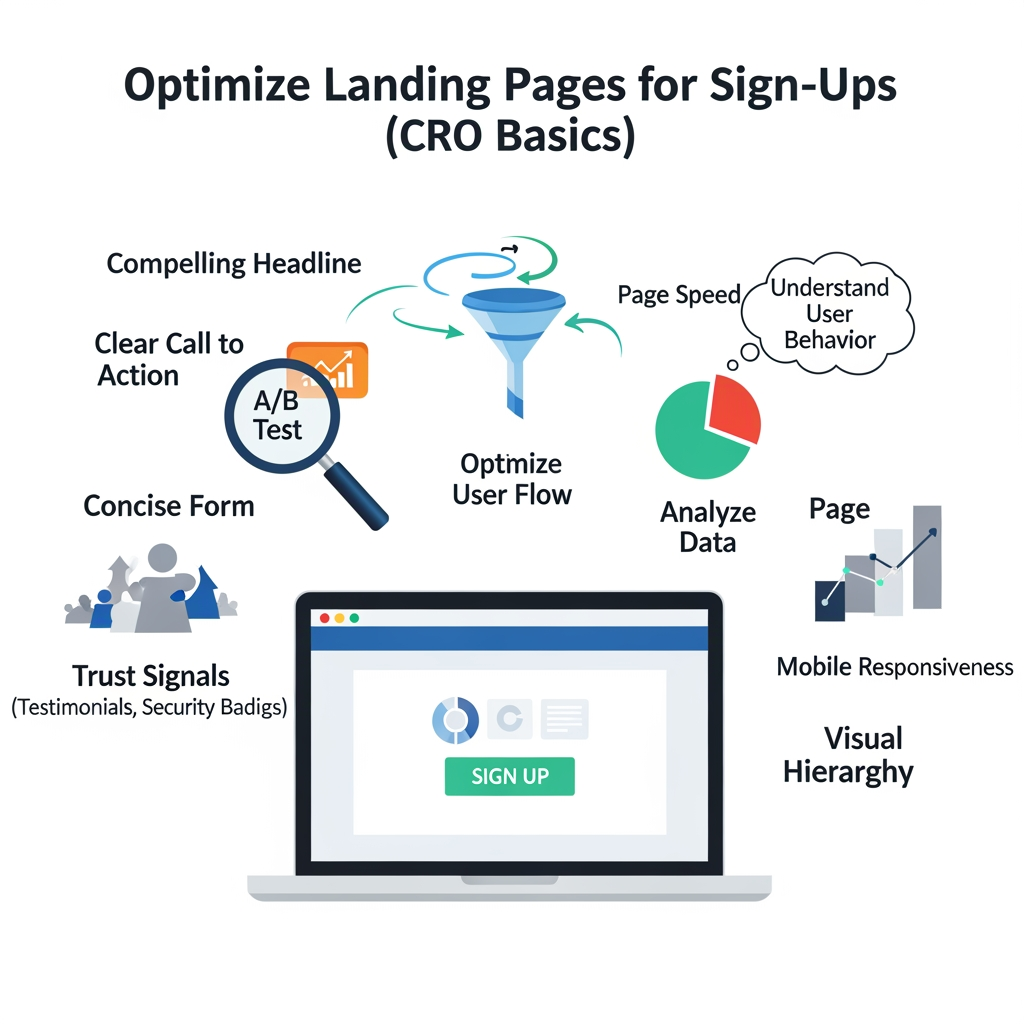
Most SaaS landing pages waste high-intent traffic by forcing extra clicks, vague messaging, or form friction before a visitor hits “Start free trial.” Optimize for sign-ups by aligning the page to a single conversion goal, matching the headline and hero copy to the keyword’s promise, and reducing the steps between interest and action. Treat every element like a funnel gate: if it doesn’t increase submissions, cut it. Use customer onboarding cues (time-to-value, setup steps) to lower perceived effort, and apply pricing psychology (anchoring, risk reversal) to reduce hesitation without adding clutter.
- Put one primary CTA above the fold and repeat it after proof blocks
- Minimize fields, enable SSO, and auto-validate to prevent drop-offs
- A/B test headline, social proof density, and microcopy; ship weekly wins
Turn Trials Into Paid Users With Activation Content
Getting the trial sign-up isn’t the win—activation is, and it’s where revenue actually starts. Your goal is to move users to the first “aha” moment fast, because activated trials convert 2–3× better than idle ones. Build activation content that maps to core jobs-to-be-done: a 3-step quickstart, in-app checklists, and short templates that produce a real output in minutes. Tie every asset to a single activation event (invite a teammate, connect data, publish a workflow) and measure time-to-value.
Pair it with user onboarding that adapts by segment: role, use case, and intent keyword. Trigger emails and in-app nudges based on stalled milestones, not day counts. Then, A/B-test activation paths and relentlessly reduce friction.
Fix Crawlability, Indexation, and Site Speed
If Google can’t efficiently crawl and trust what it indexes, your best BOFU pages won’t rank—and your CAC rises. You’ll optimize crawl budget, control indexation with intentional rules (not accidents), and keep only revenue-driving URLs in the path to purchase. Then you’ll hit Core Web Vitals targets so pages load fast, reduce drop-off, and convert more of that hard-won organic traffic.
Crawl Budget Optimization
Where does your SaaS organic funnel quietly leak—before a prospect even sees your page? It’s when Google wastes crawl budget on low-value URLs, slowing indexation speed and delaying revenue pages from entering the SERP. Treat crawl efficiency like pipeline velocity: fewer wasted requests, faster discovery, more qualified traffic hitting high-intent assets.
- Cut crawl traps: faceted parameters, infinite calendars, duplicate paths, and orphan pages that soak bot time.
- Streamline architecture: shallow clicks to pricing, demo, and integration pages; consistent internal linking signals priority.
- Boost performance: reduce TTFB, compress assets, fix render-blocking scripts—bots crawl more when pages respond fast.
Measure with server logs + Search Console: rising crawled-but-not-indexed and slower recrawl rates flag friction. Fix friction, unlock compounding growth.
Indexation Control Tactics
How often do your highest-intent pages sit invisible because Google can crawl them but won’t index them fast enough? You can’t convert what isn’t surfaced, so treat indexation as a revenue lever, not a technical afterthought.
Start by enforcing clean signals: submit a prioritized XML sitemap, set canonical URLs, and block low-value parameter pages using robots.txt or the noindex meta tag. Then tighten internal linking so product, pricing, and integration pages get consistent link equity from top-funnel content. Use the URL Inspection API and server logs to verify Googlebot hits the pages that drive trials, not tag archives. Fix redirect chains, eliminate soft 404s, and standardize status codes to reduce waste and lift crawl efficiency. These indexation tactics shorten time-to-rank and accelerate the conversion of more users from discovery to signup.
Core Web Vitals Speed
Speed is a compounding asset in SaaS SEO: it improves crawl efficiency, gets your updates indexed sooner, and removes friction right when high-intent users hit pricing, product, and signup pages. Treat Core Web Vitals as revenue infrastructure, not “nice to have.” When your core web experience is fast, Google crawls deeper, users bounce less, and trial starts rise.
- Prioritize LCP under 2.5s on pricing pages by shipping critical CSS, compressing hero media, and using a CDN.
- Cut INP by deferring third-party scripts, limiting tag managers, and optimizing React hydration.
- Stabilize CLS with fixed-size components, font-display swap, and predictable upsell banners.
Track speed health weekly in Search Console + RUM. Tie improvements to funnel metrics: CTR → signup rate → activation.
Prove SEO Impact on Activation, Retention, and MRR
Even if organic traffic looks great on a dashboard, it doesn’t prove SEO is driving business growth until you connect it to activation, retention, and MRR. Start by mapping each landing page to a funnel stage and tagging every organic session by signup, first-value event, and paid conversion. Build a cohort report: activation rate, day‑30 retention, expansion, and churn for organic vs. other channels.
Then run focus audits to isolate what actually moves users: intent match, CTA clarity, and onboarding friction. Tie experiments to leading indicators (demo-to-trial, trial-to-activated) and lagging revenue metrics (ARPA, LTV). Upgrade your backlink strategy to focus on pages that drive activation and retention, not vanity traffic. You’ll prove SEO’s compounding revenue impact.
Conclusion
You’ve built an SEO engine that doesn’t just chase traffic—it measures what matters: sign-ups, activation, retention, and MRR. Like Theseus threading the labyrinth, you map every keyword to TOFU, MOFU, and BOFU pages, then guide visitors toward trials and paid plans. You’ll compound rankings with topic clusters, lift conversion rates with CRO basics, and remove technical friction. When you connect Search Console, analytics, and revenue, you don’t guess—you attribute, iterate, and scale predictably.