What is the Difference Between SEO and ASO?
SEO helps you rank in Google SERPs to drive qualified website traffic, while ASO helps you rank in the App Store and Google Play to drive more installs. You win SEO with keyword-targeted pages, scanable titles, and authority signals like backlinks that lift CTR and conversions. You win ASO with metadata (title, subtitle, keywords), creative assets, and install velocity, which boost the impressions-to-install rate. Track CAC, CVR, and retention weekly to choose the right mix—and there’s more ahead.
SEO vs ASO: Which One You Need (and Why)
Where should you invest first—SEO, ASO, or both? Choose based on where your conversions start. If your product is discovered on the web, SEO earns demand by targeting high-intent keywords, optimizing pages, and capturing leads before install. If installs drive revenue, ASO improves store visibility and lifts conversion rates through optimized titles, subtitles, visuals, and ratings velocity. You can’t treat them as interchangeable: semantics differences change what “relevance” means, and platform boundaries change what you can control. Go SEO-first when you need scalable top-funnel acquisition and content-led authority. Go ASO-first when paid CPI is rising, and organic installs must grow. Do both when you’re building a compounding flywheel: web content pre-sells, store listing closes. Track CAC, CVR, and retention weekly.
Where SEO vs ASO Rankings Appear (SERPs vs App Stores)
You’ll see SEO rankings in Google SERPs, where signals like keyword relevance, backlinks, page speed, and CTR determine whether you win clicks. You’ll see ASO rankings inside the App Store and Google Play, where app title keywords, install velocity, ratings, reviews, and retention push you up the charts. If you optimize for the right ranking factors in the right place, you’ll capture higher-intent traffic and convert more users.
Search Results Page Signals
Here’s a bullet point list on Search Results Page Signals:
- Click-Through Rate (CTR) – Indicates how often users click on a result compared to how many times it’s shown; higher CTRs suggest relevance.
- Dwell Time – Measures how long a visitor stays on a page after clicking a search result before returning to the SERP.
- Bounce Rate – Shows how frequently users leave a page without interaction; high bounce rates can signal irrelevant or low-quality content.
- Pogo-Sticking Behavior – When users quickly return to the search results after clicking a link, implying the result didn’t meet their needs.
- Engagement Metrics – Includes scroll depth, comments, and internal link clicks that demonstrate user interaction and satisfaction.
- SERP Position Changes – Ranking fluctuations that reflect how search engines interpret the quality, relevance, and freshness of a page.
- Rich Result Features – Presence of elements like featured snippets, star ratings, or FAQs that improve visibility and credibility.
- User Feedback Signals – Data from reviews, ratings, and user suggestions that influence perceived trust and search performance.
- Brand Mentions and Authority – References from reputable sites that boost trust and signal expertise to search engines.
- Mobile-Friendliness and Page Experience – Core Web Vitals, loading speed, and mobile optimization affect user satisfaction and rankings.
- Content Freshness – Regular updates and new information signal relevance, particularly for time-sensitive queries.
- Search Intent Alignment – How well the content matches the user’s goal (informational, navigational, or transactional).
Visibility acts like a scoreboard, and SEO vs ASO rankings show up on different playing fields: Google SERPs versus Apple’s App Store and Google Play search results. On SERPs, you’re competing for clicks with titles, URLs, dates, and rich snippets that telegraph intent fast. In app stores, you’re competing for taps with icon-first listings and tighter preview real estate, so your copywriting tone must signal value instantly without bloating keyword density.
- SERPs reward scanability: bolded query terms, snippet length, and sitelink presence shape CTR.
- App stores reward immediacy: badges, short subtitles, and preview assets compress your pitch.
- Both reward relevance signals: query-match highlights and above-the-fold clarity drive conversions.
App Store Ranking Factors
Here’s a clear bullet point list on App Store Ranking Factors:
- App Title and Keywords – Primary keywords in the app title and subtitle strongly influence discoverability.
- App Description – Clear, keyword-rich descriptions help both users and algorithms understand the app’s value and functionality.
- App Icon and Visuals – High-quality icons, screenshots, and previews improve conversion rates from impressions to downloads.
- User Ratings and Reviews – Consistent positive reviews and high average ratings boost trust and ranking.
- Download Volume and Velocity – Total downloads and the rate at which new installs occur indicate popularity and relevance.
- Retention Rate – A high percentage of returning users signals app quality and user satisfaction.
- Uninstall Rate – Frequent uninstalls can negatively impact overall ranking performance.
- Update Frequency – Regular app updates reflect active maintenance and response to user feedback.
- App Performance and Stability – Crash-free operation and fast loading times contribute to a better user experience and ranking.
- Localization and Metadata – Translating metadata and content improves visibility in multiple regions and languages.
- In-App Engagement Metrics – Time spent in-app, session length, and feature usage enhance ranking signals.
- Category and Competition – Choosing the most relevant app category affects how well it competes in search results.
- Backlinks and Web Presence – External mentions and backlinks from reputable sources can indirectly influence app ranking.
- A/B Testing of Assets – Testing visuals and metadata optimizes conversion and engagement metrics that affect ranking.
- Compliance and Policy Adherence – Following App Store or Google Play guidelines ensures the app avoids penalties or removal.
Rank positions don’t move in app stores just because you “ranked for a keyword”—Apple’s App Store and Google Play weigh a tighter set of ASO signals that decide whether you show up in Search, Browse/Top Charts, or featured placements. You win Search with tight metadata: title, subtitle, keyword field, short/long description, and consistent category mapping. You win Browse with conversion rate: icon, screenshots, preview video, and A/B-tested messaging that lifts tap-through and install rate. You sustain rank with retention, uninstall rate, crash-free sessions, and review velocity; stores reward apps users keep. You protect growth with brand safety: avoid misleading creatives, policy violations, and risky ad networks. If you ship AI features, document AI ethics, privacy, and transparency—stores scrutinize trust signals that influence featuring and ranking.
SEO vs ASO Ranking Factors: The Real Checklist
- For SEO, you optimize crawlability, internal linking, Core Web Vitals, and SERP CTR by using titles/snippets that drive qualified clicks.
- For ASO, you improve the listing’s conversion rate (icon, screenshots, video), plus install velocity, ratings volume, and review sentiment.
- For both, you track cohort retention, funnel drop-offs, and experiment cadence, then ship iterations that raise LTV and reduce churn fast.
SEO vs ASO Keywords: How to Pick and Test Them
To win in SEO and ASO, you’ve got to pick keywords with data, not gut feel—use search console and SERP tools for web intent, then app store autocomplete, category rankings, and competitor metadata for install intent. You’ll prioritize terms by volume, difficulty, relevance, and conversion potential, then map them to pages or app fields that actually move clicks and installs. Next, you’ll test fast: run SEO title/meta and content experiments against CTR and rankings, and run ASO A/B tests on title, subtitle, and keyword fields while tracking impressions-to-install rate.
Keyword Research Methods
Keyword research acts as your growth lever in both SEO and ASO, but you’ll target different intent signals and test cycles. For SEO, mine SERP features, competitor gaps, and internal search logs, then map terms to funnel stages; keep keyword density natural and validate authority signals like backlink quality. For ASO, extract queries from app store autosuggest, category leaders, and review text, then cluster by jobs-to-be-done and device context to drive installs.
- Prioritize keywords by volume, difficulty, and a conversion proxy (CTR, CVR), not by vanity metrics like reach.
- Build a semantic graph: head terms → modifiers → use-cases → outcomes.
- Operationalize with dashboards: rank velocity, impression share, and incremental lift per keyword group.
Keyword Testing Strategies
Although SEO and ASO both start with a target keyword list, you’ll test winners in very different environments: SEO rewards iterative on-page experiments tied to SERP CTR and on-site conversions, while ASO hinges on store metadata changes that move impression → product page view → install rates. For SEO, run split tests on titles, H1s, internal anchors, and schema; measure rankings, CTR, bounce rates, and revenue per visit. Use a Long tail strategy to capture intent clusters, then prune losers with low assisted conversions. For ASO, rotate keyword fields, subtitle, and description in controlled releases; track impressions, CVR, and retention by cohort. Pair every test with Competitor benchmarking: compare share-of-voice, ranking velocity, and keyword difficulty to decide where you’ll out-innovate and scale.
SEO vs ASO Metrics: Traffic, Installs, CVR, Retention
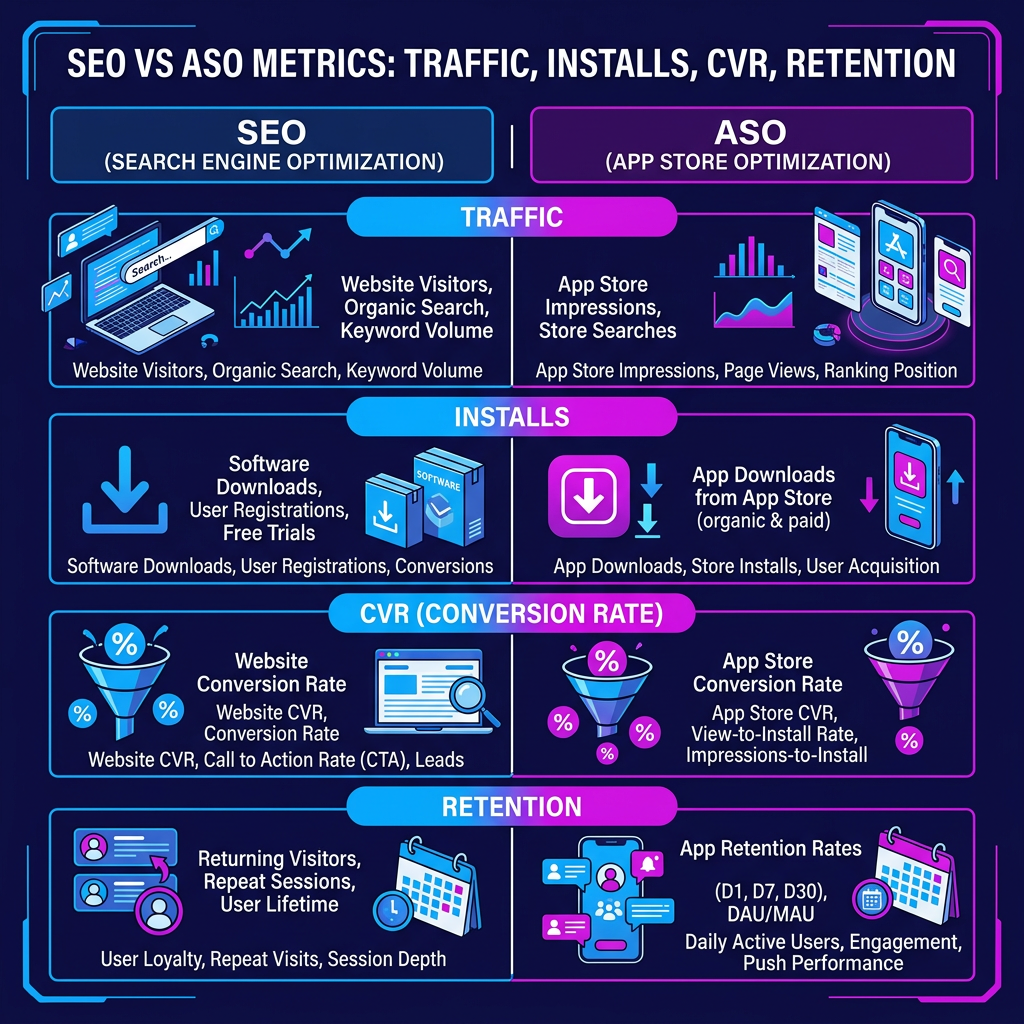
How do you know whether SEO or ASO actually moves the needle? You track SEO vs ASO metrics that map intent to outcomes: search traffic, store impressions, traffic installs, and post-install value. In SEO, prioritize clicks, organic sessions, and SERP CTR, then tie them to lead CVR and revenue per visit. In ASO, watch the impressions-to-page-view rate, the page-view-to-install CVR, and the install-to-active retention, then attribute subscription or IAP lift.
- Measure funnel drop-offs by keyword cluster, not just totals
- Segment CVR by device, locale, and store listing variant
- Pair retention cohorts with acquisition source to spot scalable loops
When you benchmark weekly deltas and run controlled tests, you’ll see which optimizations compound fastest and stay resilient under algorithm shifts.
When to Invest in SEO, ASO, or Both
When should you invest in SEO, ASO, or both? Invest in SEO when your funnel starts with search intent on the web: high-volume keywords, informational queries, and landing pages that can lift demo requests, trials, or purchases. Put budget into ASO when discovery happens inside app stores and you need more qualified installs, higher CVR, and better retention through optimized titles, subtitles, screenshots, and ratings velocity.
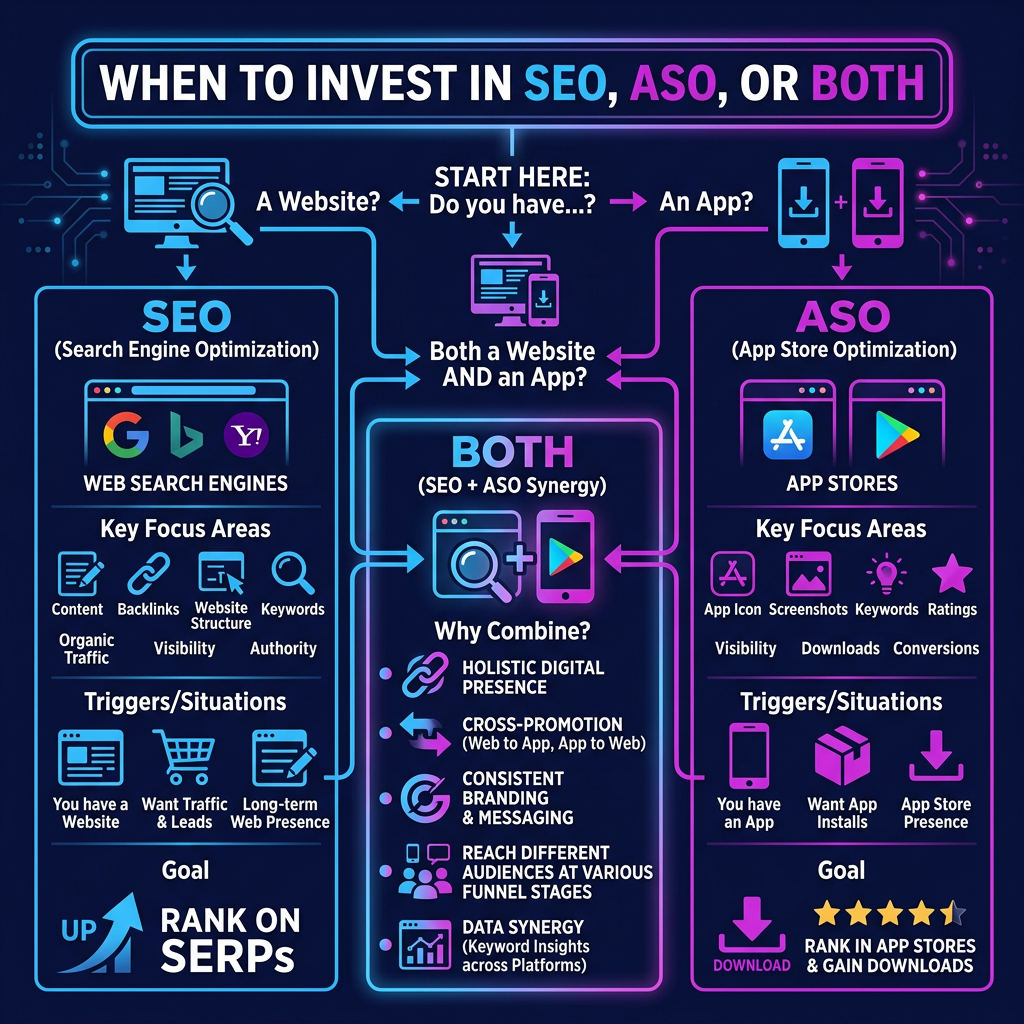
Choose both when you’re scaling: SEO captures top-of-funnel demand, while ASO converts mobile-ready users at the point of install. Use a growth mindset and budget planning to allocate spend by marginal ROI: track CAC by channel, keyword-to-conversion rate, install-to-activation, and LTV. Rebalance monthly, test rapidly, and double down where data compounds.
Conclusion
You’d think you can “set and forget” growth, but SEO and ASO won’t let you. SEO puts you on SERPs to win clicks; ASO puts you in app stores to win installs. Target high-intent keywords, test titles, descriptions, and creatives, then track CTR, CVR, CPI, retention, and LTV like your revenue depends on it—because it does. Invest in SEO for scalable traffic, ASO for compounding installs, and both for conversions.