
How Much Should an Electrical Contractor Spend on Marketing? (The ROI Breakdown)
You should spend 5%–10% of annual revenue on electrical contractor marketing, then adjust based on growth goals, capacity, and ROI. If you make $1 million, that means $50,000–$100,000 per year. Track every lead, booked job, close rate, and dollar sold by channel, including SEO, Google Ads, Local Services Ads, referrals, and email. Scale what delivers profitable jobs, cut waste fast, and use the breakdown ahead to sharpen each budget decision.
Start With a 5%–10% Marketing Budget
How much should you invest before you can measure meaningful ROI from your electrical contractor marketing? Start with a 5%–10% marketing budget, then track every lead, booked job, and closed dollar against that spend. This range provides enough data to test channels, optimize campaigns, and assess whether your growth engine can scale.
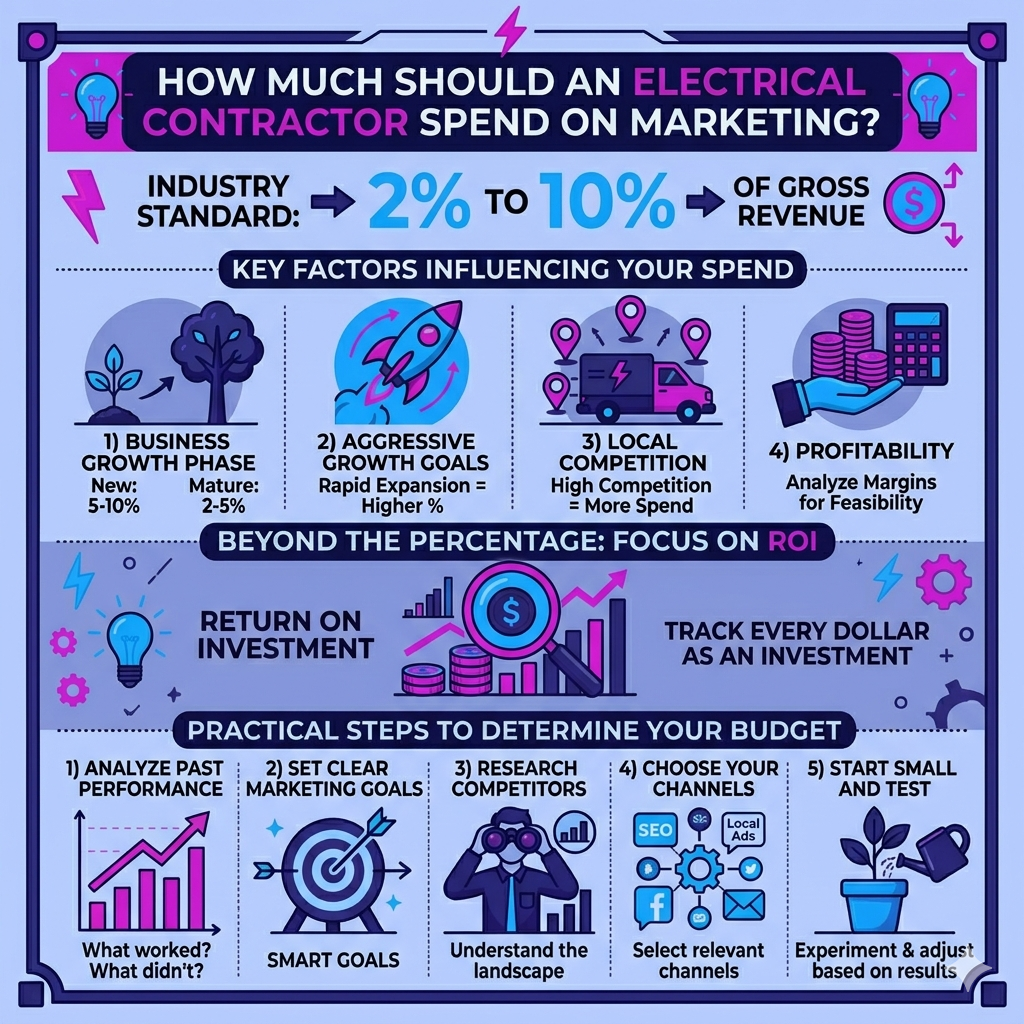
Your budget allocation should reflect your goals, not guesswork. If you’re expanding service areas, hiring techs, or pushing higher-margin projects, you’ll need stronger demand generation. If capacity is tight, spend closer to the lower end while improving conversion rates.
Think in terms of marketing vs. operations: operations fulfills demand; marketing creates it. When you fund both strategically, you avoid idle crews, underused trucks, and inconsistent pipelines while building measurable, technology-enabled revenue growth.
Set Your Budget From Annual Revenue
Once you’ve accepted the 5%–10% benchmark, anchor the actual number to annual revenue so your budget scales with your electrical business’s size. If you generated $1 million last year, a disciplined marketing range starts at $50,000 and goes up to $100,000. Use revenue forecasting to refine that figure, not guesswork. Project booked work, recurring service contracts, average ticket size, and close rates to estimate next year’s top line.
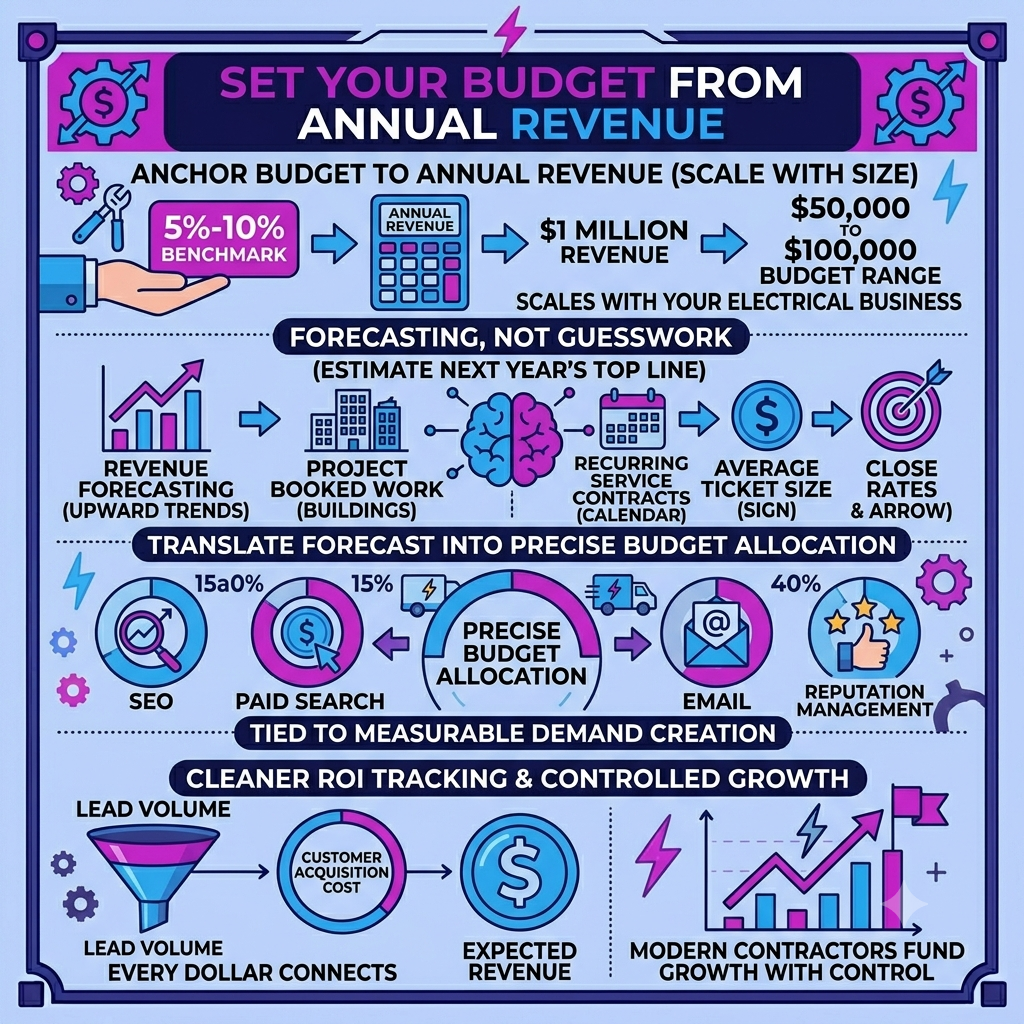
Then translate that forecast into a precise budget allocation across SEO, paid search, local service ads, email, and reputation management. This keeps spending tied to measurable demand creation rather than to random campaigns. You’ll also create cleaner ROI tracking because every dollar connects back to expected revenue, lead volume, and customer acquisition cost. That’s how modern contractors fund growth with control.
Adjust Spend for Maintenance or Growth
You should adjust your marketing spend based on whether you’re protecting current revenue or pushing for expansion. In maintenance mode, you focus budget on proven channels that keep leads steady and acquisition costs predictable. In growth mode, you increase spend toward scalable campaigns that can produce measurable revenue gains.
Maintenance Mode Budget
When lead flow is steady and your schedule is full, a maintenance mode budget helps you protect market share without overspending. You’re not trying to flood the pipeline; you’re keeping qualified demand consistent, rankings stable, and brand recall active. Track cost per lead, close rate, booked revenue, and lifetime value so every dollar earns its place. Use lead attribution to confirm which channels produce profitable jobs, not just form fills or calls. Then apply a monthly budget iteration: trim weak campaigns, refresh high-performing ads, and maintain SEO, reviews, email, and retargeting. Keep testing small innovations, like smarter call tracking or AI-assisted follow-up, without disrupting margins. In maintenance mode, your goal is efficiency: preserve visibility, reduce waste, and sustain ROI while your operations stay comfortably loaded.
Growth Mode Budget
How do you know it’s time to shift from maintenance to growth mode? Your lead flow is stable, close rates are predictable, and your crews can handle more booked work without sacrificing margins. That’s when you increase spend from defensive visibility to aggressive acquisition.
In growth mode, you don’t simply “spend more.” You invest where growth metrics prove upside: cost per booked job, revenue per lead, conversion rate, and customer lifetime value. If paid search produces profitable service calls, scale it. If SEO drives high-margin commercial projects, accelerate content and local authority. If referrals convert best, automate follow-up.
Your priority is channel alignment. Match budget to capacity, seasonality, and profit targets. Test quickly, cut weak campaigns, and double down on measurable ROI. Growth spend should create controlled expansion, not expensive noise.
Split Spend Across Local Electrical Channels
You’ll improve ROI by splitting spend across Google Local Services, SEO, and paid ads based on lead cost, close rate, and job value. Use Local Services for high-intent calls, SEO to compound organic demand, and paid ads to control lead volume. Track each channel separately so you can shift budget toward the sources producing profitable electrical jobs.
Google Local Services
Why put Google Local Services Ads in their own ROI bucket instead of lumping them into PPC? Because you pay per lead, not per click, and the buying intent is different. You’re reaching homeowners and property managers who need an electrician now, so track booked calls, cost per qualified lead, close rate, and revenue per job.
Use LSAs to read market trends fast: which services spike, which ZIP codes convert, and which hours produce profitable calls. That data helps you shift budget before competitors react. It also strengthens brand positioning because Google Screened visibility, reviews, and fast response times signal trust at the exact decision point.
Start with controlled spend, cap weak categories, and scale only when lead quality, job value, and margin demonstrate that the channel can compound profitable growth.
SEO And Paid Ads
When should you split budget between SEO and paid ads? Do it when you need leads now but want lower acquisition costs later. Paid ads capture emergency-intent searches fast, while SEO builds compounding visibility for “electrician near me,” panel upgrades, EV chargers, and commercial service terms.
Start with keyword research to identify high-margin jobs, search volume, and cost per click. Put 60-70% into paid search if your pipeline is thin; shift toward SEO as organic calls rise. Use dedicated landing pages for each service and city, so you can track conversion rate, cost per lead, booked jobs, and revenue.
Your goal isn’t traffic; it’s profitable booked work. Reallocate monthly based on ROI: fund channels that produce qualified calls, pause waste, and scale what lowers the blended acquisition cost.
Compare Costs by Marketing Channel
How should you compare marketing channels without overspending? Start by matching each channel to a business goal, then assess costs against their measurable revenue impact. Your pricing strategy should reflect how aggressively you want to grow, while brand awareness campaigns need longer evaluation windows.
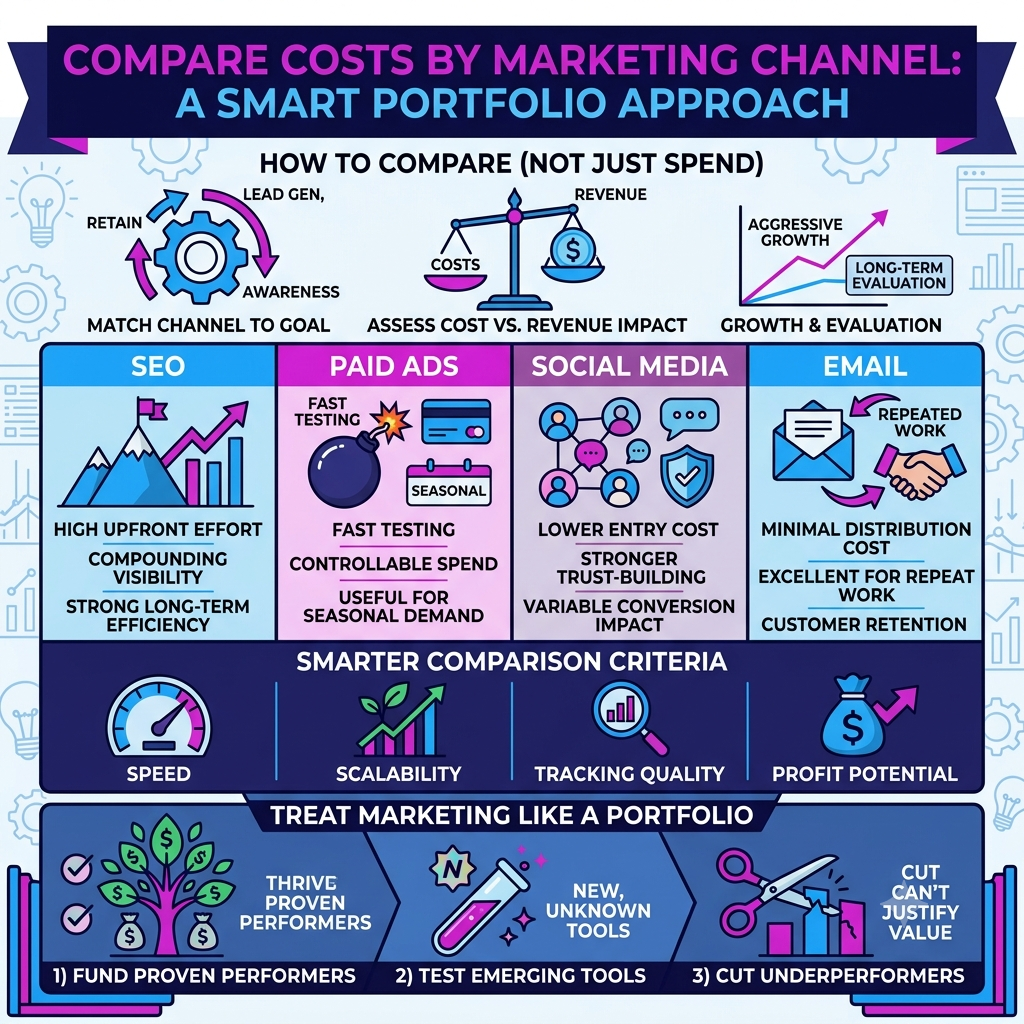
- SEO: Higher upfront effort, compounding visibility, strong long-term efficiency.
- Paid ads: Fast testing, controllable spend, useful for seasonal demand.
- Social media: Lower entry cost, stronger trust-building, variable conversion impact.
- Email: Minimal distribution cost, excellent for repeat work and customer retention.
Don’t compare channels by spend alone. Compare speed, scalability, tracking quality, and profit potential. You’ll make smarter budget moves when you treat marketing like a portfolio: fund proven performers, test emerging tools, and cut channels that can’t justify strategic value.
Know Your Cost per Electrical Lead
You can’t improve ROI until you know what each electrical lead costs. Track spend and lead volume by channel, then compare conversion rates and job value to see which sources produce profitable opportunities. Don’t stop at lead count—measure quality so you fund the channels that generate real revenue.
Define Lead Costs
Before you can improve electrical contractor marketing ROI, you need a clear cost per lead for each channel. Define lead costs by tying every inquiry to the spend that generated it, then separate raw contacts from sales-ready opportunities. This keeps lead pricing honest and helps you protect contractor branding while scaling smarter.
- Ad spend allocated to a campaign
- Landing page, software, and call tracking costs
- Creative, copy, and management fees
- Internal time spent qualifying inquiries
Use this formula: total campaign cost divided by the number of qualified leads. If you spend $2,000 and generate 40 qualified leads, you’re paying $50 per lead. That number becomes your benchmark for budget decisions, margin protection, and innovation-focused growth. Without it, you’re guessing instead of managing ROI.
Track Channel Performance
Which channels actually produce profitable electrical leads? You won’t know until you connect every inquiry to its source. Use lead tracking across Google Ads, SEO, Local Services Ads, social media, email, referrals, and directories. Assign unique call-tracking numbers, tagged URLs, CRM fields, and form-source attribution so every lead carries channel data from the first click to the booked estimate.
Then calculate cost per electrical lead by channel: total spend divided by tracked leads. Review this weekly, not quarterly, so you can shift money before waste compounds. If paid search delivers leads at $85 and a directory costs $240, your budget alignment becomes obvious. Keep testing new channels, but require measurable performance. Innovative marketing isn’t guessing; it’s building a feedback loop that moves capital toward the strongest ROI signals fast.
Compare Lead Quality
Not every electrical lead carries the same revenue potential, so cost per lead only matters when paired with lead quality. You shouldn’t rank channels by volume alone; measure which sources produce profitable installs, service agreements, and repeat commercial work. Smart client sourcing helps you shift budget toward leads that close faster and spend more.
- Track close rate by source, not just inquiry count.
- Compare average job value across PPC, SEO, referrals, and directories.
- Measure sales cycle length to spot high-friction lead sources.
- Score leads by project type, urgency, location, and budget fit.
When you know your true cost per electrical lead, you can cut waste, automate follow-up, and invest in channels that compound ROI instead of chasing cheap clicks that don’t convert.
Measure ROI From Electrical Marketing
Clarity turns electrical contractor marketing into a measurable growth system: you track how each campaign influences leads, booked jobs, revenue, and profit. Start with source-level attribution across calls, forms, chat, paid ads, organic search, email, and referrals. Then connect those touchpoints to your CRM so you can see cost per lead, cost per booked job, close rate, average revenue, and marketing ROI.
Don’t measure vanity metrics alone. Clicks and impressions matter only when they advance client acquisition. Review performance weekly, compare channels monthly, and shift budget toward campaigns that create profitable demand. This protects you from budgeting pitfalls like overspending on low-intent traffic or underfunding high-converting local searches. With clean data, you’ll invest faster, cut waste sooner, and scale marketing with confidence.
Track Profit by Electrical Job Type
Once you know which marketing channels generate leads and booked work, break the results down by electrical job type to see what actually drives profit. Separate panel upgrades, EV charger installs, service calls, generators, lighting retrofits, and commercial buildouts. Revenue alone won’t tell you enough; track gross margin, labor hours, callback rates, close rate, and customer acquisition cost by category.
- Compare margin by job type against planning benchmarks
- Identify high-demand services with scalable crew capacity
- Run risk assessment on jobs with volatile materials or labor
- Shift marketing spend toward categories with stronger net ROI
This view helps you stop funding “busy” work that drains capacity. You’ll invest in services that produce predictable profit, faster payback, and smarter growth. Over time, your budget becomes a performance system.
Avoid Common Budgeting Mistakes
When you build your marketing budget without clean inputs, you can easily overfund channels that look busy but don’t produce profitable electrical work. Avoid judging campaigns by leads alone. Track booked revenue, gross margin, close rate, and repeat potential by source. Don’t mix emergency service calls, commercial retrofits, and panel upgrades into a single performance bucket.
Watch for budget ethics, too. If a tactic relies on misleading offers, hidden fees, or an inflated sense of urgency, it can damage trust and reduce lifetime value. Tie spend decisions to the full client lifecycle, from first search to referral, warranty work, maintenance, and future upgrades.
Don’t copy a competitor’s budget percentage without your own numbers. Don’t starve testing, but don’t fund experiments without goals, timeframes, and attribution. Clean data keeps your ROI honest.
Scale Spend When ROI Is Working
Clean ROI data gives you permission to increase spend with control, not guesswork. When campaigns produce profitable booked jobs, you shouldn’t freeze the budget; you should scale the proven channel in measured increments. Treat marketing budgeting as a performance system, not an annual expense line. Increase spend where cost per lead, close rate, and revenue per job support the move.
- Raise the budget by 10–20% for campaigns that hit target acquisition costs.
- Watch capacity so new demand doesn’t damage service quality.
- Track ROI scaling by channel, job type, and service area.
- Reinvest profits into automation, tracking, and higher-intent traffic.
You’re not spending more to “get visible.” You’re allocating capital where the numbers prove return. That’s how you grow market share without sacrificing margin or operational control.
Frequently Asked Questions
You’ll usually see early traction in 30–60 days, but consistent ROI takes 3–6 months. How long before results stabilize depends on your budget, offer, tracking, and channel mix. Paid search can generate leads quickly, while SEO and automation compound more slowly. Marketing consistency matters: test weekly, track cost per booked job, optimize creatives, and reinvest in winners. With disciplined data loops, you’ll build predictable demand instead of random spikes.
Choose an agency if you need speed: businesses outsourcing marketing report 25% faster revenue growth on average. For agency vs. in-house, weigh control against expertise, tech, and execution capacity. You can keep strategy, sales feedback, and brand standards internal while outsourcing SEO, ads, analytics, and creative testing. Balance branding vs. performance marketing by tracking leads, booked jobs, and CAC. If ROI stalls, shift budget fast—don’t defend the channel.
Google Local Services Ads, paid search, and optimized Google Business Profile work best for emergency electrical services because they capture urgent intent fast. You’ll want emergency branding that emphasizes 24/7 response, licensed techs, and arrival speed. Use quick win ads for “electrician near me” and outage terms, then track calls, booking rate, and cost per job. Retarget visitors, test landing pages, and shift budget toward campaigns producing profitable calls.
About 60% of annual HVAC-electrical demand can cluster around extreme-weather months, so you should treat seasonal slowdowns as budget-shifting opportunities, not pauses. Adjust your marketing plans by moving spend toward SEO, reviews, email, and maintenance offers before demand dips. You’ll lower lead costs, keep crews booked, and build pipeline for peak seasons. Use call-tracking and close-rate data to quickly reallocate dollars toward campaigns delivering the strongest ROI.
Yes, you should. As new contractors, you need visibility fast: target local SEO, paid search, reviews, and referral partnerships to generate measurable leads. Track cost per booked job and double down on channels proving ROI. As established firms, you should optimize brand trust, retention campaigns, maintenance plans, and upsells. Use CRM data, automation, and conversion analytics to innovate, reduce acquisition costs, and scale profitably without wasting budget.
Conclusion
Your marketing budget shouldn’t feel like a leap of faith. Start with 5%–10% of revenue, adjust for growth goals, and track every channel like it’s a breaker on your panel. When leads, close rates, job types, and profit margins line up, you’ll know where to invest more. Don’t chase every shiny tactic; follow the numbers. Like Edison in the lab, test, measure, refine—and put your dollars where ROI lights the way.